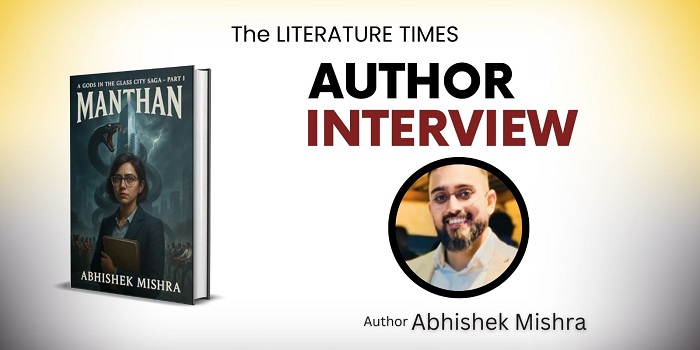
About the Book – Gods in the Glass City is a conspiracy thriller by Abhishek Mishra about a smart city that edits reality with polite screens. By day, Amaravati sells “calm.” By night, it quietly decides what the public will see. The result is a churn—manthan—where nectar and poison rise together, and no one is sure which cup is in their hand.
At the center is Mridula Sharma, an archivist who trusts paper over dashboards. A late-night file and a small mismatch on a “donor lane” turn her into a witness. Kaal, a street-clever listener, hears the city’s hidden beat—1, 2, 3, hold, 4—and begins to measure how long “safety” holds harm in place. Together with Kashi, a steady ex-cop, they collect small proofs: a stamp, a serial, a minute that won’t learn a new name. In the glass towers, programs with soft names—City Balance, mohini_gate, Vajra—choose which truth to pour. Varun slides into a quiet chair that looks like it has been waiting for him; Maya keeps the tone clean; a convoy meant for a hospital ends at a data annex. Calm is arranged. Costs are hidden.
What to expect: short, tense chapters; plain language; human stakes. Each chapter ends with a brief paradox note and a sharp hook to the next. The book favors touchable proof—ink, paper, time—over jargon. It begins with a prophecy in an old room and builds toward a simple, stubborn question: can a record made by hand outlast a story made by code?
If you like thrillers where small acts refuse to vanish, this is your book.
The Literature Times – Many readers say MANTHAN feels disturbingly close to reality. Was that intentional?
Abhishek Mishra – Yes – and that closeness was the most deliberate choice I made.
I didn’t want MANTHAN to feel like a distant dystopia or a far-off future. I wanted it to feel like one small step sideways from the present. The kind of step that doesn’t announce itself. The kind you only notice when you look back and realise how far you’ve drifted.
Everything in the book already exists in fragments: predictive systems, behavioural scoring, algorithmic governance, curated truth. I didn’t exaggerate these elements – I simply removed the comfort of denial. That’s why the story feels familiar. It doesn’t invent fear; it recognises it.
If the book unsettles readers, it’s because it refuses to let them say, “This could never happen.”
The Literature Times – Power in MANTHAN doesn’t look brutal – it looks efficient. Why was that important to you?
Abhishek Mishra – Because modern power rarely wears a crown or carries a weapon.
It wears dashboards. It speaks in percentages. It claims neutrality.
I wanted to show how authority becomes most dangerous when it believes it is objective. In MANTHAN, power doesn’t punish loudly – it optimises quietly. It smooths edges, removes friction, and presents itself as care. And that makes resistance harder, because people don’t rebel against things that appear helpful.
Efficiency feels moral. Clean solutions feel kind. But when efficiency replaces empathy, and cleanliness erases complexity, power stops being accountable. It becomes convinced.
That conviction is what terrified me – and what I wanted readers to feel.
The Literature Times – Silence plays a strong role in the novel – silenced voices, erased doubts, quiet compliance. What does silence mean to you in this story?
Abhishek Mishra – Silence in MANTHAN is not the absence of sound. It is the absence of permission.
It is what happens when people learn that asking questions carries a cost. When speaking becomes inefficient. When doubt is treated as noise that needs filtering.
I was deeply interested in how systems don’t need to censor aggressively if they can simply train people to self-censor. Once silence becomes habitual, enforcement becomes unnecessary.
But silence is also where resistance begins. The book pays attention to quiet acts: someone who keeps a record, someone who hesitates, someone who notices a pattern and refuses to forget it. Those silences are different. They are not empty – they are loaded.
The Literature Times – As a first-time author, what surprised you the most about writing a novel like MANTHAN?
Abhishek Mishra – What surprised me most was how much the book argued back.
I went in thinking I was in control of the story. Very quickly, I realised I wasn’t. The characters resisted simplification. The themes refused comfort. Whenever I tried to make the narrative easier, it felt wrong – almost dishonest.
Writing MANTHAN taught me patience. It taught me to listen – to the story, to its silences, to what it didn’t want to say explicitly. That was humbling.
As a first-time author, I expected difficulty. I didn’t expect the book to demand integrity.
The Literature Times – If MANTHAN could be described in one emotional sentence, what would it be?
Abhishek Mishra – MANTHAN is about what happens when a society chooses certainty over compassion – and calls it progress.
It is a story that asks whether we still remember how to live with doubt, how to forgive imperfection, and how to recognize poison before it wears a clean label.
If the book lingers, it’s because it doesn’t shout.
It waits.
The Literature Times – Do you see MANTHAN as a political novel?
Abhishek Mishra – I see MANTHAN as a human novel that happens to be political.
Politics enters the story not through parties or slogans, but through decisions – who gets to decide, who is protected, who is watched, and who is forgotten. These are not abstract ideas. They are lived realities shaped by systems that often claim neutrality.
I didn’t write MANTHAN to argue for a position. I wrote it to explore what happens when power becomes procedural, when morality is outsourced to systems, and when obedience is disguised as convenience. If that feels political, it’s because power always is.
The Literature Times – The novel resists clear villains and heroes. Why did you avoid moral binaries?
Abhishek Mishra – Because real harm rarely comes from monsters – it comes from ordinary people following clean logic.
The most unsettling characters in MANTHAN are not cruel; they are convinced. They believe they are reducing chaos, preventing violence, and making the city “better.” That belief makes them dangerous, because it removes doubt.
I wanted readers to feel uneasy not because someone is evil, but because the system makes sense. Moral binaries comfort us. Ambiguity forces us to think. MANTHAN lives in that uncomfortable space.
The Literature Times – What role does doubt play in the book, especially in contrast to certainty?
Abhishek Mishra – Doubt is the book’s quiet moral center.
In MANTHAN, certainty is treated as strength – measurable, scalable, decisive. Doubt is framed as inefficiency, something to be corrected. But I believe the opposite is true. Doubt is where ethics live. It’s the pause before harm, the hesitation that keeps us human.
One of the core ideas of the novel is that a system that cannot doubt cannot forgive. And a world without forgiveness eventually turns on itself.
Doubt, in the book, is not paralysis. It is restraint.
The Literature Times – As a debut author, what do you hope critics and readers judge your work on?
Abhishek Mishra – I hope they judge it on honesty.
Not on whether they agree with it, or whether it comforts them, but on whether it feels true to its own questions. MANTHAN does not try to be clever or shocking. It tries to be attentive.
If readers feel that the book respects their intelligence, trusts their discomfort, and refuses to simplify difficult ideas, then I will consider it a success – regardless of praise or criticism.
The Literature Times – What comes next for you as a writer after MANTHAN?
Abhishek Mishra – MANTHAN is the first movement of a planned trilogy, but more importantly, it marks the beginning of a responsibility I now carry as a writer.
The story that begins here is not complete yet. Two more books will follow, each moving deeper into the consequences set in motion in MANTHAN – not just for the city and its systems, but for the people who live within them. As the series unfolds, the questions will become sharper, the costs more visible, and the moral choices harder to escape.
Beyond the trilogy, my intent remains the same. I want to keep writing stories that sit at the intersection of myth, modern systems, and human consequence – stories that don’t chase trends or offer comfort, but ask questions that stay with the reader long after the final page.
If MANTHAN has taught me anything, it’s that stories don’t need to be loud to matter. They need to be precise, attentive, and honest. I intend to continue writing with that discipline as this saga moves forward.