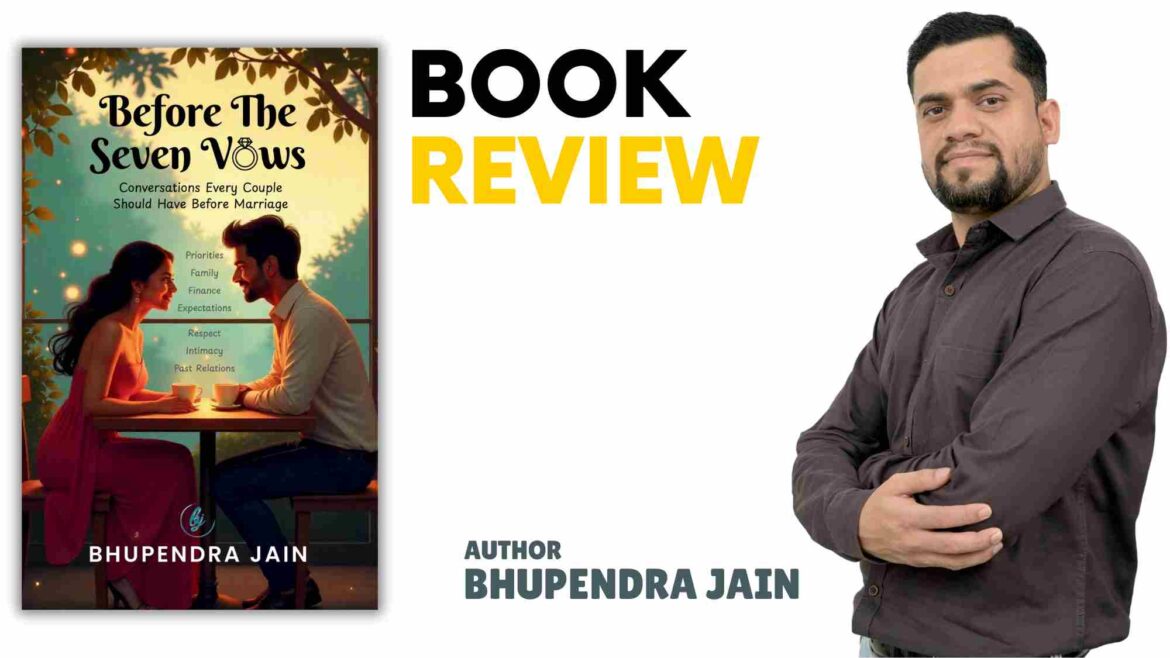
Book Title: Before The Seven Vows : Conversations Every Couple Should Have Before Marriage
Author: BHUPENDRA JAIN
ISBN: 9789363554986
Publisher: Evincepub Publishing
A Practical Guide to Finding Your Perfect Life Partner
In a country where marriage is considered one of life’s most significant milestones, Bhupendra Jain’s “Before the Seven Vows: Conversations Every Couple Should Have Before Marriage” arrives as a much-needed guidebook for anyone navigating the complex journey of finding a life partner. Whether you’re exploring arranged marriage prospects or planning a love marriage, this book offers practical wisdom drawn from real counseling experiences and deep understanding of Indian cultural dynamics.
What Makes This Book Different?
Unlike typical relationship books that either romanticize love marriages or strictly advocate for arranged marriages, Bhupendra Jain takes a refreshingly neutral stance. He doesn’t tell you which type of marriage is better. Instead, he focuses on what truly matters: how to make an informed, thoughtful decision about choosing your life partner, regardless of how you meet them.
The author, with over six years of counseling experience and having personally guided 500+ clients, brings both professional expertise and personal insight to the table. His own four-and-a-half-year journey of searching for a life partner adds authenticity to every suggestion he makes.
Understanding the Core Problem
The book begins by identifying what Jain calls “the burning problem” – making the wrong marital decision. He doesn’t sugarcoat the reality: choosing the wrong partner can negatively impact your entire life, while turning down the right person means missing the chance at a beautiful partnership. This sobering truth sets the foundation for why the conversations in this book are so crucial.
What I particularly appreciated is how the author acknowledges that everyone thinks they’re making the right decision at the time of marriage, yet many marriages struggle or fail. The difference, he argues, lies in the process – in asking the right questions, listening carefully, and making decisions based on complete information rather than assumptions or societal pressure.
The Structure: A Journey, Not Just Instructions
The book is cleverly divided into four parts, taking you through a logical progression:
Part I examines how Indian marriages have evolved, comparing past traditions with present realities. This section helps readers understand the changing landscape of relationships in India – from strict caste restrictions to increasing inter-caste marriages, from joint family expectations to nuclear family preferences. Understanding this evolution helps you contextualize your own expectations and those of your family.
Part II addresses common mistakes made by both youngsters and parents during the partner search. The author doesn’t take sides but instead highlights how lack of communication between parents and children often leads to conflict. His emphasis on the R2FCD principle (Relationship-Responsibility-Family-Communication-Decision) provides a balanced framework for thinking about marriage as both an individual and family matter.
Part III is where the book truly shines, offering psychological tools and frameworks for preparing for marital meetings. The introduction of concepts like the 3F’s and 2P’s rule (Family, Finance, Future, Personality, Past) gives readers a clear structure for organizing their thoughts. The “BJ’s Framework of Priorities” is particularly innovative, helping readers distinguish between primary (P1), secondary (P2), and substitute (P3) priorities in their lives.
Part IV forms the heart of the book – a comprehensive guide to conducting marital meetings, complete with specific questions, the right sequence to ask them, and how to interpret answers.
The Priority Framework: A Game-Changer
One of the book’s most valuable contributions is its detailed exploration of priorities. Jain introduces a three-level priority system that helps readers understand their own goals and expectations:
- Primary Priorities (P1): Your non-negotiables, what you’d leave everything else for
- Secondary Priorities (P2): Supporting goals that either wait until P1 is achieved or help you achieve P1
- Substitute Priorities (P3): Temporary goals created out of necessity when primary goals aren’t immediately achievable
This framework is brilliant in its simplicity. It forces you to think deeply about what truly matters to you. Do you prioritize family over career, or vice versa? Is financial stability your primary goal, or is emotional happiness more important? These aren’t easy questions, but the framework helps you find clarity.
The author also wisely points out that priorities can be both short-term and long-term, and that understanding your prospect’s priorities is just as important as knowing your own. After all, marriage is about mutual support in achieving each other’s goals.
The Question Categories: Smart Time Management
Perhaps the most practical aspect of the book is how questions are categorized into six types:
- Must Ask (✱✱✱): Core questions about priorities and expectations
- Good to Ask (✱✱): Important but not critical questions
- Ask if Time Permits (✱): Interesting but lower priority
- Do Not Ask (!): Questions that waste time or create unnecessary conflict
- Ask in Subsequent Meetings (~): Personal questions better saved for later
- Ask Only if it Matters to You (@): Context-dependent questions
This categorization is genius for time management. Anyone who has sat through an awkward first meeting knows how quickly time flies and how easy it is to forget important questions. This system ensures you cover what matters most first.
Real-World Wisdom and Personal Touch
Throughout the book, Jain shares personal anecdotes from his own marital meetings and counseling sessions. These stories bring the advice to life. For instance, he recounts asking a question incorrectly about a wife’s duties and immediately seeing the girl’s parents’ expressions change – a powerful lesson in how to (and how not to) phrase sensitive questions.
He also shares touching stories from clients, like the girl who requested that her future husband never shout at her in front of others, having witnessed her father do this to her mother. Such real-life examples make the book relatable and show how seemingly small requests can reveal deep emotional needs.
Addressing Difficult Topics
The book doesn’t shy away from sensitive subjects. Entire sections are dedicated to topics many people avoid discussing before marriage:
Financial Compatibility: Jain acknowledges that money matters, despite romantic notions that “love is all you need.” He provides practical questions about savings habits, expense planning, and financial expectations, while cautioning readers to ask these questions tactfully to avoid seeming greedy.
Past Relationships: With thoughtful progression, the book guides you through discussing past relationships – from crushes to serious commitments. The author’s use of the “foot-in-the-door” technique (starting with less personal questions before moving to more intimate ones) shows psychological sophistication.
Family Planning: Recognizing that modern couples have varied views on having children, Jain presents both sides of the debate without judgment, then provides questions to ensure couples are aligned on this crucial issue.
Physical Compatibility: Perhaps most boldly, the book addresses whether couples should check physical/sexual compatibility before marriage – a topic rarely discussed openly in Indian society. Jain shares his personal view while respecting that readers may disagree, ultimately leaving the decision to individuals.
Gender-Specific Considerations
The book includes separate sections for questions girls and boys should specifically consider. For girls, topics like whether to keep their maiden name, expectations about working after marriage, and dealing with in-laws are addressed. For boys, questions about accepting a working wife or relocating for her career are discussed.
This gender-specific approach acknowledges that despite progress toward equality, certain practical realities of Indian marriages still differ based on gender. The author handles these sections with sensitivity, neither reinforcing outdated stereotypes nor ignoring practical concerns.
The Communication Philosophy
Throughout the book, one message remains consistent: Never assume, always discuss. This simple principle could save countless marriages from misunderstandings. Whether it’s about surname changes, living arrangements, working after marriage, or having children – Jain insists that couples discuss everything explicitly rather than operating on assumptions.
He also emphasizes the importance of third-person phrasing. Instead of asking “What do you expect from ME?”, ask “What do you expect from your life partner?” This subtle shift makes questions less confrontational and allows the other person to speak more freely about their ideal expectations.
Practical Tools and Exercises
The book doesn’t just tell you what to do; it provides exercises to help you implement the advice. There are spaces for readers to write their own questions, categorize them according to the six-category system, and prepare their answers. The exercise table at the end allows you to create a personalized question set based on your unique priorities.
Cultural Sensitivity and Modern Relevance
What makes this book particularly valuable is how it bridges traditional Indian values with modern realities. Jain respects that many families still hold traditional expectations about marriage while acknowledging that young Indians today have different lifestyles, career ambitions, and relationship dynamics than previous generations.
He addresses topics like inter-caste marriage, nuclear versus joint families, working women, and changing gender roles without being preachy. The book accepts that there’s no one “right” way to approach marriage in modern India.
Some Limitations
While comprehensive, the book has minor limitations. At times, the extensive categorization of questions can feel overwhelming. A reader might find themselves lost in the symbols and categories rather than focusing on the conversations themselves.
Additionally, while the author’s personal experiences add authenticity, the book sometimes feels male-centric in perspective, despite efforts to address both genders equally. Some sections could benefit from more female voices and experiences.
The book’s length and detail might also intimidate some readers. Not everyone will have the patience to go through all 25 sections and numerous subsections. A quick-reference guide or summary checklist would have been helpful.
Who Should Read This Book?
This book is invaluable for:
- Young adults beginning to think about marriage
- Parents helping their children in partner search
- Couples in relationships considering marriage
- Anyone confused about what to discuss before making this life-changing decision
Even if you’re not actively searching for a partner, this book offers insights into self-awareness, understanding priorities, and effective communication – skills valuable in any relationship.
Final Verdict
“Before the Seven Vows” is more than a book about questions to ask during marital meetings; it’s a comprehensive guide to self-discovery and thoughtful decision-making. Bhupendra Jain has created a resource that combines psychological insight, practical wisdom, and cultural understanding in ways that few Indian relationship books do.
The book’s greatest strength is its refusal to prescribe one path. Instead, it equips readers with tools to make their own informed choices. Whether you choose an arranged marriage or love marriage, whether you prioritize career or family, whether you want children immediately or later – the book respects your choice while ensuring you make it consciously rather than by default.
In a society where marriages are often decided hastily based on biodata and one or two meetings, this book argues for a more thoughtful approach. It reminds us that we spend more time choosing a car or a house than we do choosing a life partner, yet marriage is arguably the most important decision we’ll ever make.
The author’s message is clear: invest time in this decision. Ask questions. Listen carefully. Discuss everything. Don’t assume. And above all, remember that you’re not just looking for someone to marry; you’re looking for a life partner who will be with you through all of life’s ups and downs.
If this book helps even a few couples avoid the pain of marital discord or helps them find their truly compatible partner, it will have served its purpose admirably. In an era of rising divorces and relationship struggles, “Before the Seven Vows” offers a path to more thoughtful, compatible, and ultimately happier marriages.
Rating: 4.5/5
A must-read for anyone serious about making one of life’s most important decisions with clarity, confidence, and wisdom.
To buy this book on Amazon: Amazon Link