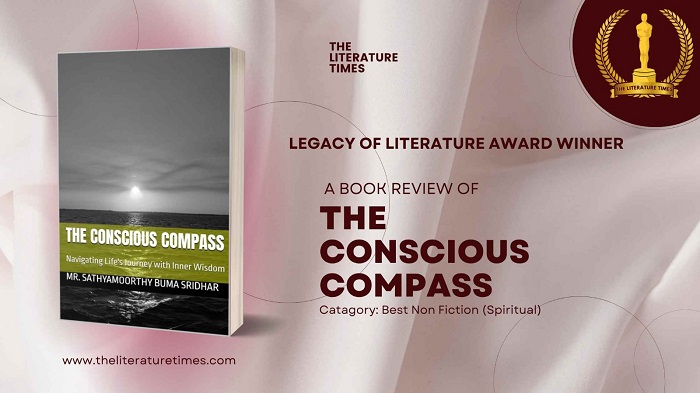
The Conscious Compass: Navigating Life’s Journey with Inner Wisdom by Sathyamoorthy Buma Sridhar is a thoughtful and inspiring exploration of the human experience, offering readers a path toward emotional clarity, spiritual depth, and personal transformation. In a world where complexity and overwhelm have become normalized, this book stands out as a gentle yet firm reminder that we already hold within us the tools to navigate life—not through rigid control or external validation, but through the cultivation of inner awareness, surrender, and gratitude.
At the heart of The Conscious Compass are five foundational principles: Acceptance, Letting Go, Surrender, Gratitude, and Awareness. These are not abstract ideals but deeply practical tools, each of which is illuminated through real-life stories and metaphor-rich reflections. The book presents these pillars not merely as moral virtues but as navigational aids—internal coordinates for those who wish to live with more presence, purpose, and peace. The metaphor of the “compass” is an apt one; rather than offering prescriptive answers, the author invites readers to turn inward and reorient their perspective with conscious intention.
What makes this book particularly effective is its grounding in lived experience. Through the stories of Sonam, Sarah, and Sonu—among others—the reader is given access to the emotional texture of real-life transformation. Sonam’s journey through familial turmoil and eventual healing illustrates how acceptance and letting go are not signs of weakness, but acts of courage. Instead of being consumed by anger and disappointment, Sonam chooses surrender—not in the sense of resignation, but in opening to a deeper current of wisdom that allows healing and new beginnings to take root.
Similarly, Sarah’s post-separation journey speaks directly to the modern epidemic of longing and perceived inadequacy. Rather than being mired in the belief that something is missing, Sarah learns to see what is already present in her life. Her story reinforces a crucial point that the book returns to often: the shift from deficit to sufficiency, from control to trust, from fear to empowerment, is always possible—but it begins with awareness.
Sathyamoorthy Buma Sridhar employs a simple yet evocative writing style, marked by clear analogies and compassionate insight. The comparison of the mind to a “busy city” and inner peace to a “mountain of awareness” effectively captures the chaotic nature of modern thought patterns and the stability that can arise from mindful observation. The recurring metaphor of thoughts as “clouds drifting across the sky” is not new in mindfulness literature, but here it is presented with warmth and clarity, helping even novice readers understand the nonjudgmental stance that underlies conscious living.
One of the book’s most practical sections focuses on the power of early morning routines, emphasizing practices such as meditation, mantra, and prayer. These are not presented as dogmatic necessities, but as accessible tools to anchor one’s day in stillness and intentionality. In a society that often demands reactivity and constant output, the suggestion to start the day in silence and connection to natural rhythms feels radical and deeply nourishing.
Another strength of the book lies in its emphasis on interconnectedness. By using the example of a laptop—a seemingly personal object—to demonstrate the countless invisible hands involved in its creation, Sridhar challenges the illusion of separateness. This passage serves not just as a commentary on gratitude but as a call to humility and collective awareness. The idea that each object, experience, and person is part of a larger web of interdependence adds a moral and philosophical depth to the book, reminding readers that mindfulness is not a solitary pursuit, but one with social and global implications.
A particularly insightful chapter addresses what Sridhar refers to as “The Three Poisons”: comparison, attachment, and desire. These psychological patterns are not vilified but examined with nuance. The author explains how they subtly infiltrate our thoughts and behaviors, often masquerading as ambition or self-improvement, while actually fostering dissatisfaction and disconnection. The book’s response is not suppression, but illumination. By bringing mindful awareness to these tendencies, the reader is invited to make conscious choices—to trade attachment for intention, comparison for self-compassion, and desire for appreciation of the present moment.
Throughout the book, Sridhar balances spiritual insight with emotional realism. There is no promise of constant bliss, nor is suffering ignored. Instead, readers are reminded that hardship, including grief and tragedy, are inevitable parts of life—but they need not be defining ones. The story of Sonu’s grief and his capacity to hold pain with mindfulness is a testament to this message. Rather than avoiding or numbing his suffering, Sonu learns to be with it, to breathe through it, and eventually to integrate it into a larger story of meaning and growth.
What sets The Conscious Compass apart from many books in the self-help or mindfulness genre is its integration of philosophical depth and psychological practicality. The book avoids trendy jargon or superficial positivity. It is not about manifesting dreams through wishful thinking or bypassing pain through detachment. Instead, it honors the full spectrum of human emotion while offering a clear, grounded path toward inner stability and outer compassion.
If there is any critique to be made, it may be that certain concepts—such as surrender or letting go—could be challenging for readers who are new to spiritual exploration or who live in survival mode where control feels necessary. At times, the book assumes a readiness for deep introspection that may not be accessible to everyone. However, Sridhar’s gentle tone and repeated encouragement to “start where you are” offer an entry point even for those who are just beginning their journey inward.
Ultimately, The Conscious Compass is not a book to be read once and shelved. It is a companion, a mirror, and a map—meant to be revisited during times of uncertainty or transition. Its lessons are simple but not simplistic, timeless but deeply relevant in today’s chaotic and noisy world. Whether you are dealing with a personal crisis, seeking clarity in your relationships, or simply feeling disconnected from your inner self, this book offers a quiet invitation back to what matters most: awareness, gratitude, and the courage to live with intention.
In a culture that often rewards speed, control, and endless striving, The Conscious Compass is a gentle yet powerful guide back to stillness, surrender, and authenticity. Sathyamoorthy Buma Sridhar has crafted a work that not only guides but transforms—reminding us that peace is not a destination but a practice, and that the most reliable compass is the one already within.