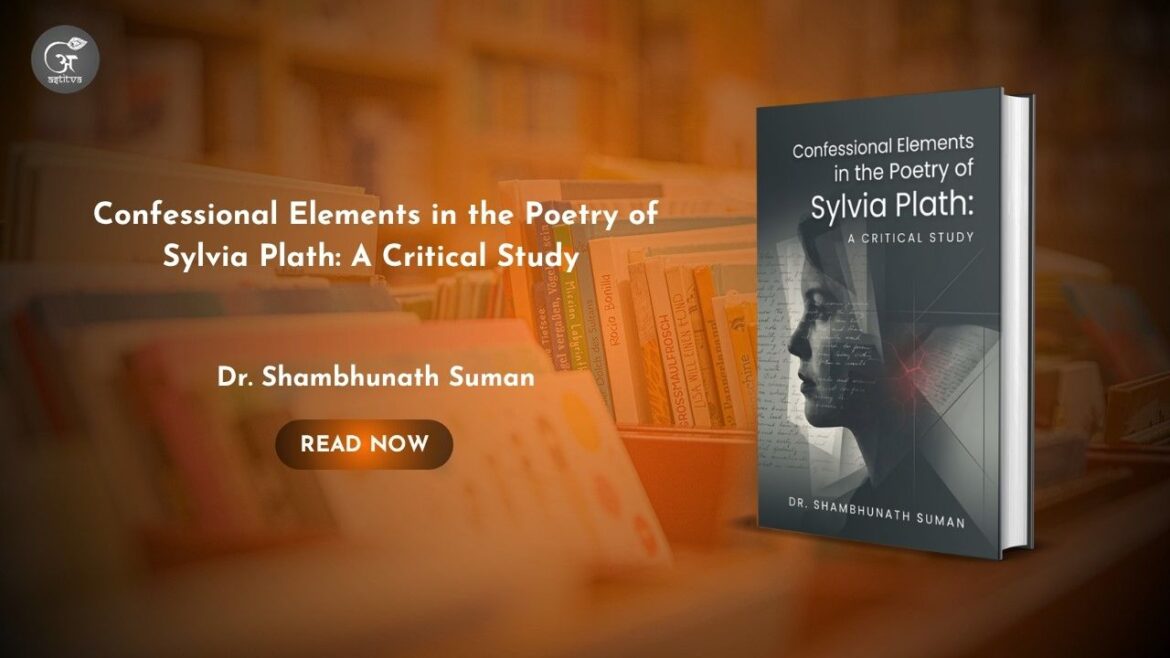
Confessional Elements in the Poetry of Sylvia Plath: A Critical Study by Dr. Shambhunath Suman arrives as an insightful and timely contribution to literary scholarship, especially for readers invested in understanding the deeper psychological and technical layers of confessional poetry. The book revisits the poetry of Sylvia Plath not through the lens of myth, tragedy, or cultural stereotype, but through a rigorous and balanced academic inquiry. It reframes Plath not merely as a tormented voice but as a highly disciplined craftswoman who consciously shaped the confessional mode into a transformative literary movement.
At the heart of this study lies the argument that Plath’s late poems, particularly the Ariel group, derive their extraordinary power from an interplay of raw autobiographical intensity and meticulous artistic control. Dr. Suman examines how the emotional turbulence in Plath’s life did not simply spill onto the page spontaneously; instead, it was channelled through deliberate structure, linguistic precision, and symbolic architecture. Her poetry, therefore, emerges not as uncontrolled outpouring but as a series of carefully engineered emotional detonations—an art form that makes the private universal, the painful luminous.
The book challenges the oversimplified notion that confessional poetry is merely personal revelation. Through close textual readings and contextual analysis, it demonstrates how Plath revolutionized the genre by merging psychological depth with avant-garde poetics, simultaneously exposing and elevating the inner life. Dr. Suman shows how themes such as identity, motherhood, fragmentation, death, rebirth, and resistance are woven with mythic echoes, structural finesse, and rhetorical sharpness. The result is a portrait of Plath as both subject and architect of her emotional world, a poet who used confession not only to express anguish but to construct a lasting literary selfhood.
Readers will find that the book also situates Plath within the larger framework of twentieth-century literary evolution. By exploring the dynamics of the confessional movement and its impact on modern poetry, Dr. Suman provides students, researchers, and teachers with a comprehensive perspective that connects biography, psychology, literary technique, and historical context. His study clarifies why Plath remains an indispensable figure for those interested in confessional literature, trauma narratives, feminist poetics, and modernist-postmodernist transitions.
Dr. Shambhunath Suman’s academic background uniquely positions him to undertake such a task. An Assistant Professor of English with extensive experience at the undergraduate level, he brings a refined understanding of literature, theory, and pedagogy. His scholarly interests span Indian Writing in English, American literature, British literature, literary theory, and English Language Teaching, giving his analysis both breadth and depth. His active participation in national and international academic platforms, along with numerous publications in peer-reviewed journals and edited volumes, reflects his ongoing engagement with contemporary critical discourse.
Beyond his scholarship, Dr. Suman is known for his learner-centric approach, emphasizing critical thinking, analytical skills, and intellectual curiosity among students. His guidance in academic writing and research methodology further highlights his commitment to nurturing emerging scholars. This book is a natural extension of that commitment—a resource that not only informs but also inspires deeper inquiry.
With its clear argumentation, rich analysis, and accessible style, Confessional Elements in the Poetry of Sylvia Plath: A Critical Study is poised to become an essential reference for students, teachers, and researchers of English literature. It offers a fresh and compelling understanding of Plath’s poetic universe, reaffirming her place as one of the most technically brilliant and emotionally resonant voices of modern poetry.