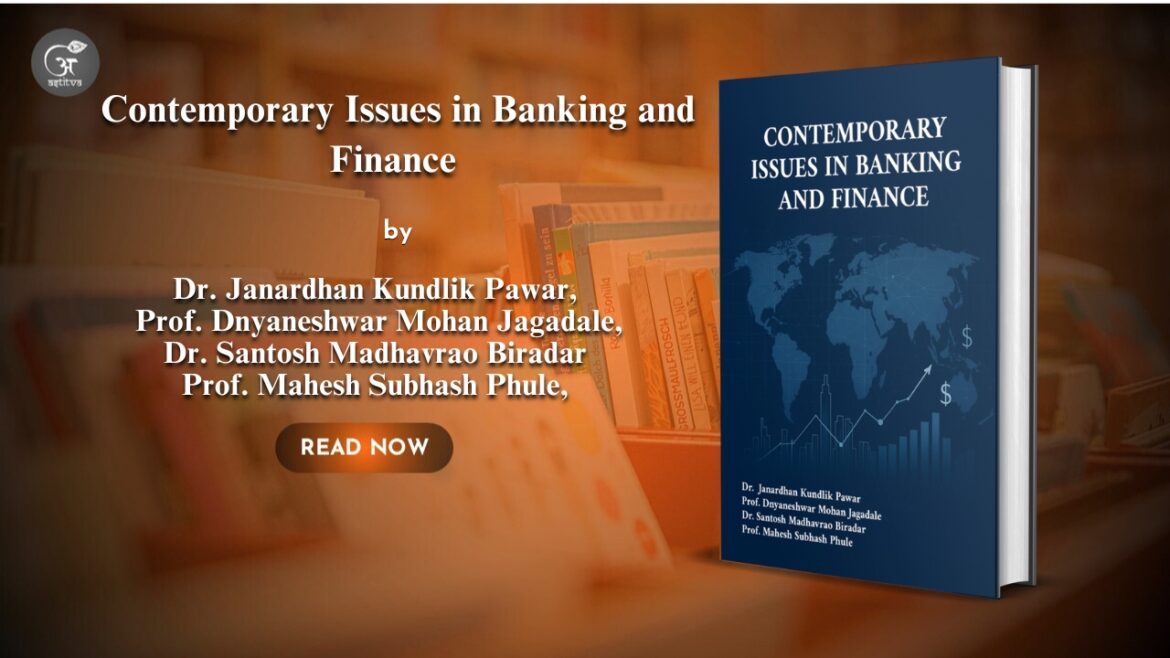
The field of banking and finance in India continues to evolve at an unprecedented pace, shaped by rapid globalization, technological advancements, and the complex expectations of modern customers. Responding to these dynamic transformations, the new book “Contemporary Issues in Banking and Finance” brings together a rich collection of scholarly articles that illuminate the crucial developments influencing today’s financial landscape. This insightful volume is authored and compiled by respected academicians—Dr. Janardhan Kundlik Pawar, Prof. Dnyaneshwar Mohan Jagadale, Prof. Mahesh Subhash Phule, and Dr. Santosh Madhavrao Biradar—each bringing deep expertise from the world of commerce, banking, and financial studies.
This book is a distinguished compilation of research papers presented for the National Conference on “Contemporary Issues and Challenges in Banking and Financial Sector in India,” organized by the RNS Institute of Technology, Bangalore. It addresses twelve major themes that define the current environment of India’s banking and finance sector. These include Mergers and Acquisitions, HR Issues in Banking, Microfinance, Risk Management, E-Banking, Merchant Banking, Retail Banking, Customer Relationship Management (CRM), Globalization challenges, Capital Market linkages, the Role of Banks, and persistent issues shaping the sector.
The book offers a multidimensional understanding of these subjects, making it an invaluable resource for academicians, research scholars, policy analysts, and industry professionals. Each article presents a well-researched perspective on how the banking ecosystem has undergone reforms in response to macroeconomic changes. Readers will find insightful discussions on the structural and regulatory progressions that have impacted financial institutions over time.
A significant portion of the book examines Risk Management, one of the most critical aspects of modern banking. The articles highlight how credit defaults, payment delays, and rising financial uncertainty continue to pose challenges for banks. The writers extensively explore the mechanisms through which banks can strengthen their credit analysis, improve their risk-mitigation strategies, and safeguard themselves from unexpected financial shocks.
Another vital theme addressed is Human Resource Management in Banking, emphasizing the growing concern of talent scarcity in the industry. The book thoughtfully discusses the challenges banks face in hiring, training, and retaining qualified professionals in a highly competitive job market. It considers how continuous knowledge enhancement, skill development, and performance-driven HR strategies are essential for strengthening the future workforce of the banking sector.
In addition, the section on Customer Relationship Management (CRM) provides deep insights into how banks and financial institutions can achieve long-term customer loyalty. The articles explore the shift toward customer-centric models and explain how successful organizations build strategies to attract high-value clients by offering personalized financial experiences.
Overall, Contemporary Issues in Banking and Finance serves as a comprehensive academic contribution that connects theoretical concepts with real-world challenges. The authors’ collective experience in academia and finance gives the book a distinctive intellectual strength. Their commitment to advancing knowledge and understanding of the banking sector is evident in every chapter.
This book stands as an essential read for anyone who wishes to deepen their understanding of India’s rapidly transforming banking and financial ecosystem. Whether you are a student, teacher, researcher, or industry practitioner, this volume offers perspectives and insights that will enrich your knowledge and broaden your analytical thinking in the field.