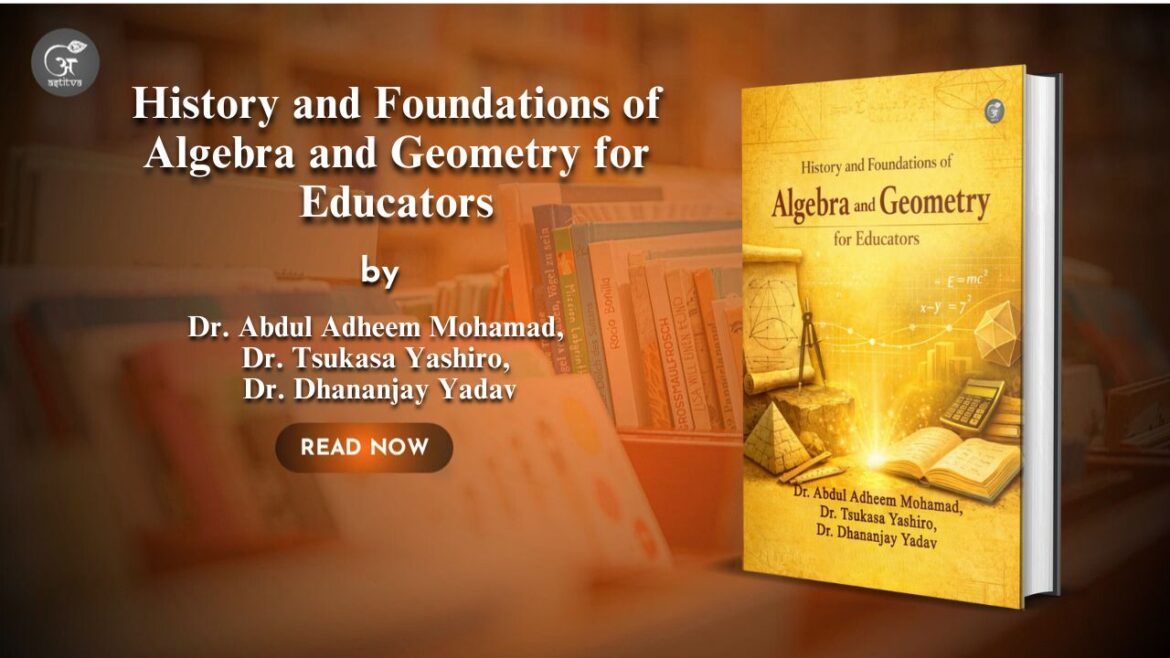
The world of mathematics education welcomes a remarkable academic contribution with the release of “History and Foundations of Algebra and Geometry for Educators,” authored by Dr. Abdul Adheem Mohamad, Dr. Tsukasa Yashiro, and Dr. Dhananjay Yadav. This scholarly work offers an integrated understanding of mathematics from both historical and conceptual perspectives, bridging the classical evolution of ideas with modern educational needs.
Originally developed as a set of lecture notes for the Department of Education at Sultan Qaboos University (Oman), the book was conceived to serve as a pedagogical guide for future mathematics educators. It provides the necessary mathematical foundation and historical context essential for teachers to enhance their instructional depth and engage students with the origins and logic of mathematical thought.
Recognizing that effective teaching in mathematics requires more than textbook knowledge, the authors emphasize the importance of understanding how mathematical ideas developed through centuries of inquiry, discovery, and refinement. Divided into **three major parts—History of Mathematics, Algebra, and Geometry—**the book seamlessly connects theoretical content with its evolution through time.
Part 1 presents a concise yet insightful journey through the history of mathematics, tracing its growth from the problem-solving practices of ancient civilizations to the revolutionary establishment of calculus. Drawing from multiple authoritative sources, this section contextualizes how mathematical thinking has shaped scientific and cultural advancement.
Part 2 delves deeply into Algebra, covering essential topics such as sets and functions, algebraic structures, number theory, theory of equations, permutations and combinations, and linear transformations. Of particular note is the discussion on Abel’s impossibility theorem and multibase arithmetic, which highlight the logical elegance and evolving challenges within algebraic research and teaching.
Part 3 explores the domain of Geometry, moving from the foundations of Euclidean concepts to the intriguing world of non-Euclidean geometry, solid geometry, transformations, and projective principles. This section helps educators appreciate the philosophical and structural shifts that shaped geometric thought from antiquity to the modern age.
Together, these sections not only reinforce mathematical knowledge but also illuminate the historical continuity and intellectual creativity that define the discipline. The book serves as both a teaching companion and reference text for educators, researchers, and students who aspire to understand mathematics beyond formulas—through the lens of logic, culture, and evolution.
The combined expertise of the authors enriches the text profoundly:
- Dr. Abdul Adheem Mohamad, with extensive academic and research experience in analysis, algebra, geometry, and topology, brings a global perspective shaped by his academic journey across New Zealand, the UK, and the Middle East.
- Dr. Tsukasa Yashiro, a mathematician and educator from Japan, adds pedagogical depth through his experience teaching both school and university-level mathematics in Japan, New Zealand, and Oman.
- Dr. Dhananjay Yadav, an accomplished researcher and Associate Professor at the University of Nizwa, Oman, integrates his analytical expertise and vast research background, making him one of the top 2% influential scientists globally (Stanford University ranking).
Their collective vision ensures that “History and Foundations of Algebra and Geometry for Educators” stands as an indispensable resource for teacher training, academic enrichment, and the continuous evolution of mathematics education.
By weaving together history, theory, and pedagogy, this book reminds educators that teaching mathematics is not just about solving equations—it is about inspiring curiosity, preserving intellectual heritage, and nurturing the next generation of thinkers.