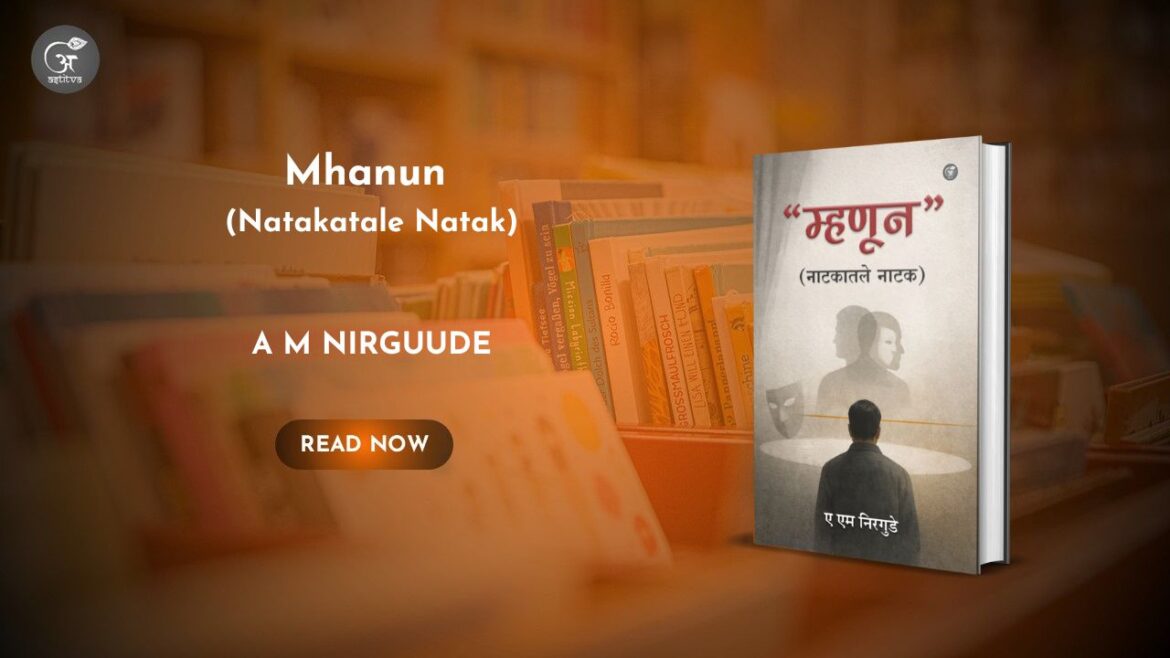
Mhanun (Natakatale Natak) arrives as a deeply emotional and socially reflective Marathi drama that enters the reader’s mind with a quiet force and stays long after the last page is turned. Written by A. M. Nirguude, the story explores the life of an intellectually disabled boy whose dreams, desires, and vulnerabilities mirror the struggles of countless individuals who are often unheard in society. Instead of presenting his condition as a limitation, the narrative closely follows his efforts to rise in life, his longing for dignity, and his pursuit of the love and affection every human being rightfully deserves. His family stands beside him, offering strength and encouragement, yet the world outside responds with doubt, cruelty, and indifference. What begins as a simple portrayal of a boy wanting to belong gradually unfolds into a powerful commentary on societal attitudes toward disability and difference.
The book gains its emotional gravity from the sincerity with which the protagonist’s journey is written. His joys, fears, and small victories are captured with empathy. The author does not sensationalize his struggle; instead, he portrays it with grounded realism. The boy’s fight is not against a physical obstacle but against a society that behaves as though people like him do not deserve equal respect. His internal world is tender, hopeful, and honest, while the external world becomes increasingly challenging. As the narrative progresses, the pressure of expectations, societal behaviour, and emotional turmoil slowly build toward a heartbreaking conclusion. His suicide is not shown as an escape but as a question that society must answer—why must a young life seeking love and dignity be pushed to such an end? The book urges readers to confront this discomfort directly, making it a must-read for anyone who believes in progress, compassion, and humanity.
A. M. Nirguude brings a rare authenticity to the story, shaped by his own nuanced understanding of people and emotions. Though an engineer with more than 30 years of experience working on various sites, his creative mind has always been active. Solitude became his classroom, and observation his craft. Over the years, these reflections have molded themselves into characters and stories that feel real and relatable. With over 100 short stories written across multiple platforms and three published books—Zatpat Karodpati Part 1, Chukleli Gita, and Instant Millionaire—Nirguude has established himself as a storyteller who blends everyday experiences with meaningful insights.
In Mhanun, he chooses drama as the medium to express a painful yet significant social reality. The emotional depth of the narrative, combined with the simplicity of language and authenticity of the characters, makes this work not only a piece of literature but a social mirror. It reminds readers that progress as a society is not defined by technology or infrastructure but by how inclusively we treat those who are vulnerable. The story demands introspection—are we doing enough? Are we listening? Are we truly inclusive, or is our idea of progress merely superficial?
The drama stands as both a tribute to those who suffer silently and a challenge to the community to rethink its values. The boy at the heart of the story may be fictional, but the circumstances he represents are painfully real. Through this work, Nirguude invites every reader to step beyond sympathy and into understanding. Mhanun is more than a book; it is a call for humanity, compassion, and responsibility—a literary reminder that every life, regardless of ability, deserves dignity, opportunity, and love.