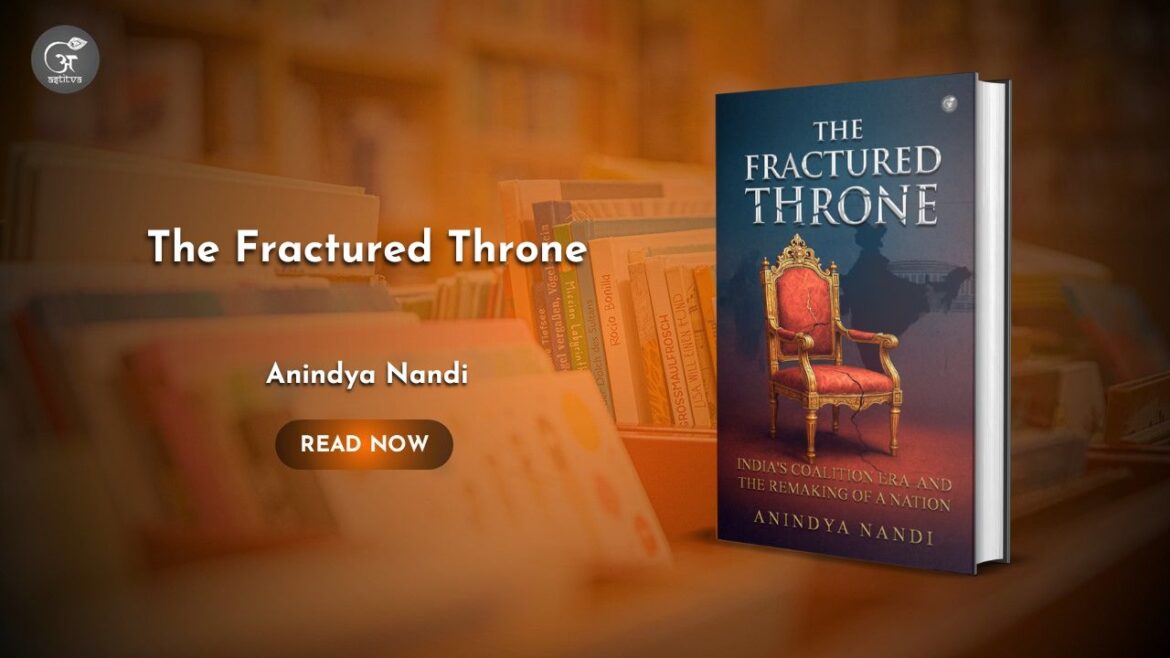
Anindya Nandi’s latest work, The Fractured Throne: India’s Coalition Era and the Remaking of a Nation, offers readers a powerful exploration of one of the most dynamic and often misunderstood chapters in Indian political history. Combining meticulous research with a deeply personal perspective, the book presents a compelling narrative of India’s journey from single-party dominance to a complex coalition era that reshaped the very fabric of governance and democracy in the country. With the precision of a seasoned analyst and the empathy of someone who lived through the change, Nandi dissects the years between the late 1980s and the early 2000s with remarkable clarity and detail.
At the heart of the book is the pivotal year of 1996, which the author recounts through his own experience as a young naval recruit. The turbulence of that time—marked by the fall of Atal Bihari Vajpayee’s 13-day government and the broader political uncertainty—is portrayed through the vivid metaphor of navigating stormy seas. Nandi’s personal reflections serve as an anchor for a broader narrative that spans across decades, connecting pivotal events like the Bofors scandal, the economic liberalization of 1991, and the formation of multiple coalition governments such as the National Front, United Front, NDA, and UPA.
What distinguishes The Fractured Throne is its human-centered approach. Rather than focusing solely on political elites and institutional changes, the book draws in the voices of ordinary Indians—students, farmers, naval cadets—whose lives were directly impacted by the policy shifts and political realignments of the time. Through these stories, Nandi explores whether the coalition era truly fractured the Indian political structure or laid the groundwork for a more inclusive and resilient democracy.
The book delves deep into the ideological fragmentation that characterized the coalition years, while also highlighting the opportunities for regional empowerment and democratic innovation that emerged in its wake. Nandi argues that despite the instability and compromise often associated with coalition politics, the period also witnessed a diversification of leadership and a recalibration of power that challenged the long-standing monopoly of a single party. The result is a nuanced portrait of a nation reinventing itself amidst chaos.
As an author, Anindya Nandi brings a unique voice to the political non-fiction genre. A retired Indian Navy sailor and geopolitical thinker, his literary and analytical work spans military history, mythological reinterpretation, and cultural preservation. His background in defence, coupled with a passion for India’s ancient traditions, lends his writing a rare depth—one that bridges past and present, policy and philosophy.
Through this book, Nandi continues his mission of national awakening, not only by examining the past but by provoking critical thought about India’s political future. His insights extend beyond the printed page into his wider body of work, including his leadership of the Rastriya Sanatan Sangathan, his defence publications, and his active involvement in socio-political discourse. The Fractured Throne reflects the culmination of years of observation, experience, and scholarly inquiry, distilled into a gripping narrative that will appeal to history enthusiasts, political analysts, and general readers alike.
In a time when India’s democratic structure continues to evolve and adapt, Anindya Nandi’s The Fractured Throne serves as both a mirror and a map—reflecting where we’ve come from and pointing toward where we might be headed. Thought-provoking, emotionally resonant, and intellectually rigorous, this is not just a book about Indian politics; it is a timely reminder of how democracy, even in its most chaotic form, remains a work in progress—demanding vigilance, participation, and an understanding of the forces that shape its course.