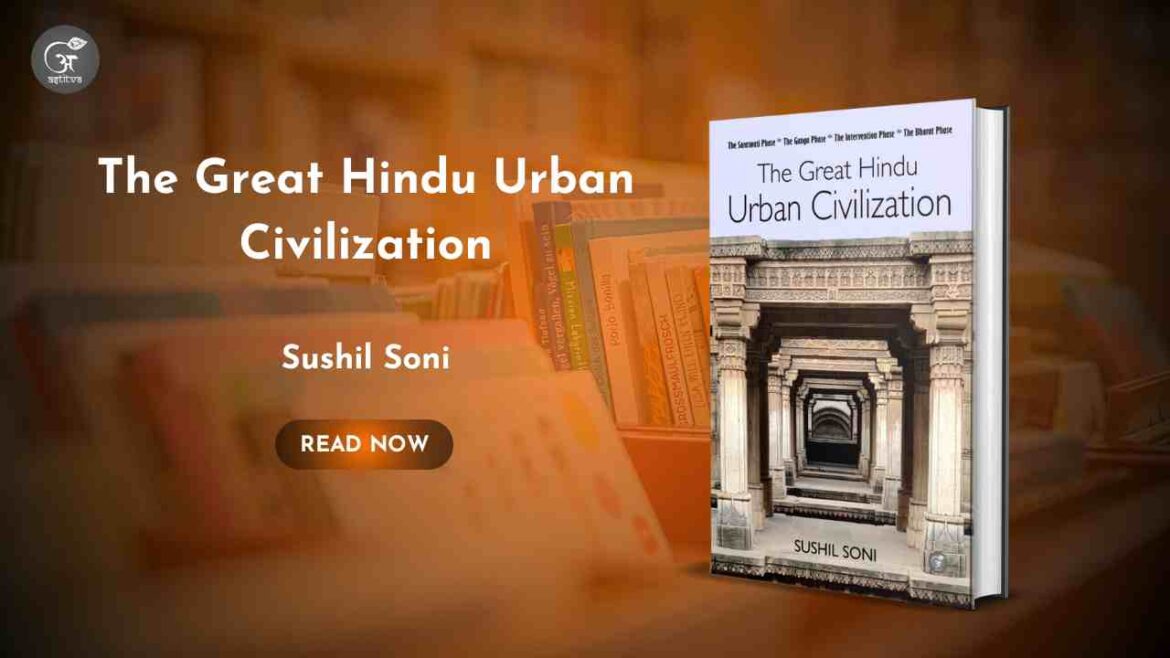
In an era where historical narratives are being re-examined and redefined, The Great Hindu Urban Civilization by Sushil Soni emerges as a landmark work that challenges the long-standing Eurocentric-Marxist interpretations of Indian history. Through a compelling blend of archaeological evidence, cultural continuity, and philosophical insight, Soni boldly reclaims the authentic story of one of the world’s oldest and most sophisticated civilizations.
The book exposes the flaws and ideological biases of the Eurocentric-Marxist framework, revealing how India’s ancient past was systematically misrepresented to fit colonial agendas. Soni meticulously argues that the so-called Aryan Invasion/Migration theory, once treated as historical truth, has now collapsed under the weight of new discoveries. These findings have rendered the artificial divisions between the Vedic and Harappan civilizations, and between the so-called Aryan and Dravidian peoples, irrelevant and obsolete.
Tracing the unbroken thread of Hindu civilization, the author introduces readers to its four transformative phases — The Saraswati Phase, which marks the dawn of urbanization and Vedic culture along the now-extinct Saraswati River; The Ganga Phase, symbolizing the flourishing of spiritual, philosophical, and political life across the fertile plains; The Intervention Phase, when foreign invasions and religious impositions disrupted the civilizational flow; and finally, The Bharat Phase, representing today’s resurgence of national consciousness, self-awareness, and cultural pride.
Soni’s work is not just an academic treatise; it is a powerful civilizational narrative that celebrates continuity amidst change. It emphasizes that Hindu civilization, far from being static, has evolved dynamically — absorbing, adapting, and rising anew through every historical challenge.
Rich in research and interpretation, The Great Hindu Urban Civilization urges readers to look beyond textbook myths and rediscover Bharat’s true civilizational heritage — one that is deeply spiritual, intellectually robust, and socially advanced. It stands as a clarion call to reclaim pride in India’s unbroken cultural lineage and to recognize that the story of Bharat is not one of decline, but of continuous revival.
With this book, Sushil Soni firmly establishes himself as a courageous voice in the quest for historical truth — inspiring scholars, thinkers, and every proud Indian to revisit the origins of civilization with renewed clarity and conviction.
Is this conversation helpful so far?