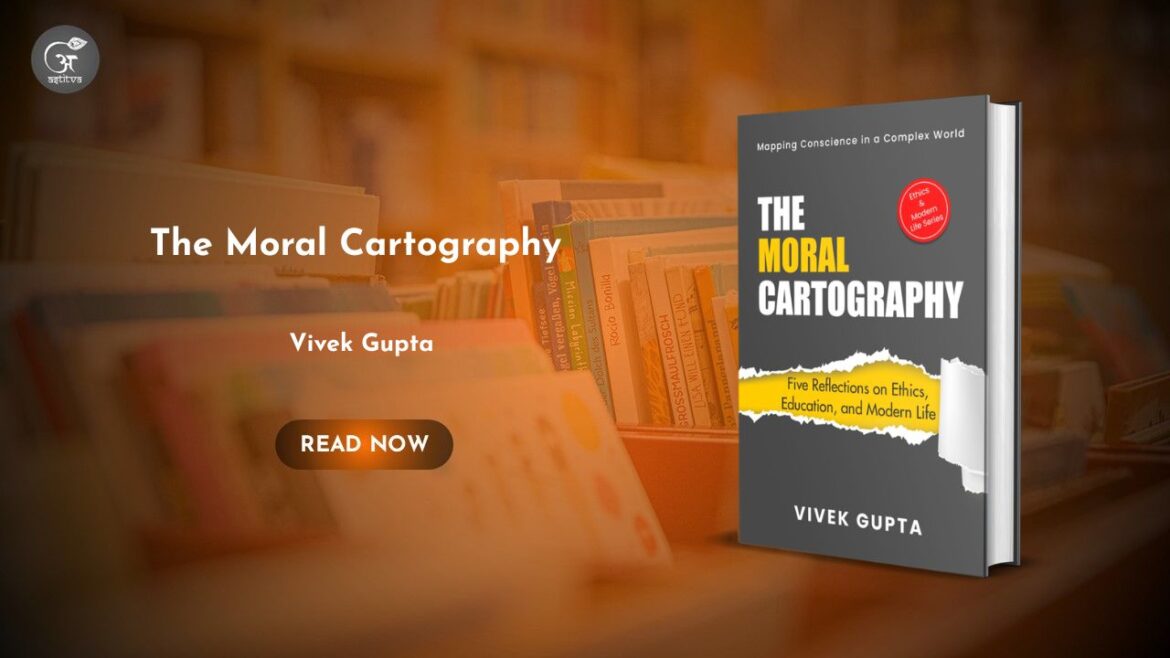
The literary work The Moral Cartography: Five Reflections on Ethics, Education, and Modern Life by Vivek Gupta emerges as a thoughtful and timely contribution to contemporary discussions on ethics, responsibility, and human progress. In an era marked by rapid technological advancement, digital connectivity, and constant social transformation, the book addresses a pressing paradox of modern civilization: while humanity has achieved unprecedented innovation and opportunity, it simultaneously faces growing ethical uncertainty and social fragmentation.
Through a reflective and philosophical approach, the book invites readers to examine the deeper foundations of modern life. Rather than presenting rigid doctrines or prescriptive solutions, Vivek Gupta offers a contemplative exploration of five interconnected themes that shape human society—conscience, character, social responsibility, dignity, education, and the meaning of progress. Each reflection encourages readers to pause and reconsider the moral direction of a world that often prioritizes speed, consumption, and competition over ethical clarity and collective well-being.
At the core of the book lies the idea that meaningful societal transformation begins within the individual. By emphasizing the importance of conscience as an inner compass, the author highlights how personal integrity forms the foundation for broader social change. The narrative examines contemporary challenges such as addiction, questions of gender dignity, and the evolving role of education. However, these subjects are not approached merely as social issues or institutional concerns. Instead, they are explored as moral responsibilities that shape the character of civilizations and influence the ethical trajectory of future generations.
The work also raises an important question for the modern age: does technological and economic advancement truly align with human values? In a time when progress is often measured through material growth and efficiency, Vivek Gupta encourages readers to develop discernment and reflection. The book suggests that advancement without moral grounding can become fragile and unsustainable. True development, it argues, must be anchored in values that uphold dignity, responsibility, and collective harmony.
Written in a balanced, accessible, and reflective tone, the book speaks particularly to young readers and emerging generations who are navigating an increasingly complex social landscape. Instead of instructing or imposing rigid ideas, it encourages introspection and thoughtful dialogue. It reminds readers that freedom gains its true meaning only when it is guided by responsibility and ethical awareness.
The central conviction that runs throughout the book is simple yet profound: genuine progress cannot be measured solely by how far society advances technologically or economically, but by the values it carries along the way. In this sense, The Moral Cartography functions both as a mirror and a compass—reflecting the ethical dilemmas of contemporary society while guiding readers toward a path of responsible thought and action.
The author, Vivek Gupta, is known for his reflective thinking and commitment to intellectual inquiry. As a dedicated aspirant preparing for the Staff Selection Commission (SSC) examinations, his engagement with studies related to governance, accountability, and public administration has significantly influenced his perspective on society and ethics. His writings explore the delicate balance between individual conscience and the broader structures that shape collective life.
Born in Madhya Pradesh, India, Vivek Gupta’s journey has been shaped by perseverance, discipline, and continuous self-reflection. His academic and intellectual pursuits have encouraged him to think deeply about the ethical foundations necessary for responsible citizenship and meaningful social progress. A defining thought that reflects his outlook states: “When the world competes to capture your attention, discipline is choosing to stay loyal to your goal.”
The inspiration behind The Moral Cartography arose from a moment of quiet reflection during his time studying in a library. Observing the fast-paced and often dazzling nature of contemporary life, where individuals increasingly view themselves as self-sufficient and detached from deeper ethical and social connections, he realized that the modern world requires something beyond competition and achievement. What society truly needs, he concluded, is harmony—a meaningful coordination between values, responsibility, and human purpose.
Through this book, Vivek Gupta does not attempt to offer a rigid moral framework or definitive answers. Instead, he extends an invitation to readers to reflect on the direction of their lives and the ethical foundations of the societies they inhabit. His writing emphasizes that while societies may advance technologically and materially, genuine progress must also be measured by inner development—by the clarity of conscience, the strength of character, and the courage to act with integrity.
Ultimately, The Moral Cartography: Five Reflections on Ethics, Education, and Modern Life stands as a reflective guide for readers seeking deeper understanding in a rapidly changing world. By combining philosophical insight with accessible language, the book encourages individuals to cultivate ethical awareness and responsible citizenship. It reminds readers that ideas shaped by moral consciousness can serve as a guiding compass—not only for individuals but also for communities striving toward a more thoughtful, balanced, and humane future.