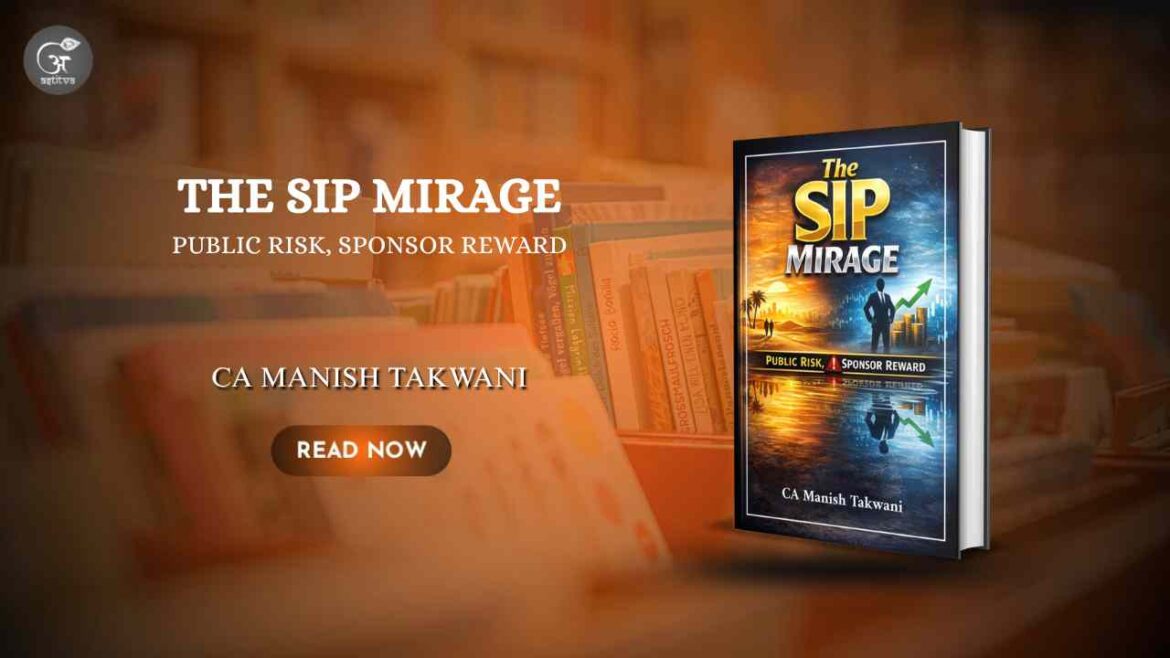
In an era where Systematic Investment Plans (SIPs) are widely promoted as the safest and most disciplined route to wealth creation, a new book challenges this narrative with striking clarity and investigative depth. The SIP Mirage – Public Risk, Sponsor Reward by CA Manish Takwani is a powerful exposé that questions the very foundation of trust on which India’s mutual fund industry stands.
Published by Astitva Prakashan, this thought-provoking work is not merely a financial guide but a wake-up call for millions of retail investors who entrust their savings to mutual funds. The book dives deep into the structure, functioning, and regulatory ecosystem of the industry, revealing how systemic gaps and conflicts of interest often shift risk from institutions to individual investors.
Drawing upon extensive research of SEBI regulations, financial laws, and real-world case studies, CA Manish Takwani presents a compelling argument: while mutual funds were designed to democratize finance, their operational reality often benefits sponsors, brokers, and intermediaries more than the investors themselves.
One of the most striking aspects of the book is its detailed exploration of SIPs. Marketed as a disciplined and reliable investment tool, SIPs are dissected to reveal hidden costs, structural biases, and the illusion of safety they often project. The author highlights how steady inflows from SIP investors can become a predictable revenue stream for fund houses, regardless of actual performance.
The book is structured in a clear and engaging manner, beginning with the origins and promise of mutual funds, moving through the anatomy of manipulation, and finally addressing the cracks in the system along with possible reforms. It not only exposes the problems but also equips readers with the awareness and tools needed to make informed financial decisions.
What sets The SIP Mirage apart is its balanced approach. It does not discourage investment but instead advocates for informed participation. It urges regulators to strengthen oversight, policymakers to close loopholes, and investors to question the narratives sold to them.
The foreword aptly describes the book as “a wake-up call,” emphasizing that trust is the backbone of financial systems—and when that trust is compromised, it is the ordinary investor who suffers the most.
With its bold insights, real-life examples, and clear call for accountability, The SIP Mirage – Public Risk, Sponsor Reward is essential reading for anyone involved in investing—whether a beginner or a seasoned participant. It stands as a reminder that financial success is not just about discipline, but about awareness, transparency, and vigilance.