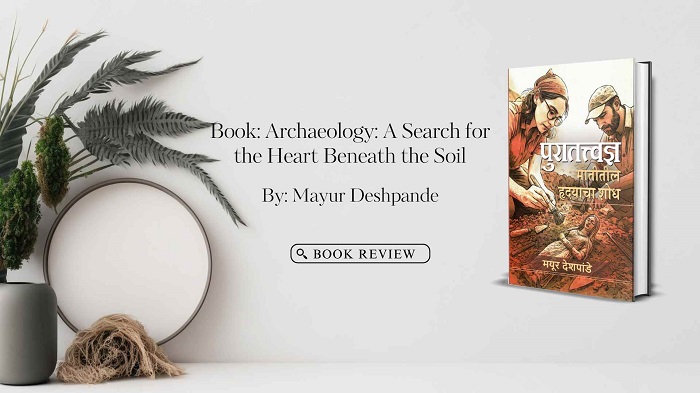
“Archaeology: A Search for the Heart Beneath the Soil” is a novel that defies genres and invites readers into a world where emotion is unearthed with the same delicacy as a fragile artifact. In this deeply reflective and aesthetically rich narrative, Mayur Deshpande merges archaeology with human psychology, history with longing, and ancient clay with contemporary heartbreak. What emerges through this fusion is not merely a novel but an emotional excavation, encouraging readers to dig into the deeper layers of their own forgotten or unspoken feelings. The story begins with a simple discovery during a routine excavation on the Deccan Plateau—a small, bridal clay figurine that has been buried for thousands of years. Yet from this moment onward, the reader understands that what lies beneath the soil is far more than an artifact. It is a story, a soul, and a silent memory waiting to be awakened. This figurine, named Maria, becomes the emotional epicenter of the novel. She is not portrayed as an object but as a living, breathing embodiment of sorrow, longing, and a love that once existed in an era where emotions were not spoken but sculpted. Maria is the past preserved in clay, and yet she becomes a mirror for the present.
At the heart of the story is Pruthwij, a young archaeologist whose sensitivity makes him attuned not only to physical remnants of the ancient world but also to the invisible emotions they carry. His connection with Maria begins as a professional curiosity but rapidly shifts into a deeper, more personal resonance. As he studies her form, expressions, and the craftsmanship that shaped her, Pruthwij finds himself confronting parts of his own life that he had quietly buried. His unfinished relationship with Alice—his college companion, confidant, and the one love that slipped quietly into silence—begins to surface again. The brilliance of Deshpande’s storytelling lies in creating a parallel between Maria’s ancient, unheard emotions and Pruthwij’s contemporary, unspoken ones. The clay figurine symbolizes everything humans suppress, delay, or fail to articulate. Her silence becomes the universal language of longing. Through her, the past speaks to the present, reminding readers that emotions remain unchanged across time, even if the world around them evolves.
As Pruthwij revisits memories of Alice, the narrative delicately weaves between timelines and emotional states. Alice, though physically absent for much of the book, is present in every reflection, every hesitation, and every unexpressed thought. Her absence is felt more strongly than the presence of many conventional characters in typical novels. Deshpande skillfully shows how relationships that never receive closure tend to follow us quietly, shaping our decisions, our fears, and our hopes. Through Pruthwij and Alice, the book reflects on love that remains unfinished—not because it failed, but because life moved in different directions. In this way, the novel achieves a rare emotional depth, offering readers a chance to revisit the relationships or memories they’ve left behind.
Maria’s silent presence transforms not just Pruthwij’s professional life but his inner world. Every crack on her clay surface, every curve sculpted by an ancient hand, becomes symbolic. She becomes a bridge between centuries, between two hearts, and between the conscious and subconscious. The story expands beyond archaeological boundaries and enters philosophical terrain. It invites readers to question what it means to preserve history, emotions, and memories. Are artifacts mere remnants of the past, or do they carry echoes of the people who once touched them, loved them, or dreamt through them?
What makes “Archaeology: A Search for the Heart Beneath the Soil” so compelling is the author’s elegant portrayal of silence. Silence becomes a character—sometimes comforting, sometimes haunting, but always meaningful. Maria never speaks, yet she communicates more profoundly than any spoken dialogue. Her expression, her moistness, and the fine carvings of her hands all form an intimate language that the reader begins to understand just as Pruthwij does. The beauty of this novel lies in this unspoken communication. It demands emotional participation from the reader and encourages introspection.
By the time the story reaches its conclusion, the reader realizes that the excavation is not merely physical. It is symbolic of the excavation of one’s inner world. The reunion—Maria with the present world, Pruthwij with Alice, and the reader with their own inner silence—forms a circle of healing. The novel closes gently but powerfully, leaving behind a lingering feeling that something buried within us has also been unearthed. Deshpande’s writing ensures that the book does not end—it continues to breathe in the reader’s own thoughts long after the last page is turned. “Archaeology: A Search for the Heart Beneath the Soil” is not just a story; it is an echo of the universal truth that time may bury emotions, but they never truly disappear. And when they resurface, they remind us who we are, whom we once loved, and what we have silently carried within us.