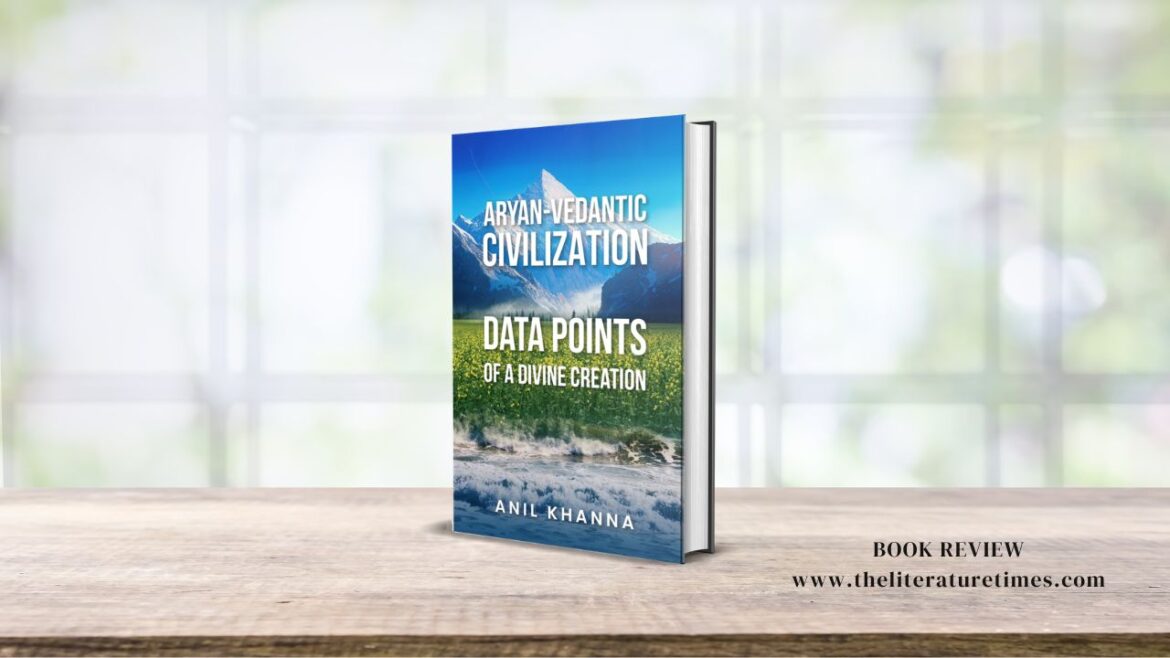
Aryan–Vedantic Civilization: Data Points of a Divine Creation is an ambitious, deeply researched, and ideologically driven work that attempts to reinterpret the origins, evolution, and philosophical foundations of Indian civilization. The book does not merely narrate history; it presents a civilizational thesis—arguing that the Indian (Aryan–Vedantic) civilization is a consciously designed, divinely guided project rooted in knowledge rather than survival alone
At the heart of the book lies a powerful central idea: that Indian civilization is unique in world history because it was founded on knowledge as purpose. According to the author, while other civilizations emerged primarily from material or survival needs, the Indian civilization evolved systematically to host and preserve eternal truth, culminating in Advaita Vedanta. This framing immediately distinguishes the work from conventional historical or anthropological studies and places it firmly at the intersection of philosophy, theology, cosmology, and cultural history.
The book is structured methodically, beginning with cosmic creation and gradually narrowing its focus to geography, life, human evolution, civilization, and finally philosophy. This macro-to-micro approach mirrors the author’s belief in a divinely ordered progression. Early chapters discuss the origin of the universe, drawing parallels between modern scientific theories such as the Big Bang and ancient Indian concepts like Shakti, Shabd, Aum, and cyclical creation-destruction (Pralaya and Mahapralaya). One of the book’s more striking arguments is its allegorical interpretation of the “missing antimatter” problem in modern physics, which the author correlates with the mythological slaying of Mahishasura by Goddess Durga. While this comparison may challenge empirically trained readers, it reflects the author’s consistent effort to read mythology as encoded knowledge rather than superstition
The discussion on the formation of the Indian subcontinent is another strong section. The author emphasizes the Himalayas not merely as a geological phenomenon but as a civilizational asset of unparalleled scale and significance. Rivers, monsoons, fertile plains, biodiversity, and climatic stability are presented as deliberate enablers for long-term human and cultural evolution. The sacred geography of India—through Shakti Peethas, Jyotirlingas, and the four Dhams—is interpreted as a systematic consecration of land, embedding divine energy into the physical terrain itself. This synthesis of geography and spirituality is one of the book’s most distinctive contributions.
Perhaps the most compelling and controversial portion of the book is its treatment of Dashavatara as a scientific evolutionary framework. The author presents the ten avatars as milestones in biological, intellectual, and spiritual evolution—from aquatic life (Matsya) to future civilizational correction (Kalki). By aligning these stages with modern evolutionary timelines and anthropological findings (such as Neanderthals and Homo sapiens), the book boldly positions Indian knowledge systems as precursors to modern evolutionary theory. While many scholars may contest the chronology and methodology, the internal coherence of the argument is noteworthy and intellectually stimulating.
The chapters on civilization-building highlight tangible institutional contributions: Sanskrit as a “Dev Bhasha,” the Devanagari script, the decimal system, village governance models, family structures, jurisprudence, and ethical economics. The discussion on the decimal system is particularly insightful, arguing convincingly that India contributed not merely the numeral zero but the entire conceptual framework of base-10 counting—a civilizational leap that transformed mathematics, astronomy, and daily life worldwide
The philosophical culmination of the book arrives with Vedanta and Advaita. The author positions Adi Shankaracharya’s Advaita not as an abstract metaphysical doctrine but as the natural endpoint of a long civilizational journey—from material existence to realization of non-duality. In this sense, the title Aryan to Vedantic is not symbolic but literal: it marks the transition from a knowledge-seeking civilization to one capable of hosting and transmitting ultimate truth.
From a critical standpoint, the book is unapologetically assertive. It challenges Western academic frameworks, questions colonial-era historiography, and openly critiques Indian scholars who, in the author’s view, uncritically adopted external narratives. Readers expecting a neutral or purely academic tone may find the conviction overwhelming at times. Additionally, the reliance on mythology as historical or scientific evidence will remain contentious for empiricists. However, the author does not claim neutrality; the book is a civilizational argument, not a detached survey.
In conclusion, Aryan–Vedantic Civilization is a bold, expansive, and thought-provoking work. Whether one agrees with all its claims or not, the book compels readers to reconsider Indian civilization through a lens of continuity, intentionality, and depth rarely attempted in contemporary discourse. It is best read not as a conventional history book, but as a philosophical manifesto grounded in cultural memory, symbolism, and a profound reverence for knowledge as the foundation of human evolution. For readers interested in Indic philosophy, civilizational studies, and alternative frameworks of history, this book offers a challenging and rewarding intellectual journey.