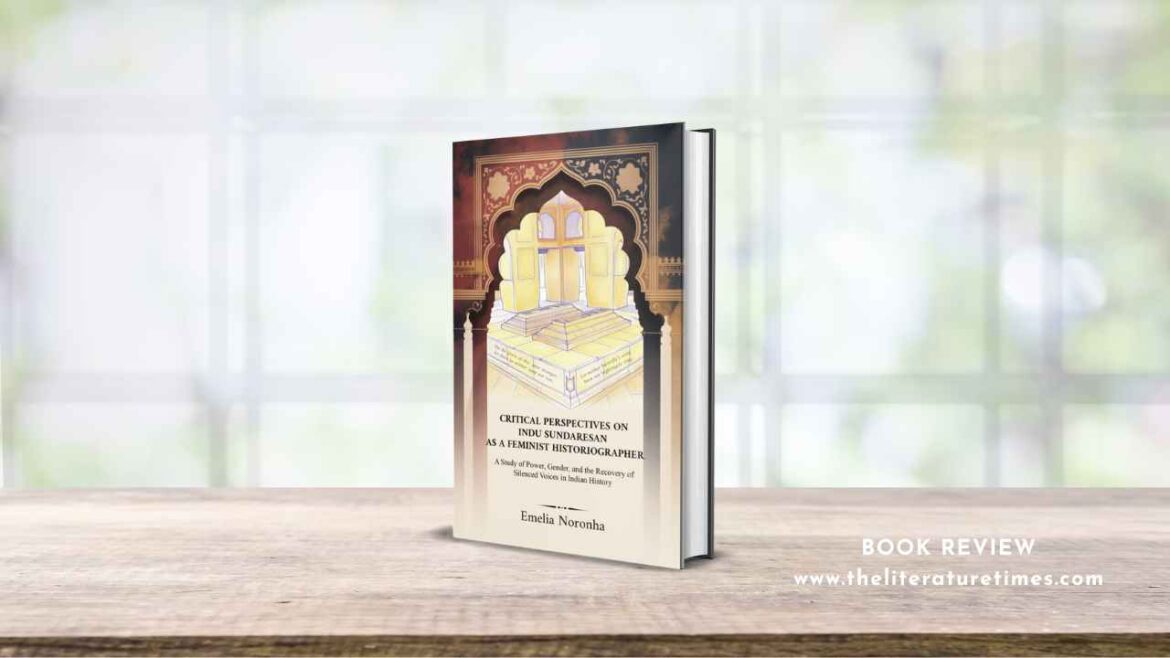
Critical Perspectives on Indu Sundaresan as a Feminist Historiographer: A Study of Power, Gender, and the Recovery of Silenced Voices in Indian History by Emelia Noronha is a rigorous and intellectually rich critical study that makes a significant contribution to feminist historiography, postcolonial literary criticism, and Indian historical studies. Drawing upon her doctoral research, Noronha offers a sustained and theoretically grounded analysis of Indu Sundaresan’s historical novels, positioning the novelist as an important feminist historiographer who reclaims marginalized voices from India’s Mughal and colonial past.
The book examines Sundaresan’s major works—The Twentieth Wife, The Feast of Roses, The Shadow Princess, The Splendor of Silence, and The Mountain of Light—and argues that these narratives challenge dominant, patriarchal, and colonial versions of Indian history. Noronha’s central contention is that Sundaresan’s fiction does not merely retell historical events but actively intervenes in the writing of history by foregrounding women, subaltern figures, and affective spaces traditionally excluded from official historiography.
One of the major strengths of the book lies in its strong theoretical foundation. The opening chapter provides a comprehensive framework drawing from New Historicism, feminist historiography, postcolonial theory, and gender studies. Thinkers such as Stephen Greenblatt, Michel Foucault, Hayden White, Ranajit Guha, Romila Thapar, and Dipesh Chakrabarty are thoughtfully engaged to establish how history itself is a narrative shaped by power relations. Noronha convincingly demonstrates that historiography is never neutral and that historical writing often serves ideological and imperial interests. This theoretical clarity allows the subsequent literary analyses to remain focused and analytically sharp.
Noronha’s discussion of New Historicism is particularly effective. She highlights how literature and history are mutually imbricated, arguing that Sundaresan’s novels function as cultural texts that expose the anxieties, contradictions, and silences of the past. By treating literary fiction as a legitimate site of historical knowledge, the author challenges the rigid boundaries between “history” and “story” imposed by colonial and Eurocentric traditions. This approach enables a nuanced reading of Sundaresan’s work as both imaginative and historiographically subversive.
The chapters devoted to the Mughal harem are among the most compelling sections of the book. Noronha dismantles the Orientalist trope of the harem as a space of mere sensuality and confinement, reinterpreting it instead as a complex site of emotional labor, caregiving, relational power, and female agency. Through close readings of The Twentieth Wife and The Feast of Roses, she shows how motherhood, kinship, and affect become alternative modes of power within a patriarchal structure. This re-reading is particularly valuable as it recovers women’s lived experiences from behind the veil of imperial historiography.
Equally insightful is Noronha’s analysis of The Shadow Princess and The Mountain of Light, where she explores themes of sacrifice, colonial domination, mimicry, hybridity, and gendered power. Her examination of the Kohinoor diamond as a symbol of imperial greed and gendered suffering is especially striking. The book effectively reveals how women’s bodies and emotions become battlegrounds for both colonial and patriarchal control, while also highlighting moments of resistance and ethical agency.
The discussion of The Splendor of Silence further strengthens the study by focusing on colonial sexuality, racial othering, and disciplinary mechanisms. Noronha’s engagement with themes such as domesticity, brothels, and the regulation of bodies underscores the gendered nature of imperial power. She skillfully illustrates how Sundaresan exposes the hypocrisy of the so-called “civilizing mission” by revealing its dependence on silencing native voices and controlling female bodies.
While the book is academically dense and occasionally demanding for non-specialist readers, this complexity is also its strength. Noronha’s scholarship is meticulous, well-researched, and clearly situated within contemporary critical debates. The extensive use of historical sources, theoretical texts, and literary analysis reflects the depth of her research and adds credibility to her arguments.
In conclusion, Critical Perspectives on Indu Sundaresan as a Feminist Historiographer is an important and timely contribution to Indian literary criticism and feminist historical studies. Emelia Noronha successfully demonstrates how historical fiction can function as a powerful counter-historiographical tool, recovering silenced voices and challenging dominant narratives. The book will be of immense value to researchers, scholars, and postgraduate students of English literature, history, gender studies, and postcolonial studies, and it firmly establishes Sundaresan’s work as a vital intervention in the politics of history-writing.