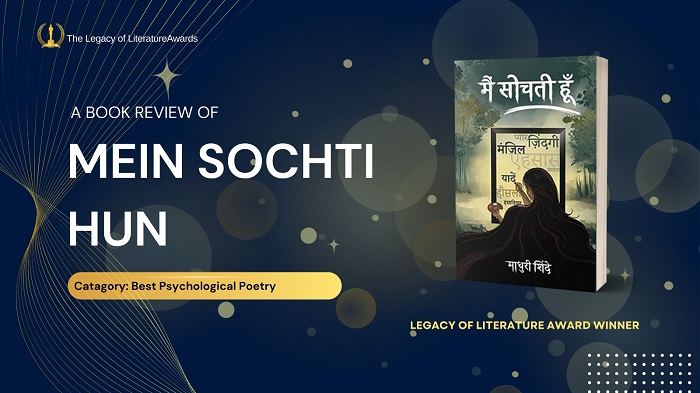
Mai Sochti hu is a deeply introspective and emotionally articulate poetry collection that captures the fragility, beauty, and contradictions of human existence. Madhuri Shinde writes not merely to express but to explore; each poem is a personal contemplation unfolding like a conversation between the self and the world. Her words are gentle yet piercing, tender yet rebellious, and rooted in a raw sincerity that makes the reader pause, reflect, and sometimes confront their own truths. What stands out most is not the form or the technicality of poetry, but the intimacy of thought—the feeling that each poem carries a lived emotion, a memory, or a revelation.
From the very first piece, the poet invites the reader into a journey where identity, pain, hope, and introspection are constant companions. The recurring question “ज़िंदगी तू कौन है?” captures the restless curiosity of a mind trying to define life through experience rather than philosophy. Many poems sit within the vast emotional spectrum of longing, loss, discovery, and resilience. They echo the universal truth that life is not made of answers, but of continuous attempts to understand our own place in an unpredictable world.
Shinde’s strength lies in her ability to convert ordinary moments into profound reflections. A raindrop, a broken mirror, a market, a dried leaf, a crowded street—these familiar images become symbolic of deeper human states. For example, the poem आईने के सामने खड़े रहकर खुद को ढूंढते हैं हम आज–कल makes the reader confront the alienation that modern life breeds, where the face in the mirror seems familiar yet emotionally distant. Similarly, वो कौन था moves from the story of one individual to a piercing critique of society and the tragic loss of humanity behind religious identities. In poems like तिरंगा, patriotism becomes not a celebration alone, but a question of collective responsibility toward a symbol that many value only ceremonially.
Themes of loneliness and belonging flow subtly throughout the book. In Mai Sochti hu, the poet converses with the self as if it were another person—recognising the distance between who we are internally and who we appear to the world. Poems such as चलते रहना and फकत एक उम्मीद evoke resilience not through moral lessons but through lived struggle, accepting that the path forward exists even when hope feels insufficient. Even love in this collection is not romanticised; it appears as comfort, as pain, as memory, and sometimes as fear. The emotional honesty in मासूम and तुम shows that love changes people, often making them forget the innocence they once possessed. Shinde refuses to accept love as fantasy—she recognises it in its vulnerable, imperfect form.
Madhuri Shinde also expresses a subtle rebellion against social hypocrisy. In poems such as कैंसा बाज़ार है and चुनावी तेवर, her tone sharpens, exposing a world where people trade emotions, values, and humanity for selfish desires. These observations are never loud or aggressive; instead, they emerge from clarity and lived awareness. Her criticism is not ideological—it is humane. She urges readers to recognise the decay of empathy in society while reminding them that change begins within. In this sense, her poetry not only looks inward but also outward, capturing the rhythm of the world around her.
One of the most striking features of the collection is the absence of poetic pretension. Shinde does not embellish pain or glorify suffering; she writes in simple, conversational language, but with emotional depth that lingers. Her blending of Hindi–Urdu vocabulary adds musicality to the verses without compromising readability. Whether she writes of childhood memories, dreams, heartbreak, or social injustice, the language remains accessible yet lyrical. It is clear that the poet writes from instinct rather than academic poetic tradition, trusting emotion more than structure.
The book does not search for dramatic enlightenment or perfect endings. Instead, it acknowledges life as an unfinished poem—beautiful, painful, incomplete, and meaningful precisely because of its imperfections. In अधूरी ग़ज़ल है ज़िंदगी, Shinde reaches a philosophical peak, expressing that life may always feel incomplete, but it is in the attempt to complete it that living becomes worthwhile. The poem becomes a metaphor for the book itself: a collection of thoughts that does not seek closure but invites reflection.
By the final pages, the reader recognises that Mai Sochti hu is not just a book of poetry—it is a diary of emotional evolution across years. It holds nostalgia and wisdom, innocence and maturity, acceptance and questioning. The poems—written between 2002 and 2021—trace the transformation of a person who has seen love, loss, disappointment, hope, and self-discovery. Yet, the voice remains compassionate throughout, proving that genuine sensitivity is not lost but reshaped by experience.
This collection demands to be felt rather than analysed. Readers who appreciate polished literary poetry may look for structure, but those who value authenticity will find something much more important—truth. Madhuri Shinde writes not to impress, but to connect. Each poem is an invitation to pause and feel something real—to acknowledge the emotions that everyday life forces us to suppress. That is the special gift of Mai Sochti hu; it reminds the reader that thinking, feeling, and questioning are not weaknesses, but pathways to meaning.
Ultimately, this book is for anyone who has ever searched for themselves in the noise of the world, who has ever carried memories like silent companions, and who believes that poetry should not decorate life but reflect it. In its simplicity lies its power, and in its honesty lies its beauty.