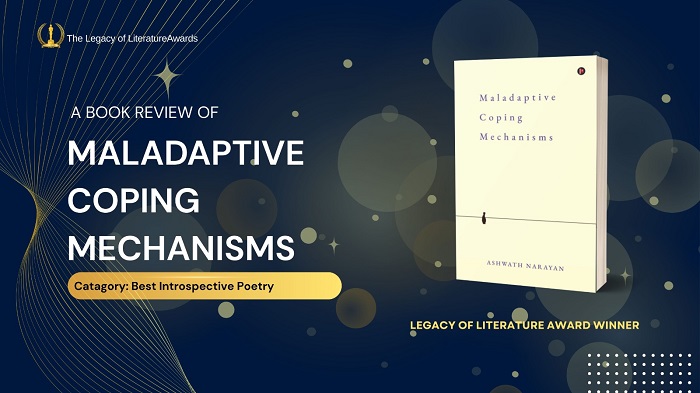
Maladaptive Coping Mechanisms is not a conventional poetry collection—it is a raw, unsettling diary of trauma, grief, abandonment, love, and psychological survival written in verse. The author does not approach pain intellectually; he lives inside it, breathes through it, and bleeds it line after line. What unfolds through the book is not a journey that begins in darkness and ends in light, but a brutal tug-of-war between despair and hope, sanity and self-sabotage, attachment and abandonment. It is uncomfortable, heavy, and honest—sometimes painfully so. And that is its greatest strength.
Right from the opening poem, The Boy Who Knew Nothing, the reader is thrust into the interior landscape of a wounded mind that has been taught to mistrust love and expect disappointment. There is a confessional urgency in the author’s voice, as if every stanza is an act of survival rather than artistic expression. The imagery oscillates between myth and memory, nightmare and nostalgia, and the lines visibly capture a mind trying to analyse itself even while drowning inside the emotion it is trying to name. Throughout the book, the speaker seeks answers, closure, meaning, and connection, yet every attempt reinforces the belief that none of these things can be held for long.
The recurring theme of trauma bonding and abandonment reveals itself gradually rather than abruptly. The emotional arc is not linear but cyclical: love brings temporary relief, then triggers fear, self-hatred, hypervigilance, and finally a return to solitude. In poems like An Actor and a Fraud, Beyond all a Coward and Imposters, the author’s fear of inadequacy, illness, and impermanence spills across the page with such vulnerability that even the metaphors feel like open wounds. The book presents the mind not as a battlefield with heroes and villains, but as a labyrinth where the victim, the abuser, the protector, and the saboteur are all the same person. This internal multiplicity is one of the most compelling threads of the narrative.
One of the remarkable aspects of the collection is its refusal to decorate trauma. There is no poetic beautification of assault, abuse, or mental breakdown. When the author describes childhood abuse, hypervigilance, abandonment by family, and invalidation by lovers, the language becomes rough, almost claustrophobic—reflecting not how memory is remembered, but how memory is survived. In Solitary Confinement, for instance, the mind isolates itself not out of strength but because the world feels unsafe. The poems become windows into behaviours that psychology names “maladaptive,” but which, in the context of unimaginable suffering, were simply the only available means of staying alive.
The romantic relationship at the centre of the book is not written as a love story but as the emotional fulcrum around which the author’s psychological battles intensify. The lover is simultaneously a saviour, an anchor, a trigger, and a ghost. The poet never pretends that the love was healthy, yet never diminishes its power. When the relationship unravels, the book shifts into a darker emotional register. Loss becomes not an event but a state of existence. The sense of catastrophic panic after separation is described with haunting precision, where memory becomes both drug and poison.
Stylistically, the book is unfiltered and intentionally unpolished. Instead of structured metre or literary sophistication, the author employs repetition, emotional escalation, dramatic symbolism, and striking metaphorical bluntness. For some readers, this may feel excessive or overwhelming—but that excess is authentic to the emotional world the poet inhabits. Trauma does not arrive neatly. Panic does not rhyme. Flashbacks do not follow iambic pentameter. The style mimics the disorder, rather than sanitising it into art. That choice makes the collection heavier but more sincere.
What makes the book unforgettable is not just the depiction of suffering but the subtle philosophy buried underneath the emotional debris. The speaker is aware of therapy, self-work, childhood conditioning, hypervigilance, psychosomatic stress, and trauma responses. He is not oblivious to his own patterns—he is trapped inside them despite awareness. There is a heartbreaking moment in several poems where insight becomes self-punishment rather than liberation; knowledge of trauma does not free him, it sharpens guilt. The poems illustrate a painful truth: healing is not just understanding what happened, but believing we deserve better—and that belief is often the hardest part.
The final poems are not triumphant or resolved. There is no forced optimism, no moral takeaway, no redemption arc. The author does not pretend to have healed, forgiven, or moved on. Instead, the book ends the way trauma behaves in real life—with an unfinished sentence, with memories that still hurt, with the longing for love that both heals and destroys. This unresolved ending is not a flaw—it is an honest reflection of someone still trying to survive their past and navigate their present.
Maladaptive Coping Mechanisms is not a casual read. It demands empathy, patience, and emotional stamina. Those who seek polished literary poetry may find it chaotic. Those who have lived through cycles of trauma, abandonment, hypervigilance, or emotional dependency will see themselves on the page with almost uncomfortable accuracy. The book does not teach, preach, or console. It bears witness.
This collection is not simply poetry—it is testimony. It is the voice of someone who was silenced for too long, speaking with the only remaining language he has: pain transformed into words so that it does not consume him silently. Few books portray mental anguish with such honesty, and although it leaves the reader bruised, it also leaves them deeply aware of the strength it takes to survive the kind of childhood and adulthood the author describes. That alone makes it an important and unforgettable work.