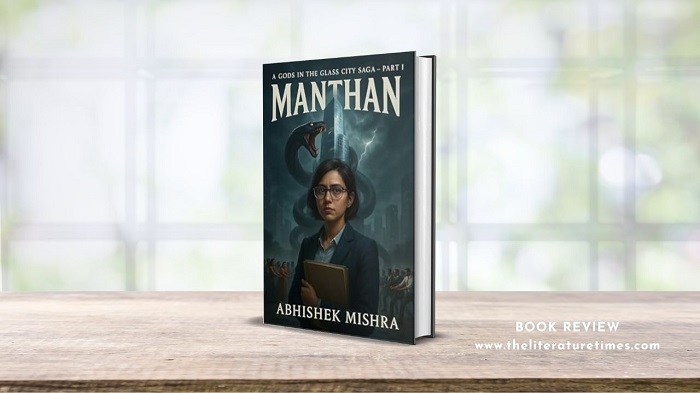
Manthan: A Gods in the Glass City Saga by Abhishek Mishra The story opens in 1985 on a nameless Himalayan peak, where a dying “Keeper” delivers a terrifying prophecy to his disciple. He warns of a future where men will build a “god” not of wood and stone, but of steel and code—a god that answers but never listens. Fast forward to the present day, and this “God in the Glass” has arrived in the form of Amaravati, a hyper-intelligent city infrastructure spearheaded by the charismatic Vikramaditya Singh.
Dr. Mridula Sharma, a meticulous archivist, discovers the “Miscellaneous Esoteric Folklore, File 37B”—the very transcription of that 1985 prophecy. As she translates its warnings about “serpents of light” (fiber optics) and an “ocean of memory” (big data), the world around her begins to mirror the text with surgical precision. When her mentor, Om Purohit, is found dead with his mouth packed with ritualistic barley, Mridula realizes that Amaravati is not just a city project; it is a staged enactment of a divine blueprint.
Themes: Certainty vs. Mercy
Mishra masterfully weaves the Vedic concept of Samudra Manthan (the churning of the ocean) into a modern critique of surveillance capitalism.
• The Cost of Order: The city of Amaravati promises “absolute certainty”. However, as the protagonist notes, “Certainty means remembering everything,” while “Mercy means forgetting some things”.
• The Halahala (Poison): In mythology, the churn produced both nectar (Amrita) and poison (Halahala). In Manthan, the “nectar” is the efficiency of the smart city, while the “poison” is the SYS_A11 protocol—a hidden layer of control that can manipulate traffic, doors, and lives to “clean” the city of dissent.
Characterization and Style
The characters are archetypes updated for the 21st century. Vikramaditya is the modern Indra, ruling from his glass throne. Mridula is the seeker of truth, armed with pencils and grid paper, representing the human element that refuses to be “automated”.
Mishra’s prose is lean and atmospheric. He uses a “four-square grid” style of thinking within the narrative—Logic, Signals, Countermoves—making the reader feel like they are part of the investigation. The tension is not built on explosions, but on “one point two second door delays” and “black hatchbacks” that wait patiently for the perfect moment to strike.
Verdict: Manthan is a haunting, intellectual thriller. It asks a vital question for our era: When we build a god that never forgets, where do we hide our humanity?