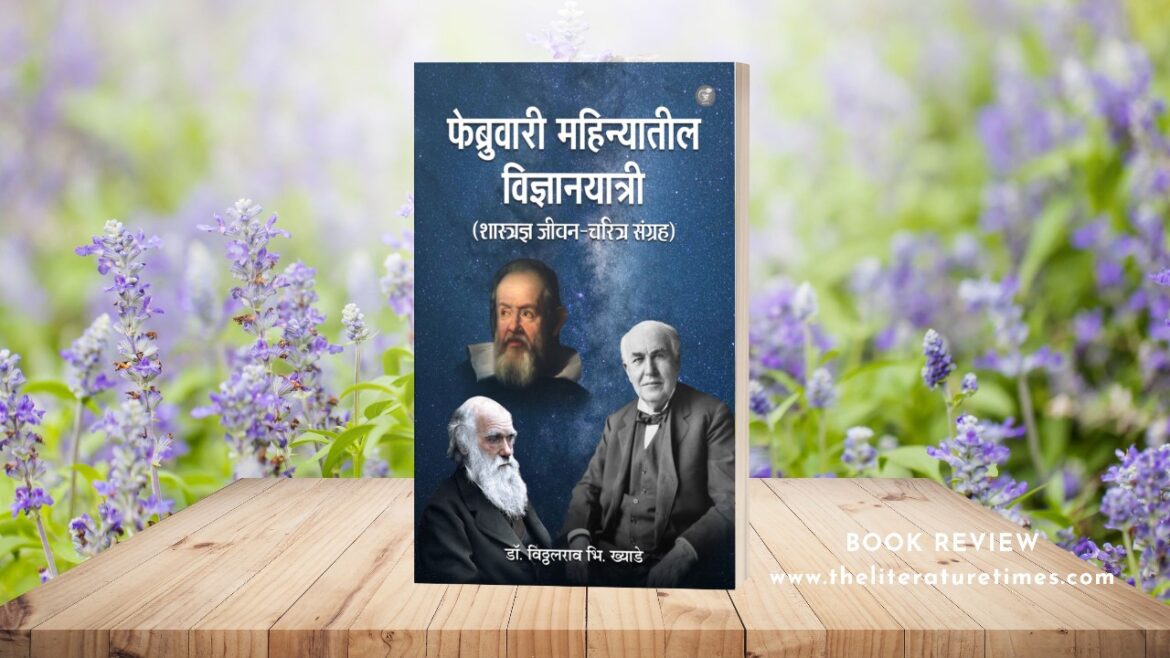
Phebruvari Mahinyatila Vidnyanayatri: Shastradnya Jeevan Charitra Sangrah by Dr. Vitthalrao Bhimsha Khyade is a remarkable and inspiring literary contribution to the field of science communication, blending deep scientific reverence with cultural and linguistic identity. This compilation pays homage to legendary scientists born in the month of February—icons such as Charles Darwin, Galileo Galilei, Linus Carl Pauling, and India’s own Dr. Shantiswarup Bhatnagar—whose revolutionary work laid the foundation for modern scientific understanding and progress. With his characteristic scholarly clarity and passion, Dr. Khyade crafts each biography with meticulous attention to historical context and scientific contribution, making complex concepts accessible to readers from varied backgrounds. What sets this book apart is its commitment to presenting these global scientific legacies in Marathi, a classical (Abhijat) Indian language, thereby fostering scientific temperament and knowledge-sharing at the grassroots level. The narrative doesn’t merely recount life stories but dives into the motivations, challenges, and inner workings of these scientific minds, thus humanizing the often intimidating image of a scientist. Dr. Khyade’s approach is both educative and evocative—his descriptions evoke the curiosity that drives scientific discovery while instilling admiration for the perseverance and brilliance of these February-born pioneers. In a time when science literacy is crucial, this book acts as a bridge between the general public and scientific heritage, emphasizing how invention and innovation shape human civilization. Dr. Khyade also subtly weaves in the importance of National Science Day, celebrated on 28 February to honor C.V. Raman’s discovery of the Raman Effect, making the release of this book timely and contextually relevant. The book doesn’t just stay limited to past achievements; it encourages young minds to explore, question, and dream. It echoes the ethos that science is not a finished domain, but a continually evolving journey that invites participation. Dr. Khyade’s own academic and research credentials, including his work on herbal compounds, silkworm biotechnology, BSF protein applications, and cancer immunology, lend further credibility and insight into his writing. His legacy as a teacher, mentor, and award-winning researcher is visible in his precise yet passionate prose. His capacity to connect the global with the local, the historical with the contemporary, and the scientific with the emotional makes this book more than a collection of biographies—it is a celebration of human intellect and a guide to aspiring scholars and students. The sheer depth of the content, combined with an easy narrative flow, makes it ideal not just for academic institutions and libraries, but also for readers with a general interest in science, history, and inspiration. Through Phebruvari Mahinyatila Vidnyanayatri, Dr. Khyade not only celebrates the month of February as a cradle of scientific birth but also ensures that the torch of curiosity and innovation continues to burn brightly in every reader’s heart. This work is a must-read and a valuable asset in the movement toward scientific popularization in Indian languages.