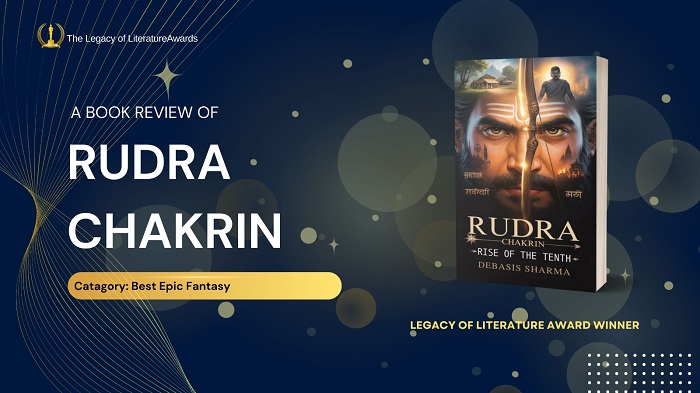
“Rudra: Rise of the Tenth” is an ambitious, sweeping epic that pulls from the deep wells of mythology, spiritual philosophy, and cosmic warfare to craft a narrative that feels both timeless and refreshingly new. At its heart stands Rudra, a newborn child marked by prophecy and endowed with extraordinary gifts, emerging into a world fractured by war, corruption, and the insidious spread of Kali’s darkness. From its opening pages, the novel signals its intent: this is not merely a story of heroism but a meditation on destiny, morality, and the constant tension between destruction and renewal.
The strength of the book lies first in the mythic quality of its world-building. The author constructs a universe where celestial beings, demonic forces, immortal sages, and ancient weapons coexist within a cohesive spiritual framework. The landscape feels vast and textured, filled with echoes of classical mythology while simultaneously carving out its own identity. Every location—from war-torn villages plagued by cosmic corruption to the sacred realms where immortal sages guide Rudra—carries symbolic weight. The narrative moves fluidly between mortal and supernatural planes, giving readers the sense of an unfolding cosmic tapestry whose threads are delicately interwoven. It is clear that significant care has gone into shaping the lore, rituals, and metaphysical rules that govern this world.
Rudra himself is a compelling protagonist, not because he is destined for greatness but because his journey embraces vulnerability and inner conflict. Although he wields divine gifts and is recognized early as a prophesied warrior, the narrative allows him space to grow, falter, and confront the shadows within himself. His training under the immortal sages is more than a sequence of power acquisition—it is a spiritual apprenticeship. These chapters, steeped in meditative and philosophical reflection, highlight the novel’s deeper exploration of self-mastery and enlightenment. The author portrays Rudra’s struggles with nuance; his battles against demonic forces are reflections of the internal battles he wages against fear, anger, and doubt. This duality gives the story emotional resonance and elevates it beyond a simple good-versus-evil adventure.
The divine bow Sharanga, along with the other celestial weapons Rudra encounters, serves as a symbolic extension of his growth. Their power is not merely mechanical but moral; the narrative emphasizes that true strength lies not in wielding divine force but in understanding the wisdom required to use it. This approach reinforces the book’s central themes of balance, restraint, and spiritual awakening. Weapons become conduits for cosmic justice rather than instruments of violence, and this philosophical framing adds depth to the action-driven sequences.
The antagonist force—Kali’s corruption—functions not only as an external threat but as an embodiment of chaos, ignorance, and decay. Its presence creeps through the novel like a looming storm, manifesting in demonic adversaries, corrupted landscapes, and cosmic distortions. This gives the book a pervasive sense of dread and urgency. Yet the author avoids flattening the conflict into simplistic binary terms. Kali’s influence is examined as a cyclical force, one that has repeatedly overwhelmed creation across vast ages. Rudra’s quest, then, becomes not merely a battle but an attempt to break an entrenched cosmic pattern, adding stakes that transcend personal survival or even the preservation of a single world.
The inclusion of ancient figures such as Vibhishana—an immortal king whose wisdom bridges epochs—enriches the story’s mythological depth. Rudra’s journey to Lanka to seek counsel from Vibhishana is among the book’s most intriguing narrative threads. Here the novel deftly merges mythic nostalgia with forward momentum, showing how the past continues to cast long shadows over the present. These interactions with legendary figures help anchor Rudra’s quest within a larger cosmology and give the reader a sense of continuity across ages of mythic history.
As an epic narrative, the book moves between intense action sequences and contemplative passages with considerable skill. Battles against corrupted entities and demonic antagonists are described with cinematic dynamism, but equally important are the moments of introspection, meditation, and philosophical dialogue. Readers looking solely for fast-paced conflict may find the slower, reflective sections demanding, but these moments are precisely what give the story its spiritual signature. They reinforce the idea that the true battleground lies within the self, and that Rudra’s development is measured as much by internal transformation as by external victories.
If the novel has a limitation, it may be that its vastness occasionally risks overwhelming the reader. With so many realms, deities, cosmic laws, and philosophical concepts introduced, there are moments where the world-building borders on dense. Yet, for readers who appreciate richly layered mythological epics, this density becomes an asset rather than a hindrance. The narrative’s commitment to its cosmological depth is admirable and sets it apart from more conventional fantasy.
What ultimately makes “Rudra: Rise of the Tenth” memorable is its fusion of mythic grandeur with emotional authenticity. It offers the spectacle of cosmic war—divine weapons clashing against the forces of darkness—while grounding its story in the universal themes of courage, sacrifice, self-discovery, and the eternal quest for balance. The climactic question of whether Rudra can break the eternal cycle of defeat becomes not only a plot point but a philosophical challenge, one that resonates beyond the narrative.
In the end, the novel stands as a compelling and immersive addition to mythological fantasy, offering readers a tale that respects tradition while forging something entirely its own. It invites reflection as much as it inspires awe, weaving heroism with spirituality in a way that lingers long after the final battle.