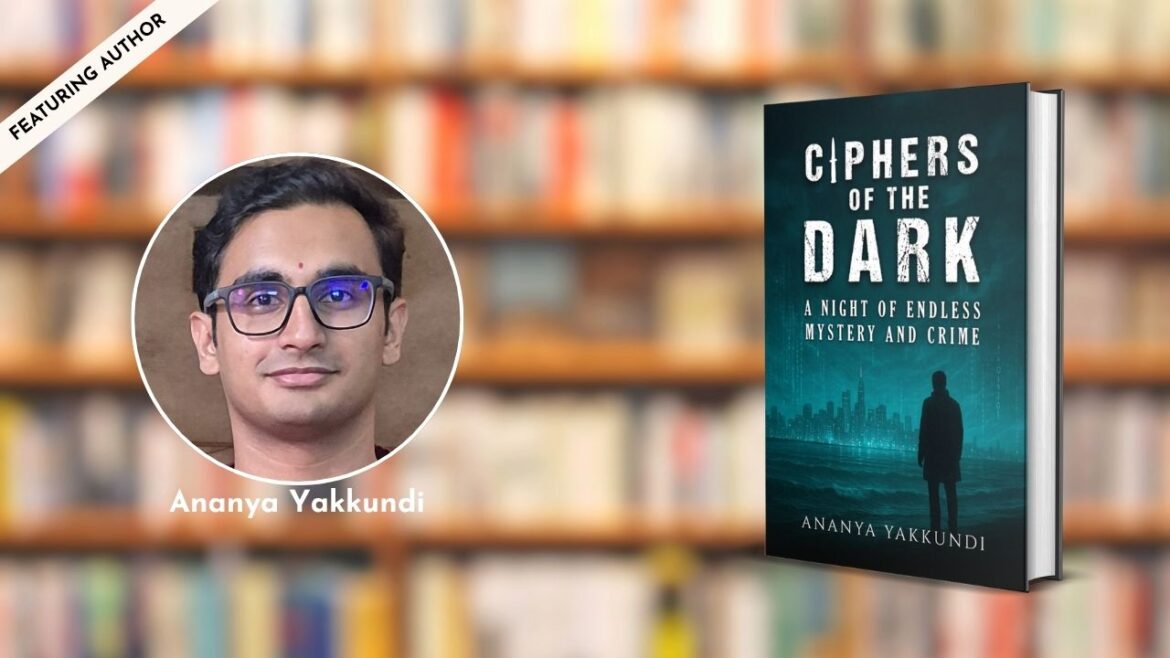
There is something undeniably compelling about a young writer who steps into the world of crime fiction with the confidence and clarity of a seasoned storyteller. At just twenty-three, Ananya Yakkundi has done precisely that. With his debut novel Ciphers of the Dark, he announces his arrival not quietly, but with the kind of narrative force that demands attention. What makes his journey remarkable is not only his youth, but the discipline, passion, and deep fascination with mystery and crime that pulse through every page he writes.
A software engineer by profession, Ananya comes from Hubballi—a city known for its grit, its pace, and its ability to shape sharp minds. Amidst lines of code, project deadlines, and a demanding work schedule, he somehow nurtured another world entirely, one woven with darkness, suspense, and complex human psychology. Many aspiring authors speak of writing someday; Ananya chose not to wait. He carved out time from his everyday routine, writing late into the night or in the rare quiet moments of early mornings, driven purely by a creative fire that refused to dim.
What emerged from that fire is Ciphers of the Dark—a gripping, fast-paced thriller that pulls readers straight into the chaos of a city on the brink and a detective fighting not just criminals, but time itself. At the heart of the story stands Detective Sahadev Sharma, a man caught in the emotionally fraught investigation of his ex-girlfriend’s brutal murder. The case is personal, painful, and loaded with emotional baggage. But before he can even process the weight of the crime, the city is hit with another murder. It is this chilling repetition—same method, same brutality—that signals the rise of a serial killer, one far more calculating and sinister than anyone anticipates.
Ananya writes Sahadev not as an invincible hero, but as a deeply human figure navigating a maze of suspicion, betrayal, and political rot. As the investigation widens, the detective finds himself entangled with corrupt officials, a dangerously influential godfather figure ruling the city’s underbelly, and a cryptic software threat capable of destabilizing national security. The blend of gritty street crime with high-tech intrigue showcases Ananya’s unique narrative style—one influenced by his technical background yet rooted in classic suspense traditions.
What sets Ciphers of the Dark apart is Ananya’s instinctive understanding of pace and tension. He knows when to hold back and when to tighten the noose. The novel drags its readers into a whirlwind of clues, dead ends, unexpected alliances, and ruthless enemies. At every turning point, Sahadev is forced to question not only the people around him but his own instincts. Few leads, fewer allies, and absolutely no one he can trust—Ananya ensures that the detective’s loneliness seeps into the reader’s mind, making the fight against the unseen mastermind all the more nerve-racking.
It becomes clear that this is not just a story about solving murders. It is a race against an opponent who always seems to be one step ahead. Ananya brings this psychological warfare to life with sharp detail and pulse-quickening intensity. Sahadev’s investigation becomes a desperate gamble, a test of will and endurance. Every decision carries the grime of danger and the possibility of catastrophic consequences. In portraying this, Ananya showcases the maturity of a writer who understands that crime thrillers are not merely about violence—they are about fear, intellect, and the psychology of survival.
For a debut novelist, Ananya demonstrates a remarkable ability to balance emotional depth with thriller-genre expectations. He builds characters who feel real and flawed. He paints a city teetering at the edge of darkness. And he crafts a plot that constantly surprises, never allowing the reader to settle comfortably. His storytelling is cinematic, his chapters addictive, and his understanding of suspense intuitive.
Yet, despite the thrill of the story and the sophistication of his craft, Ananya remains grounded. He lives with his parents, cherishes the support they provide, and maintains a strong sense of gratitude toward the environment that shaped him. Writing for him is not an escape from life but an extension of it—a way to explore questions, confront fears, and create worlds that challenge the boundaries of imagination.
Before venturing into novels, he wrote numerous short stories, honing his ability to deliver tight, compelling narratives with emotional precision. These early experiments in storytelling served as the foundation upon which Ciphers of the Dark was built. And now, with this first book, he takes a confident step into the broader world of fiction, carrying with him the ambition to create, to thrill, and to keep readers turning pages long into the night.
There is something exciting about watching a young author begin his journey at full stride. Ananya Yakkundi’s entry into the literary world is not merely promising—it is powerful. Ciphers of the Dark delivers suspense, emotion, intelligence, and high-voltage drama. If this debut is any indication of what lies ahead, readers can expect many more nights of gripping mystery and adrenaline-filled storytelling from this talented new voice in Indian crime fiction.