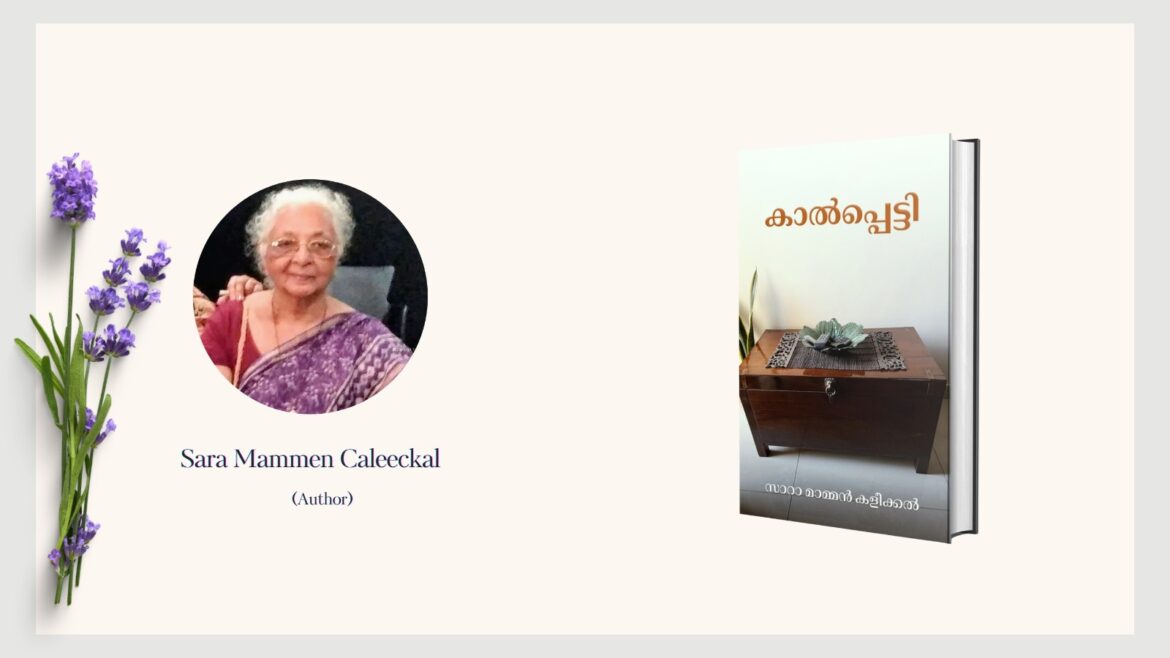
In a literary landscape shaped by memory, resilience, and rediscovery, Kaalpetty by Sara Mammen Caleeckal emerges as a deeply personal and evocative collection of poetry that spans both time and geography. Written during the reflective silence of the post-Covid period, this anthology brings together 29 Malayalam poems and 7 English compositions, each resonating with the voice of a poet who has lived, observed, and internalized the many shades of human experience across eight decades. KAALPPETTY is a Malayalam word which means Treasure Chest.
What makes Kaalpetty particularly compelling is not merely its bilingual nature, but the emotional and cultural journey it represents. After setting aside her engagement with Malayalam for over fifty years, Sara’s return to the language feels less like a revival and more like a homecoming. This rekindled relationship with her mother tongue carries a quiet intensity, as though each word has been waiting patiently to be spoken again. The poems in Malayalam possess an intimacy and rootedness that reflect both nostalgia and rediscovery, bridging the gap between past and present.
At the same time, the inclusion of English poems—following her earlier collection Endless Tracks published in 2021—adds another dimension to her voice. These poems, while stylistically distinct, echo similar themes of introspection, displacement, and emotional endurance. Together, the Malayalam and English works form a cohesive tapestry, revealing a poet who is equally at ease navigating multiple linguistic and cultural identities.
The thematic breadth of Kaalpetty is striking. Sara draws upon a lifetime of experiences, weaving together moments of agony and ecstasy, reflections on war and peace, and the quiet transitions that define different stages of life. There is a sense that each poem is anchored in lived reality—nothing feels imagined for the sake of art alone. Instead, the verses carry the weight of authenticity, shaped by encounters with both personal and collective histories.
Geography plays a vital role in shaping the imagery and emotional tone of the collection. The landscapes of the Indian subcontinent and East Africa appear not merely as backdrops but as living presences within the poems. These places, rendered through varying moods and colors, mirror the inner landscapes of the poet herself. From the lush, familiar terrains of Kerala to the expansive, sometimes stark vistas of East Africa, Sara captures the interplay between environment and emotion with remarkable sensitivity.
Another notable aspect of Kaalpetty is its temporal depth. The poems do not belong to a single moment in time; rather, they traverse decades, allowing readers to witness the evolution of thought, feeling, and perspective. This temporal layering gives the collection a reflective quality, as though the poet is in constant dialogue with her younger self, revisiting memories with the clarity and wisdom that only time can provide.
The post-Covid context in which these poems were written also lends the collection a subtle but significant undertone. While the pandemic is not always addressed directly, its presence is felt in the contemplative mood that permeates the work. Themes of isolation, vulnerability, and resilience surface in nuanced ways, suggesting that the global crisis served as a catalyst for introspection and creative expression. In this sense, Kaalpetty becomes not only a personal archive but also a quiet testament to a shared moment in human history.
Stylistically, Sara’s poetry is marked by simplicity and clarity, yet it carries a profound emotional resonance. She does not rely on elaborate metaphors or complex structures to convey her ideas. Instead, her strength lies in her ability to articulate deep truths with understated elegance. This accessibility makes the poems inviting, allowing readers from diverse backgrounds to connect with the emotions embedded within them.
At its core, Kaalpetty is a celebration of continuity—of language, memory, and the human spirit. It demonstrates that creativity does not diminish with time; rather, it evolves, gaining depth and richness through lived experience. Sara Mammen Caleeckal’s journey back to Malayalam, alongside her continued exploration of English poetry, reflects a refusal to be confined by age or convention. Her work stands as an inspiring reminder that it is never too late to return to one’s roots or to rediscover the passions that define us.
In bringing together voices from different phases of her life, Sara offers readers more than just a collection of poems; she presents a mosaic of existence itself. Each piece, whether rooted in joy or sorrow, contributes to a larger narrative of endurance, reflection, and renewal. Kaalpetty thus becomes not only a literary work but also an emotional chronicle, inviting readers to pause, reflect, and perhaps find echoes of their own journeys within its lines.