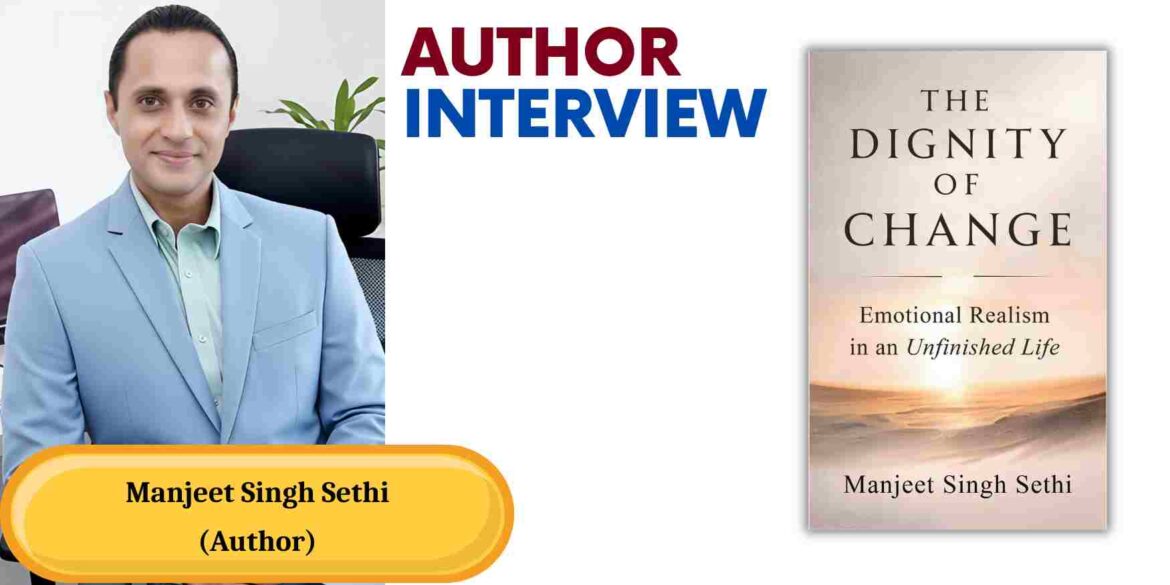
- Title: The Dignity of Change: Emotional Realism in an Unfinished Life
- Author: Manjeet Singh Sethi
- ISBN: 978-93-4726-354-5
- Publisher: Evincepub Publishing
About the author: Manjeet Singh Sethi is a Holistic Life Coach, Mental Health Counsellor, and mindfulness practitioner with over twenty-eight years of experience in leadership, corporate training, and human development. Through Welcoming Mindfulness, he integrates emotional awareness and grounded presence into both individual and organisational spaces. He is the author of “Breathe: Mastering Mindfulness for Modern Living,” a recipient of the Rabindranath Tagore Award, and it is archived in the National Library of India for its contribution to mindful living and contemporary thought. His writing combines clarity with emotional depth, offering reflection without prescription and guidance without pressure.
Q1: Can you tell us a little about yourself and your journey as an author?
Manjeet Singh Sethi : My journey as an author did not start with the goal of becoming a writer. It began with close observation of life. For many years, I held leadership roles in the retail and beauty industries, engaging with people from diverse backgrounds and managing the demands of high-performance environments. Along the way, I began to notice the emotional realities many people quietly face: pressure, uncertainty, self-doubt, and the longing to find meaning in their work and lives.
Writing became a way for me to reflect on these experiences. Over time, it also became a way to share them. My work today through “Welcoming Mindfulness” and my books grows from this journey, helping people understand that growth is not about perfection but about awareness and dignity in the process of change.
Q2: What inspired you to start writing?
Manjeet Singh Sethi : The motivation to write stemmed from listening. Over the years, I have met many individuals who are capable, responsible, and hardworking, yet internally they carry emotional fatigue and unanswered questions. I realised that many people seldom get the chance to pause and express what they truly feel. Writing allowed me to create that space. It became a quiet way of giving voice to experiences that many people go through but rarely articulate.
Q3: When did you first realize you wanted to become a writer?
Manjeet Singh Sethi : I wouldn’t say there was a specific moment when I decided to become a writer. It developed gradually. As I started pondering my own experiences and those of those around me, I realised that writing helped me understand life more clearly. Over time, sharing these reflections became significant because readers began to relate to them. That connection made me realise that writing could become an important part of my journey.
Q4: Which authors or books have influenced your writing the most?
Manjeet Singh Sethi : My writing has been shaped more by ideas and personal experiences than by any single author. I have always felt a strong pull towards books that honestly explore human emotions, personal development, and the intricacies of life. Works on mindfulness, psychology, and reflective literature have influenced my thinking.
What influences me most is writing that does not promise perfect solutions but fosters a deeper understanding of oneself.
Q5: How has your personal or professional background shaped your writing?
Manjeet Singh Sethi : My professional journey has given me a close insight into human behaviour in real-world settings—corporate environments, leadership positions, team interactions, and personal ambitions. These experiences have shown me that behind every professional role lies a human story.
This understanding profoundly shapes my writing. I aim to approach topics with realism and compassion, recognising that people are continually balancing responsibilities, expectations, and personal growth.
Q6: What inspired you to write this book?
Manjeet Singh Sethi : “The Dignity of Change” arose from observing how people experience change in their lives. Often, change is discussed as something dramatic or transformational. In reality, change is usually gradual, uncertain, and deeply emotional. I wanted to write about that quieter reality, where growth occurs through reflection, acceptance, and patience rather than sudden breakthroughs.
Q7: How did the idea for this book first come to you?
Manjeet Singh Sethi :The idea stems from a simple observation: life is perpetually incomplete. We are continually evolving, learning, and adapting. Yet many individuals feel compelled to seem certain and finished. This book stems from the idea that there is dignity in accepting life as a continual work in progress.
Manjeet Singh Sethi : I hope readers understand that change does not need to be rushed or forced. Growth can happen quietly as we become more aware of our thoughts, emotions, and choices. The book encourages readers to appreciate their own journey instead of constantly comparing themselves to others.
Q9: How long did it take you to write this book?
Manjeet Singh Sethi : The writing itself took several months, but the ideas driving the book evolved over many years through personal reflection and professional experience. In many ways, the book reflects a long process of observing life and understanding how people navigate change.
Q10: Was there a particular moment or experience that triggered the story or research behind the book?
Manjeet Singh Sethi : There wasn’t a single moment, but rather many small experiences. Conversations with people who felt uncertain about their path, individuals facing professional pressures, and moments of personal reflection all contributed to the ideas behind the book. These experiences gradually shaped the themes that run throughout the book.
Q11: What does your writing routine look like?
Manjeet Singh Sethi : My writing routine is quite straightforward. I favour quiet moments of reflection before I start writing. Sometimes I write early in the morning when my thoughts are clear and undisturbed. I also spend time observing and contemplating before putting ideas into words because, for me, writing is closely linked to reflection.
Q12: Do you plan your writing in detail, or do you let the story develop naturally?
Manjeet Singh Sethi : I usually start with a broad structure, but I allow the writing to evolve naturally. Many meaningful insights emerge during the writing process itself. This balance between structure and spontaneity helps keep the writing genuine.
Q13: What were the biggest challenges you faced while writing this book?
Manjeet Singh Sethi: One difficulty was sharing emotional experiences honestly without overcomplicating them. Writing about true feelings requires sensitivity and clarity. I aimed for the ideas to remain thoughtful yet accessible to readers from diverse backgrounds.
Q14: How do you overcome writer’s block?
Manjeet Singh Sethi : When writing becomes difficult, I take a break from the page for a while. Walking, reflecting, or simply observing everyday life often helps ideas come back naturally. Sometimes, clarity comes not from forcing words but from giving the mind space.
Q15: Which part of the book was the most enjoyable for you to write?
Manjeet Singh Sethi : The most enjoyable parts were those that explored how people grow through everyday moments rather than dramatic events. Writing about subtle change and personal reflection felt meaningful because it mirrors real life.
Q16: Is there a character or idea in the book that you personally relate to the most?
Manjeet Singh Sethi : I feel the strongest connection to the core idea of living an unfinished life with dignity. Like everyone else, I keep learning and growing through different stages of life. That sense of continuous development is something I deeply relate to.
Q17: Are the characters or scenarios inspired by real people or events?
Manjeet Singh Sethi : Many ideas in the book are inspired by real experiences and observations, although they are presented in a reflective and universal manner rather than describing specific individuals. This enables readers to recognise parts of their own journey within the narrative.
Q18: Which character or concept was the most difficult to develop?
Manjeet Singh Sethi : The most difficult concept to explain was emotional realism, the idea that life involves uncertainty, contradictions, and unresolved questions. Conveying this truthfully while maintaining hope required careful balance.
Q19: What kind of research did you do while writing this book?
Manjeet Singh Sethi : The research involved exploring fields such as psychology, mindfulness, and human behaviour. I also reflected on professional experiences, conversations, and personal observations gathered over the years. These sources contributed to shaping the ideas presented in the book.
Q20: Did you discover anything surprising during the research process?
Manjeet Singh Sethi : What surprised me most was how many people share similar emotional experiences regardless of their profession or stage of life. The struggles and hopes people carry are often more universal than we realise.
This understanding strengthened my belief that discussions about emotional awareness and change are important for everyone.
Please utilise the following quotes which will act as featured quotes or headline extracts.
Highlights
On the core idea of the book.
“Life is seldom complete or perfectly resolved. The Dignity of Change examines the idea that growth does not always come suddenly. Often, it appears quietly, through reflection, acceptance, and the courage to keep evolving while life remains unfinished”.
On emotional realism.
“Emotional realism involves recognising that uncertainty, doubt, and change are inherent to being human. Rather than resisting these feelings, we can face them with awareness and respect”.
On the purpose of the book.
“If readers finish the book with a bit more patience towards themselves and a greater respect for their own journey, then the book has fulfilled its purpose”.
Buy Manjit Singh’s Book on Amazon: Click here to check