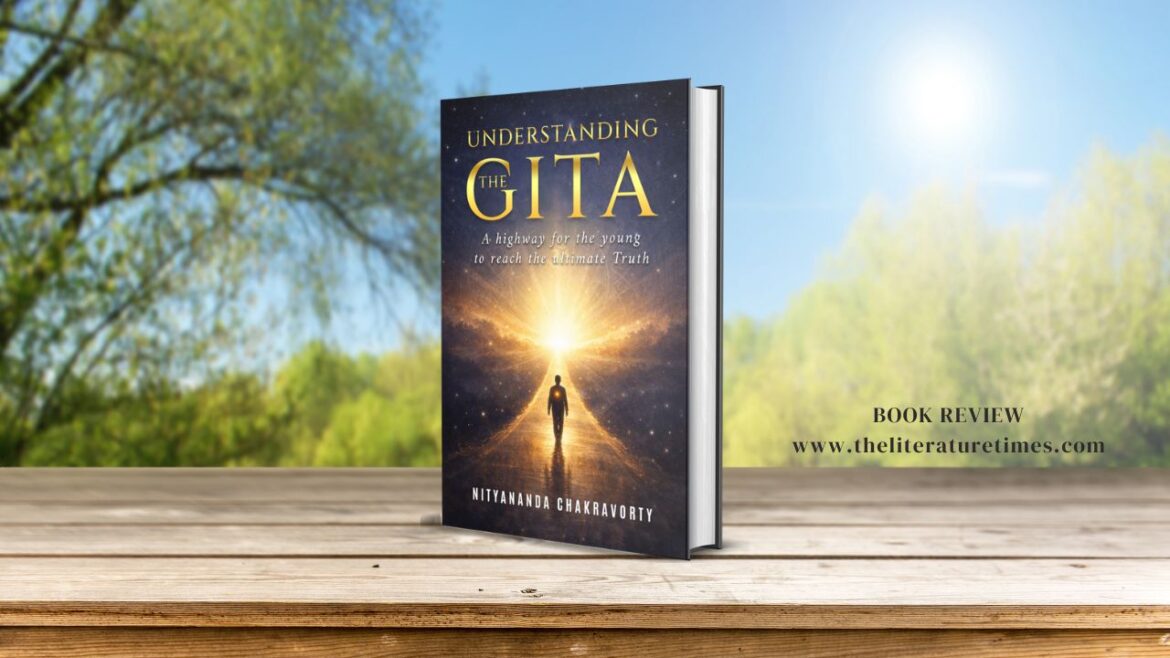
Understanding the Gita: A Highway for the Young to Reach the Ultimate Truth by Nityananda Chakravorty is not merely a book meant to be read; it is a book meant to be lived. From the very first pages, the author makes it clear that his purpose is not to overload the reader with philosophical information, but to guide them toward inner transformation. This distinction is crucial. Many spiritual books explain ideas, doctrines, and interpretations, but Chakravorty’s work goes a step further by focusing on application. It speaks directly to the inner landscape of the reader, inviting a shift from a life driven by ego and restlessness to one rooted in awareness, discipline, and transcendence.
One of the most compelling aspects of this book is its emphasis on transformation across three domains of human existence: cognitive, affective, and psychomotor. In simple terms, the author addresses how we think, how we feel, and how we act. He argues convincingly that true spiritual growth cannot be confined to intellectual understanding alone. Knowing the teachings of the Gita is not enough; they must be reflected in emotions and embodied through action. This holistic approach makes the book deeply practical. Readers are not treated as passive recipients of wisdom but as active participants in their own evolution.
The central theme of shifting from ego-“I” to egoless-“I” runs consistently throughout the narrative. Chakravorty presents ego not as an enemy to be violently destroyed, but as a veil that obscures one’s true divine nature. This metaphor of veiling and unveiling is powerful. The idea that every human being is already divine, yet temporarily clouded by ignorance and indolence, is both comforting and empowering. It places responsibility squarely on the individual while also offering hope. Liberation is not something to be imported from outside; it is something to be uncovered from within.
What distinguishes this book from many traditional commentaries on the Gita is its non-sectarian tone. The author repeatedly emphasizes that the Gita does not belong to any single creed, community, or belief system. Instead, it speaks to universal imperatives of spiritual life. Whether a reader identifies as a believer, skeptic, or seeker, the book remains relevant. This inclusive stance broadens the book’s appeal, especially for younger readers who may feel alienated by rigid religious frameworks but are still searching for meaning and direction.
The two-stage module for self-purification is one of the book’s most practical contributions. Rather than presenting lofty ideals without guidance, Chakravorty offers a structured pathway. Stage one focuses on foundational exercises that are simple, self-explanatory, and objective. These exercises encourage self-observation, discipline, and ethical alignment. Stage two builds upon this foundation with deeper actions aimed at strengthening inner resilience and preparing the seeker for advanced practices such as Dhyana, Yoga, renunciation, and meditation. The gradual, step-by-step nature of this model is especially helpful for beginners, who might otherwise feel overwhelmed by spiritual disciplines.
Another strength of the book lies in its language and tone. Despite dealing with profound philosophical concepts, the author avoids unnecessary complexity. His writing is clear, direct, and often conversational, making the text accessible without diluting its depth. The reader feels as though they are being guided by a compassionate mentor rather than lectured by a distant scholar. This quality aligns with the author’s description of the book as a “trusted friend” on the spiritual journey.
Chakravorty’s extensive background as an economist, academic, and researcher subtly informs the structure of the book. There is a sense of order, logic, and progression in the way ideas are presented. At the same time, his identity as a poet, lyricist, and devoted seeker adds emotional warmth and spiritual sensitivity to the text. This blend of intellectual rigor and devotional sincerity gives the book a distinctive voice.
The book also excels in addressing the realities of modern life. It does not ask readers to abandon their responsibilities or retreat from society. Instead, it encourages aligning existing behaviors with higher purpose. Whatever one’s profession, personality, or circumstance, the Gita’s principles can be applied. This practical adaptability makes the teachings relevant to contemporary challenges such as stress, identity confusion, and moral uncertainty.
One of the most impactful ideas in the book is the notion that every successful step forward, however small, is a step toward the Truth. This perspective counters the common tendency to measure spiritual progress in dramatic breakthroughs. Instead, Chakravorty validates consistent, patient effort. The journey is portrayed as incremental, but cumulative. Over time, as the seeker ascends from lower to higher states of nature, the “brighter light of the soul” gradually reveals itself. This imagery beautifully captures the organic nature of inner awakening.
For young readers in particular, Understanding the Gita serves as both a compass and a roadmap. It addresses the confusion and restlessness that often accompany youth, offering not rigid answers but reliable tools. The subtitle, A Highway for the Young to Reach the Ultimate Truth, feels apt because the book emphasizes direction, movement, and momentum rather than static belief.
In conclusion, Understanding the Gita is a thoughtful, compassionate, and practical guide to spiritual living. It bridges ancient wisdom and modern life with clarity and humility. Rather than positioning itself as an authoritative final word, the book functions as an invitation—an invitation to explore, practice, and transform. For anyone seeking a deeper understanding of themselves and their place in the universe, this book offers not just insight, but a living pathway toward inner freedom and lasting peace.