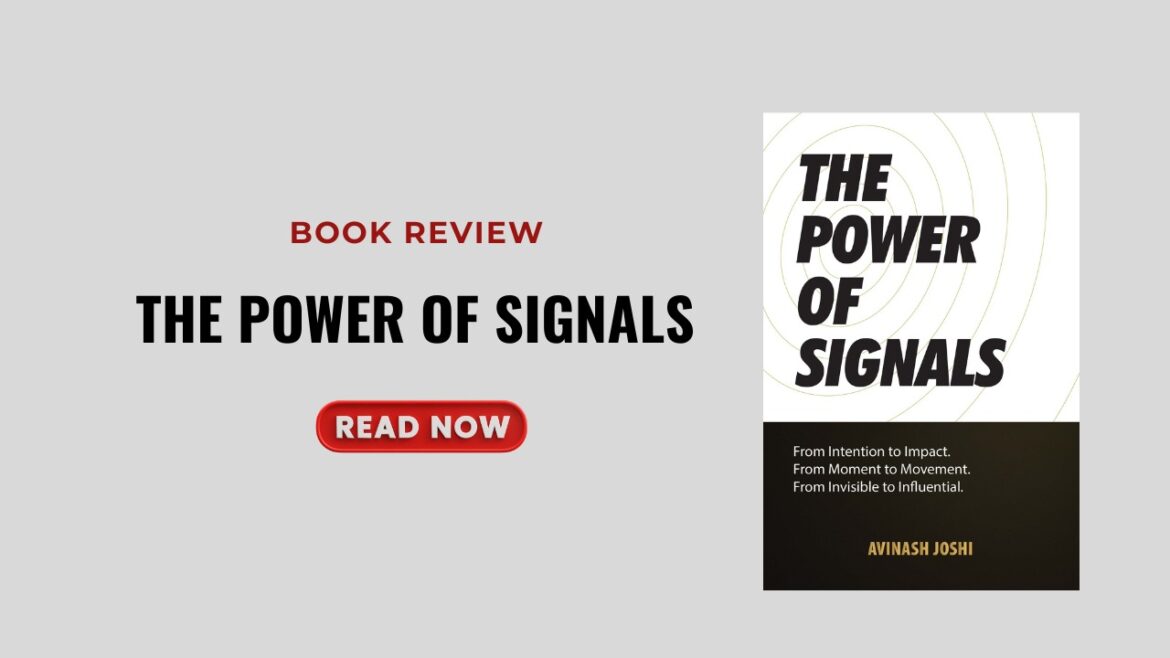
When I first picked up The Power of Signals, I expected a typical leadership or marketing book filled with frameworks and case studies. What I didn’t expect was how deeply reflective and practical it would feel. Avinash Joshi doesn’t just explain influence — he reframes it. By the end of the first few chapters, I found myself thinking less about famous leaders and more about my own everyday actions.
The core idea of the book is beautifully simple: influence does not begin with words; it begins with visible, repeatable actions — what Joshi calls “signals.” And when those signals are repeated consistently, they transform into symbols that shape culture, identity, and belief. It sounds straightforward, but the way he unpacks this idea is layered and powerful.
The early chapters, especially the explanation of the journey from Signal → Repetition → Symbol → Lasting Influence, are incredibly clear. The discussion around the golden arches of McDonald’s, the black turtleneck of Steve Jobs, and Gandhi’s charkha are not presented as random examples — they are dissected to show how repetition builds recognition, recognition builds expectation, and expectation builds trust. I appreciated how the author connects psychology — like the Mere Exposure Effect and identity crystallisation — with real-world influence.
What struck me most was how the book moves from icons to ordinary people. A parent attending every match, a colleague admitting mistakes publicly, a teacher showing up early to tutor — these examples made the concept personal. Influence is not reserved for global leaders; it is available to anyone willing to repeat meaningful actions with commitment.
Chapter 3, on diagnosing context, felt especially important. Joshi makes it clear that the wrong signal in the wrong context becomes noise. The comparison between Gandhi’s simplicity and Steve Jobs’ drama is one of the book’s strongest sections. It shows that brilliance isn’t universal — it’s contextual. That insight alone is worth the read.
The writing style is conversational but intentional. The author speaks directly to the reader, often asking reflective questions that made me pause. It doesn’t feel like a lecture; it feels like a guided exploration.
If there’s one strength that stands out, it’s practicality. The 90-day influence plan promised later in the book suggests this isn’t just theory — it’s meant to be applied. And that’s what makes The Power of Signals memorable. It doesn’t shout; it demonstrates. Just like the very concept it teaches.
This book isn’t about becoming famous. It’s about becoming intentional. And in today’s noisy world, that may be the most powerful message of all.
Title: The Power of Signals
Author: Avinash Joshi
Publisher: Evincepub Publishing