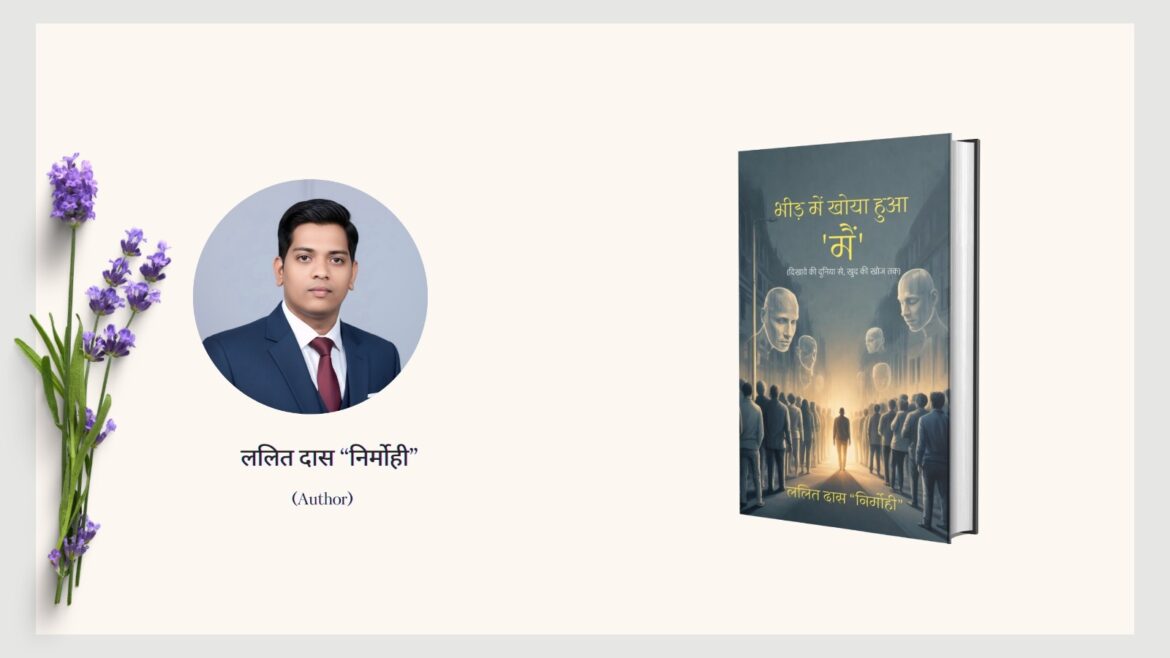
“Bheed Mein Khoya Hua ‘Main’” (The Self Lost in the Crowd) is not merely a collection of poems; it is an intimate and courageous journey back to one’s own existence. In this compelling work, Lalit Das “Nirmohi” explores the emotional and psychological landscape of the modern individual who, in the pursuit of social validation and digital visibility, gradually loses touch with his authentic self. The book stands as a mirror to contemporary life, urging readers to pause, reflect, and reconnect with their inner voice.
We live in an era defined by appearances. Social media timelines are carefully curated, achievements are publicly displayed, and comparisons have become second nature. In trying to look better in the eyes of others, we often abandon the quiet truths within us. “Bheed Mein Khoya Hua ‘Main’” addresses this silent crisis of identity. Through forty poems written over twelve transformative years, from 2014 to 2026, Nirmohi weaves together personal experiences, emotional struggles, realizations, and spiritual insights. The result is a collection that feels deeply personal yet universally relatable.
The book unfolds in four distinct phases, each representing a stage in the human journey toward self-awareness. The first phase, “The Mask,” examines the outer struggles of life. Here, the poet reflects on the many facades we wear—strength, success, contentment—often to meet societal expectations. Over time, these masks become so convincing that we begin to forget who we truly are beneath them. Through vivid yet simple imagery, Nirmohi captures the exhaustion of constantly performing for the world. His words gently question whether external approval is worth the cost of inner peace.
The second phase, “The Inner Journey,” marks a turning point. Moving away from the noise of the external world, the poet turns inward. Silence becomes a powerful companion rather than a void to be feared. In this section, self-realization emerges through introspection. Nirmohi suggests that true transformation begins when we dare to ask ourselves difficult questions: Who am I beyond my roles and responsibilities? What do I genuinely seek? The poems in this phase are contemplative and meditative, encouraging readers to embrace solitude as a path to clarity. The tone is not preachy but reflective, offering wisdom born from lived experience.
The third phase, “Nirmohi Philosophy,” introduces the central spiritual perspective of the collection. To be “Nirmohi” is not to withdraw from life but to live without unhealthy attachment. The poet emphasizes detachment not as indifference, but as balance. Much of human suffering, he suggests, arises from excessive expectations and emotional dependency. By learning to live with awareness and neutrality, one can experience freedom even amid chaos. This philosophy resonates deeply in a world driven by constant desire and competition. Through gentle metaphors and grounded reflections, Nirmohi presents detachment as a practical and attainable way of living.
The final phase, “The Dawn of Hope,” brings warmth and renewal. After confronting masks and exploring inner silence, the poet returns to the roots—family, memories, simplicity, and gratitude. Poems like “Baba Ki Wo Kameez” (Father’s Shirt) highlight the beauty of ordinary relationships and the emotional richness found in small, often overlooked details. In remembering his roots, the poet rediscovers strength and purpose. Hope does not arrive dramatically; it unfolds softly, like morning light after a long night. This section assures readers that self-discovery is not about abandoning the world but about returning to it with clarity and authenticity.
Lalit Das “Nirmohi” writes in a language that is simple yet profound. His poetry does not rely on ornate vocabulary or complex structures. Instead, its power lies in honesty. He shares his vulnerabilities without hesitation, allowing readers to see their own reflections in his words. The emotional depth of the collection makes it accessible to a wide audience—young professionals navigating identity crises, individuals seeking spiritual grounding, and anyone feeling overwhelmed by modern expectations.
What makes “Bheed Mein Khoya Hua ‘Main’” particularly significant is its relevance to our time. It acknowledges the pressures of the digital age without condemning them outright. Instead, it invites balance. It reminds us that while being part of the crowd is inevitable, losing oneself within it is not. The book becomes a bridge between the world of appearances and the realm of authenticity.
Ultimately, this collection is about rediscovery. It speaks to those who feel disconnected despite being constantly connected. It reassures readers that feeling lost is not a failure but the beginning of a search. Lalit Das “Nirmohi” offers not just poetry, but companionship on the journey inward. “Bheed Mein Khoya Hua ‘Main’” is a reflective, heartfelt work that gently guides readers back to their true selves—proving that in the midst of noise and distraction, the quiet voice within still waits to be heard.