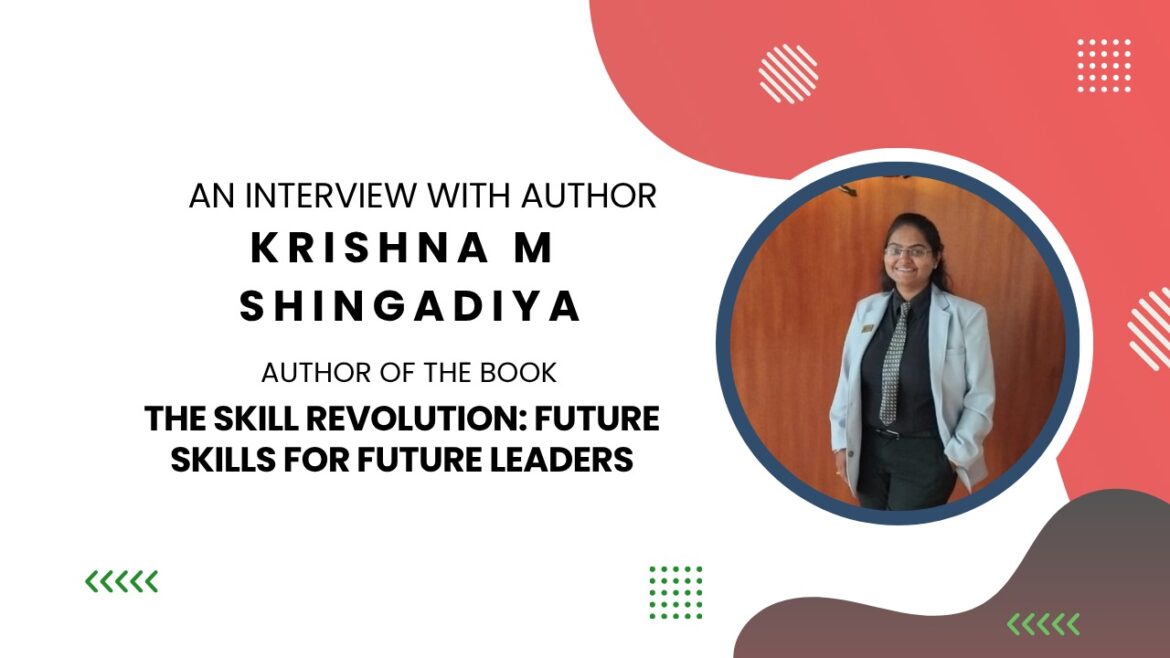
Title: The Skill Revolution: Future Skills for Future Leaders
Author: Krishna M Shingadiya
Publisher: Evincepub Publishing
Amazon: https://www.amazon.in/Skill-Revolution-Future-Skills-Leaders/dp/9373354191
About the Author
Krishna M. Shingadiya is an accomplished Marketing Strategist, Strategic Business Consultant, Author, and Corporate Trainer dedicated to transforming entrepreneurs, startups, and MSMEs into sustainable, growth-driven organizations.
With extensive consulting experience across diverse industries, she has worked with business owners to improve marketing strategies, sales systems, business processes, digital transformation, leadership development, and organizational growth. Her expertise combines practical business consulting with modern digital marketing, enabling businesses to scale in today’s competitive marketplace.
Krishna is also an experienced Digital Marketing and Soft Skills Trainer, having conducted virtual and offline training programs for entrepreneurs, business owners, professionals, and aspiring marketers. Her training philosophy focuses on practical implementation, strategic thinking, and measurable business results rather than theory alone.
As the founder of Krishna Digital Marketing Academy, she is committed to making business education accessible through online learning, social media, workshops, and digital content. Her mission is to equip entrepreneurs with the knowledge, skills, and strategic mindset required to build successful and future-ready businesses.
Krishna is the author of three business-focused books designed to empower the next generation of entrepreneurs and business leaders:
MBA to CEO explores the journey from academic knowledge to executive leadership, providing practical insights on leadership, business strategy, decision-making, and organizational success.
The Skill Revolution highlights the essential future skills required in the age of Artificial Intelligence, digital transformation, automation, and continuous innovation, helping professionals remain competitive in an evolving global economy.
The Startup Blueprint serves as a practical roadmap for entrepreneurs, covering every stage of building a successful startup—from idea validation and business planning to marketing, scaling, fundraising, and long-term growth.
Through her writing, consulting, and training, Krishna aims to bridge the gap between business theory and real-world execution. Her work inspires entrepreneurs to build resilient businesses, embrace innovation, and create lasting impact in their industries.
Professional Expertise
- Strategic Business Consulting for MSMEs & Startups
- Marketing Strategy & Business Growth
- Digital Marketing & Personal Branding
- Sales System Development & Customer Acquisition
- Startup Mentoring & Business Scaling
- Leadership Development & Soft Skills Training
- Business Process Improvement & Organizational Growth
- Corporate Workshops & Executive Coaching
Mission
“To empower entrepreneurs, startups, and MSMEs with practical strategies, future-ready skills, and transformational business knowledge that creates sustainable growth and lasting success.”
Zinnia Laha: Your book boldly states that “skills are the new currency.” What convinced you that we have entered an era where practical skills matter more than academic qualifications alone?
Author : For decades, a degree was considered the primary passport to professional success. Today, that reality has fundamentally changed. We are living in an economy where knowledge is no longer scarce—it’s instantly accessible. What has become scarce is the ability to apply that knowledge to solve meaningful problems.
Throughout my journey as an entrepreneur, consultant, trainer, and mentor, I have interacted with thousands of students and professionals. One pattern became impossible to ignore: many highly qualified individuals struggled to create impact, while others with average academic backgrounds built remarkable careers because they possessed practical skills that businesses genuinely needed.
This shift has been accelerated by technology. Organizations are no longer hiring only for qualifications; they are hiring for adaptability, creativity, digital competence, communication, and problem-solving. Employers ask a different question today: “What value can you create?” rather than “What degree do you hold?”
That is why I describe skills as the new currency. Just as financial currency derives its value from its purchasing power, professional skills derive their value from their ability to create outcomes. Degrees may open the first door, but skills determine how far that door leads.
In the coming decade, the professionals who continuously learn, adapt, and build relevant capabilities will always remain valuable, regardless of how industries evolve.
Zinnia Laha: You discuss AI as a powerful partner rather than a threat. What do you think is the biggest mistake people make while trying to understand Artificial Intelligence?
Author : The biggest misconception is that people view Artificial Intelligence through the lens of replacement instead of collaboration.
History shows that every major technological revolution has changed the nature of work rather than eliminating the need for human contribution. AI is no different. It is exceptionally powerful at processing information, recognizing patterns, generating ideas, and automating repetitive tasks. However, it lacks human judgment, empathy, ethical reasoning, creativity born from lived experience, and the ability to inspire trust.
The real danger is not AI replacing people. The greater risk is people refusing to learn how to work alongside AI.
I encourage readers to think of AI as an intelligent assistant rather than an intelligent master. It should amplify human capability, not replace independent thinking. Professionals who rely blindly on AI risk becoming intellectually dependent. Those who combine AI with critical thinking, emotional intelligence, and strategic decision-making will become exponentially more productive.
Ultimately, AI will not determine our future. Our willingness to learn, adapt, and use it responsibly will.
Zinnia Laha: One of the strongest messages in your book is continuous learning. How can professionals who already have demanding jobs build a habit of learning without feeling overwhelmed?
Author : One of the biggest myths about learning is that it requires large amounts of free time. In reality, continuous learning is less about time and more about intention.
I encourage professionals to adopt what I call the “micro-learning mindset.” Instead of waiting for the perfect opportunity to enroll in lengthy programs, dedicate thirty to sixty minutes every day to purposeful learning. Read a chapter, watch a high-quality lecture, explore a new AI tool, listen to an insightful podcast during your commute, or apply one new concept directly to your work.
Learning should become part of your lifestyle rather than an occasional event.
Equally important is application. Knowledge that remains inside notebooks has little value. Every new idea should be tested, implemented, discussed, or taught. The fastest way to retain knowledge is to convert it into action.
In today’s world, careers are no longer built by what we learned in college; they are built by what we continue learning after college.
Zinnia Laha: You introduce concepts like Skill Stack, Personal Branding, Digital Literacy, and AI Productivity. If someone could master only three skills over the next two years, which would you recommend and why?
Author : If I had to recommend only three capabilities, I would choose those that remain valuable regardless of industry, technology, or economic change.
The first is communication. Every great idea succeeds only when it can be communicated effectively. Whether you’re leading a team, pitching a client, creating content, or building a business, communication is the bridge between knowledge and influence.
The second is AI-enabled productivity. The future belongs to professionals who know how to collaborate intelligently with technology. AI should become an extension of your thinking, helping you research faster, automate repetitive work, generate ideas, and make better decisions.
The third is personal branding. In the digital economy, your reputation often reaches people before you do. A strong personal brand creates trust, attracts opportunities, and positions you as someone whose expertise is recognized even beyond your immediate workplace.
When communication, AI capability, and personal branding work together, they create a professional who is not only employable but highly visible, adaptable, and future-ready.
Zinnia Laha: Many people fear that automation will replace jobs. In your opinion, which human qualities will become even more valuable as machines become more intelligent?
Author : As machines become increasingly capable of performing predictable tasks, uniquely human qualities become exponentially more valuable.
Empathy will matter because people trust people.
Creativity will matter because innovation begins where existing data ends.
Critical thinking will matter because AI can generate answers, but humans must determine whether those answers are appropriate, ethical, and strategically sound.
Adaptability will become essential because technology evolves faster than traditional career paths.
Above all, integrity will become a defining advantage. In an era where information can be generated instantly, trust becomes one of the rarest and most valuable assets.
The professionals who thrive will not compete against machines. They will focus on developing the qualities that machines cannot authentically replicate.
Zinnia Laha: Throughout the book, you encourage readers to become value creators rather than job seekers. What practical shift in mindset helps someone move from chasing opportunities to creating them?
Author : The transformation begins when we stop asking, “Where can I find a job?” and start asking, “What problem am I capable of solving?”
This may sound like a small shift in language, but it completely changes the way we think about careers. Job seekers focus on vacancies. Value creators focus on needs. The marketplace has always rewarded those who solve problems, improve systems, save time, reduce costs, increase revenue, or make people’s lives easier.
Creating opportunities requires curiosity. It means observing industries, listening carefully to customer pain points, and identifying gaps that others overlook. It also requires initiative. Instead of waiting for permission, value creators begin building projects, freelancing, consulting, creating content, or developing solutions that demonstrate their capabilities.
I often remind readers that opportunities are rarely discovered by chance—they are usually created through consistent action. Every successful entrepreneur, leader, or innovator began by solving a problem that others had accepted as normal.
When your focus shifts from finding work to creating value, opportunities begin to find you.
Zinnia Laha: You explain that future leaders must combine technology with emotional intelligence. How can professionals ensure they remain deeply human while becoming increasingly dependent on digital tools?
Author : Technology should enhance our humanity, not diminish it. The challenge is not that we are using digital tools; the challenge is forgetting that leadership is ultimately about people.
As AI becomes integrated into daily work, professionals must consciously invest in the qualities that technology cannot replace—listening with empathy, building trust, understanding emotions, resolving conflicts, mentoring others, and communicating with authenticity. These are not “soft” skills; they are strategic leadership capabilities.
I also encourage leaders to spend time away from screens. Real conversations, face-to-face collaboration, observing customers, and engaging with diverse perspectives help us develop emotional intelligence in ways that no digital platform can replicate.
The future belongs to leaders who can use technology to improve efficiency while using emotional intelligence to inspire commitment. AI can process information, but only people can build cultures, create belonging, and earn loyalty.
The most successful professionals will be those who become technologically advanced without becoming emotionally disconnected.
Zinnia Laha: Several chapters focus on freelancing, consulting, content creation, and multiple income streams. Do you believe every professional should think like an entrepreneur, even if they never start a business?
Author : Absolutely. Entrepreneurial thinking is not defined by owning a company; it is defined by taking ownership of your value.
Every professional, regardless of their role, benefits from thinking like an entrepreneur. That means understanding customers, identifying opportunities, managing resources wisely, continuously improving skills, and taking responsibility for outcomes rather than simply completing assigned tasks.
Even within a large organization, the people who progress the fastest are those who treat their department as if it were their own business. They look for efficiencies, innovate, collaborate across teams, and constantly ask, “How can I create greater value?”
Freelancing, consulting, and content creation are not merely additional income sources—they are practical classrooms that teach communication, negotiation, sales, branding, pricing, and resilience. These experiences strengthen professional judgment, whether someone eventually becomes a founder or remains in corporate leadership.
In my view, entrepreneurship is first a mindset. A business may or may not follow, but the mindset will transform the way you approach every opportunity.
Zinnia Laha: If you were mentoring a 21-year-old graduate entering the workforce today, what would your 90-day roadmap look like to prepare them for the future of work?
Author : The first ninety days should not be spent trying to impress people; they should be spent building habits that compound over a lifetime.
I would encourage them to divide the journey into three phases.
The first thirty days are about observation and learning. Understand the organization, the industry, customer expectations, and how successful professionals think. Build the discipline of reading, note-taking, and asking thoughtful questions.
The next thirty days focus on skill development and execution. Strengthen communication, master essential digital tools, begin using AI responsibly, improve productivity, and volunteer for projects that stretch your capabilities. Start documenting your learning and building your personal brand.
The final thirty days are about value creation. Take ownership of a meaningful challenge, contribute ideas, seek feedback, build relationships across departments, and demonstrate initiative without waiting for instructions. Begin exploring freelancing, content creation, or consulting projects to gain market exposure beyond your primary role.
By the end of ninety days, success should not be measured only by a salary or designation. It should be measured by a stronger mindset, better habits, greater confidence, and a clear commitment to lifelong learning.
Zinnia Laha: Looking ahead five to ten years, what do you believe will separate extraordinary professionals from average performers—and what inspired you to write this book to prepare readers for that future?
Author: The gap between extraordinary professionals and average performers will not be defined by intelligence—it will be defined by adaptability.
The professionals who thrive will be those who embrace continuous learning, combine technology with human insight, communicate effectively, build trusted personal brands, solve complex problems, and create value beyond the boundaries of their job descriptions. They will not fear change; they will prepare for it before it arrives.
Average performers often wait for the future to happen to them. Extraordinary professionals actively shape their future by investing in themselves every single day.
The inspiration behind writing this book came from a simple but powerful realization. I met countless talented individuals who had potential but lacked direction. Many were working hard, yet they were preparing for yesterday’s opportunities instead of tomorrow’s realities.
This book is my attempt to bridge that gap. It is not merely a guide to career growth; it is a roadmap for becoming future-ready. My goal is to help readers develop the mindset, skills, and confidence required to lead in an era where change is the only constant.
Ultimately, I believe success in the future will belong not to those who know the most, but to those who learn the fastest, adapt the quickest, and create the greatest value for others.