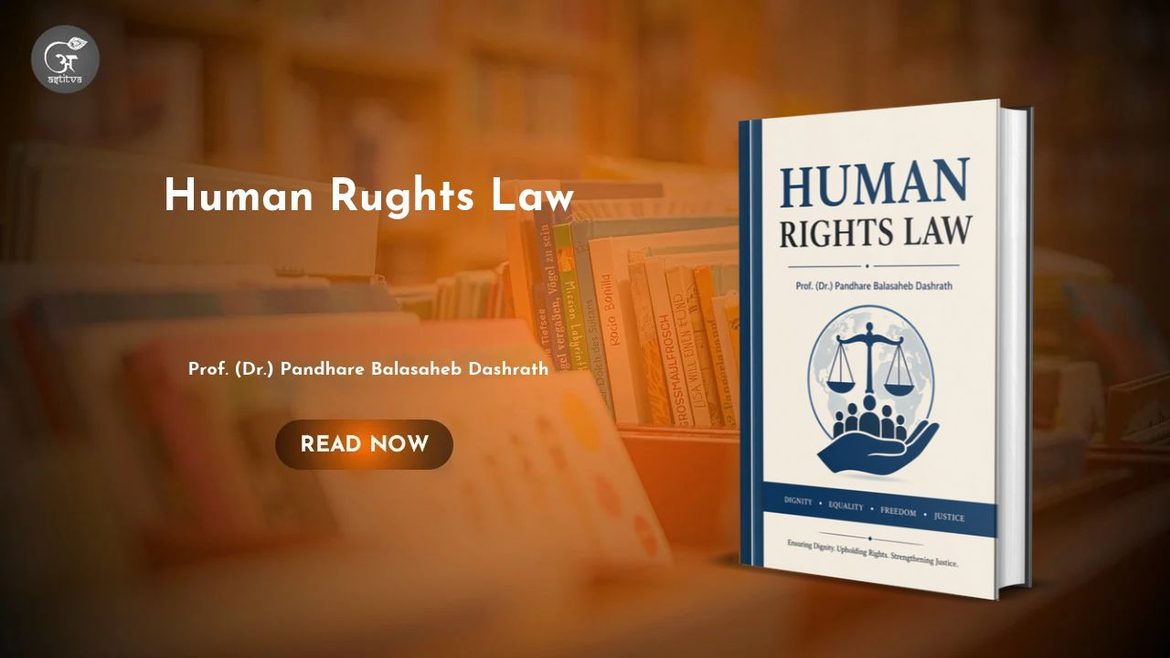
A comprehensive academic work explores the evolution of human rights, international legal frameworks and constitutional protection in India.
Human rights are the foundation of a just, equal and democratic society. Addressing their historical evolution, legal foundations and contemporary challenges, Prof. (Dr.) Pandhare Balasaheb Dashrath has authored a comprehensive academic book titled Human Rights Law, published in 2026.
The book offers an extensive examination of human rights as both a legal principle and a moral commitment to protecting human dignity, liberty, equality and justice. It explores how the understanding of human rights has evolved through centuries of philosophical thought, political struggles, constitutional developments and international cooperation.
Written particularly with postgraduate law students in mind, the book has been structured in accordance with the revised LL.M. curriculum of Savitribai Phule Pune University under the specialization of Constitutional and Administrative Law for the academic year 2025–26. It aims to provide students with a consolidated resource for understanding the subject and preparing for university examinations.
The book is divided into seven chapters, covering a broad range of important topics. Beginning with the historical emergence of human rights and traditional concepts of justice, it explains the conceptual foundations of rights, including their universal, inalienable and indivisible nature. It further examines the different generations of human rights, covering civil and political rights, economic and social rights, collective rights, peoples’ rights and minority rights.
A significant section of the book focuses on the internationalisation and universalisation of human rights. It discusses major international instruments, including the Universal Declaration of Human Rights (1948), the International Covenants on Civil and Political Rights and Economic, Social and Cultural Rights (1966), and important conventions concerning genocide, racial discrimination, women’s rights, torture, children’s rights and refugees.
The book also addresses emerging issues in human rights jurisprudence, including cultural relativism, democracy, international accountability and the relationship between globalization, trade, labour and human rights. These discussions highlight the evolving nature of human rights in response to changing social, political and economic realities.
Another important aspect of the work is its examination of human rights within the Indian legal system. It discusses constitutional safeguards, judicial protection, access to justice, criminal jurisprudence and the rights of women, children, Dalits, tribal and indigenous communities, and minorities. References to significant Supreme Court judgments, including Maneka Gandhi v. Union of India, Vishaka v. State of Rajasthan and Justice K.S. Puttaswamy v. Union of India, further connect theoretical concepts with Indian judicial developments.