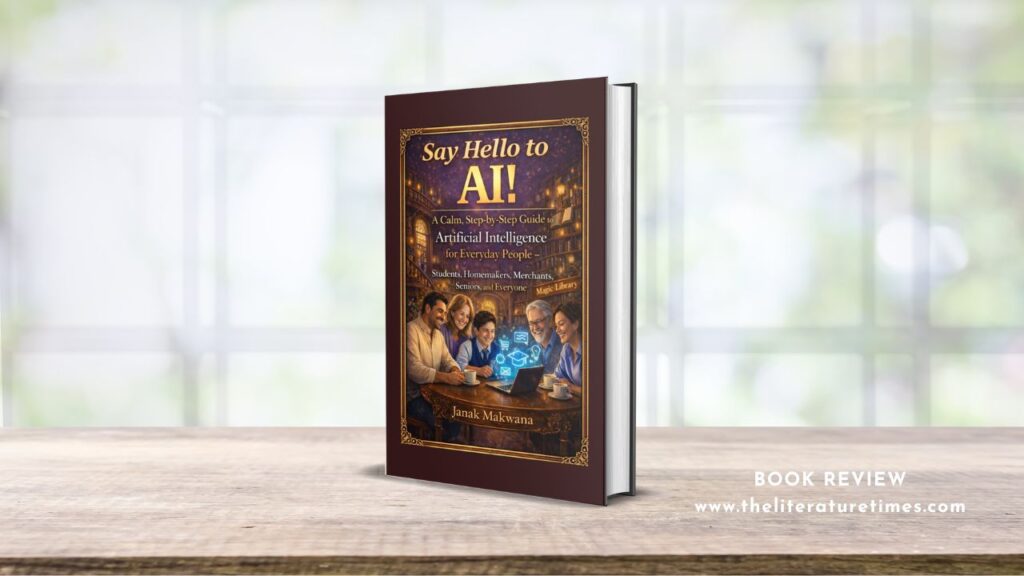
Say Hello to AI!: A Calm, Step-by-Step Guide to Artificial Intelligence for Everyday People – Students, Homemakers, Merchants, Seniors, and Everyone by Janak Makwana arrives at a time when Artificial Intelligence is rapidly becoming part of everyday life. From smartphones and online shopping recommendations to virtual assistants and automated services, AI is already quietly shaping how people live and work. Yet for many individuals, the concept of AI still feels distant, complicated, or even intimidating. This book attempts to bridge that gap by presenting AI in a calm, accessible, and human-friendly way.
Rather than approaching the subject through complex technical explanations or futuristic speculation, the book focuses on clarity and understanding. The author recognizes that many people are curious about AI but feel excluded from conversations about technology because of unfamiliar terminology or overly technical discussions. Say Hello to AI! addresses this challenge by creating a welcoming entry point for readers who simply want to understand what AI is, how it affects their lives, and how they can interact with it responsibly.
One of the most notable strengths of the book is its tone. Instead of presenting AI as a revolutionary force that must be mastered immediately, the author introduces it as a tool that can gradually be understood and integrated into daily life. The writing style is calm, patient, and respectful toward readers who may be encountering the topic for the first time. This approach helps remove the fear often associated with technology and replaces it with curiosity and confidence.
The book emphasizes that Artificial Intelligence should serve people rather than overwhelm them. This philosophy runs throughout the narrative and shapes how the subject is explained. Readers are not pressured to become technical experts; instead, they are encouraged to become informed users who understand the possibilities and limitations of AI. By focusing on real-life contexts such as learning, working, managing daily tasks, and creative thinking, the book demonstrates that AI is not just for engineers or tech professionals but for everyone.
Another compelling aspect of the book is its inclusiveness. The author deliberately writes for a wide range of readers including students, homemakers, merchants, professionals, and senior citizens. In many discussions about AI, these groups are often overlooked, as the focus tends to remain on technology specialists or industry leaders. By addressing everyday individuals directly, the book highlights an important idea: understanding technology is becoming a basic life skill in the modern world.
The author’s professional background in software engineering, large-scale platforms, security, and emerging technologies lends credibility to the book’s insights. Having worked closely with complex systems and technological innovation, the author brings practical experience to the discussion. However, what makes the book particularly engaging is the author’s emphasis on the human side of technology. The narrative consistently reflects the belief that innovation should enhance human life rather than create confusion or anxiety.
The book also explores the broader social and ethical dimensions of AI. Instead of portraying artificial intelligence purely as a powerful technological advancement, the author invites readers to think about how it should be used responsibly. Questions about ethics, decision-making, and human values are subtly woven into the discussion, reminding readers that technology is shaped by the intentions and choices of the people who design and use it.
Another strength of the book is its ability to simplify a complex subject without oversimplifying it. The explanations are straightforward and easy to follow, yet they still convey the depth and significance of AI’s impact on society. This balance makes the book particularly valuable for readers who want a foundational understanding without feeling overwhelmed by technical jargon or theoretical frameworks.
The structure of the narrative also contributes to its readability. Ideas are introduced gradually, allowing readers to build confidence as they progress through the book. The step-by-step approach mirrors the author’s philosophy of patient learning. Instead of rushing toward conclusions or predictions about the future, the book encourages readers to take time to understand the present moment of technological change.
In a world where discussions about AI are often dominated by excitement, fear, or exaggerated claims, Say Hello to AI! offers something refreshingly different: perspective. The author acknowledges both the potential benefits and the challenges associated with artificial intelligence, presenting a balanced view that encourages thoughtful engagement rather than blind enthusiasm or skepticism. This balanced perspective makes the book particularly relevant for readers seeking a grounded understanding of AI’s role in modern life.
Ultimately, the book succeeds in achieving its core purpose: helping readers feel more comfortable with a technology that is becoming increasingly important. By the end of the reading experience, the subject of Artificial Intelligence no longer appears distant or mysterious. Instead, it becomes something approachable, understandable, and manageable.
Say Hello to AI! is not a technical manual, nor does it attempt to transform readers into AI specialists. Its value lies in something more meaningful—it empowers people to participate in the evolving technological world with confidence and awareness. For anyone who has felt curious about AI but unsure where to begin, this book provides a thoughtful and reassuring starting point.
Through its calm voice, inclusive perspective, and human-centered philosophy, the book reminds readers that the future of technology is not just about machines and algorithms—it is ultimately about people, understanding, and the choices we make as we move forward in an increasingly digital world.
This book is more than a story; it is a journey that invites readers to look inward, confront their own struggles, and find strength in vulnerability. It reminds us that life’s challenges, though daunting, are stepping stones to discovering our true selves.
Soul Without Borders is a remarkable debut that will leave a lasting impression on readers. It is a book for anyone seeking purpose, hope, and inspiration in a world that often feels fragmented. Jaya Singh has set a high bar with her debut, and it will be exciting to see how her journey as an author unfolds in the future.







Your perspective matters
Share your thoughts respectfully. Comments are moderated.