
An original work of romantic fiction. All characters and events are fictional.
The first thing Meera noticed was the umbrella.
It stood dripping beside the empty chair across from her, black and slightly crooked, the handle wrapped in blue thread. She had seen that umbrella before. Not this particular one, perhaps, but the way its owner repaired things instead of replacing them.
Then she heard the voice.
“You still order tea when everyone else has coffee.”
She looked up from the manuscript on her table. Arjun stood beside the chair, rain darkening the shoulders of his shirt, carrying the unmistakable expression of someone who had prepared a dozen greetings and forgotten them all.
Meera had not seen him in eleven years.
“You still make observations before saying hello,” she replied.
He smiled, and something in the busy café seemed to become very quiet.
Two Cups of Tea
Outside, Bengaluru’s evening traffic moved through sheets of rain. The café had changed names twice since they were students. The bookshelves were new, the cushions were different, and the owner had replaced the old brass bell above the door with a motion sensor. But the window seat remained. It had always been theirs, back when “theirs” had seemed like a word the future would never argue with.
“May I?” Arjun asked, indicating the chair.
She considered saying she was waiting for someone. It would have been an easy lie. Instead she moved her bag.
“For a little while.”
He folded his damp jacket over the back of the chair. The waiter arrived, and Arjun asked for ginger tea without consulting the menu.
“You haven’t changed,” Meera said.
“That seems unlikely.”
“Your order hasn’t.”
“Some things are worth keeping.”
She looked down at the pages spread before her. He followed her gaze.
“Still writing?”
“More than ever. Sometimes professionally. Sometimes to avoid doing other things.”
“You always said the second reason was more honest.”
Eleven years had filled her life with work, deadlines, a different city, a failed engagement that had ended without a dramatic scene, and a new apartment with too many plants. Yet he remembered how she talked about writing.
“What about you?” she asked. “Are you still building things?”
“A school in Mysuru. A few public libraries before that.”
“You wanted to build a bridge.”
“I did. It was smaller than I imagined, and much more difficult.”
She laughed before she could stop herself. It startled them both.
What They Never Said
When they had last stood together, Meera had been twenty-five, holding an offer letter for a publishing job in Delhi. Arjun had been leaving for a two-year engineering assignment. Their argument had begun with train tickets and ended with silence.
In her memory, he had said she was choosing a career over them.
In his memory, she had said he expected her to follow wherever he went.
They had both told the truth badly.
“I read your book,” Arjun said at last.
She blinked. “Which one?”
“The one about the old woman who keeps a map of places she’s never visited.”
“That was three years ago.”
“I know.”
“You could have told me.”
“I wasn’t sure I had the right.”
Meera traced the edge of her cup. “You didn’t need a right to tell me you read a book.”
“No. But I thought a message from me would ask you for something, even if I pretended it didn’t.”
She remembered all the messages she had typed over the years and then deleted. A photograph of a bridge in a travel magazine. A line from a poem. A birthday she had remembered and deliberately let pass.
“I saw your name in a newspaper once,” she said. “There was a library opening. You looked very serious.”
“I was trying not to cry. My father had wanted that library for years.”
“I didn’t know.”
“He died the winter before it opened.”
She reached across the table and laid her hand near his, not quite touching. “I’m sorry, Arjun.”
He nodded. There was no attempt to make her understand an entire decade in one sentence.
The waiter brought another pot of tea. Rain tapped against the glass, soft at first, then hard enough to drown the traffic.
The Distance Between Two People
“Do you know what bothered me most?” Meera asked.
“About us?”
“About the way we ended. We were so busy defending our decisions that we never asked whether the other person was frightened.”
Arjun turned his cup once on its saucer. “I was frightened.”
“I know that now.”
“I thought if you left, you’d discover a life that didn’t need me.”
“And I thought if I stayed, I’d never forgive either of us.”
He looked at her for a long moment. “We were both right to go.”
She had never expected those words. For years, whenever she pictured their last argument, she imagined a better version of herself delivering a perfect final speech. It had never occurred to her that the sentence she most wanted might be so simple.
“I think we were,” she said.
The café lights flickered, and the woman behind the counter apologised. A power cut, she explained, though the backup system would come on soon. In the brief darkness, the city outside looked like an unfinished painting.
Arjun’s phone lit his face. “My driver says the road near the station is flooded.”
“Do you need to go?”
“Not yet.”
“Good.”
She had meant the word casually. It did not sound casual.
He put the phone face down.
A Question That Had Waited Eleven Years
“Are you happy?” Arjun asked.
Meera almost gave the response she used with relatives: busy, grateful, doing well. Instead she considered what happiness had become. She liked her apartment. She loved her work. She had friends who came over without warning and knew exactly where the spare plates were kept. Some evenings she felt lonely. Some evenings she cherished being alone.
“Often,” she said. “Not always. But more honestly than I used to be.”
“That sounds like you.”
“And you?”
“Mostly. I have work I care about and people I care about. I learned how to cook one decent meal. My friends are tired of eating it.”
“What is it?”
“Lemon rice.”
“That’s hardly cooking.”
“And yet none of my friends make it as well.”
She smiled. “Are you married?”
“No.”
“Seeing anyone?”
“No.” He hesitated. “You?”
She shook her head.
The question left a small space between them, neither invitation nor refusal. Arjun did not reach across it too quickly. That was new. The Arjun she had loved at twenty-five would have rushed to fill every silence. The man sitting before her seemed able to leave a thought unfinished until someone was ready for it.
“There is something I should have said when you got the job,” he said.
She waited.
“I was proud of you.”
Meera looked away toward the blurred headlights. She had received praise from editors, readers and strangers at book festivals. This particular sentence was somehow still important.
“I would have liked to hear that then.”
“I know.”
“I was proud of you too,” she said. “Even when I was angry.”
“I would have liked to hear that.”
“I know.”
After the Rain
When the café announced closing time, the rain had stopped. The air outside smelled of wet earth and the sharp metallic scent of the road. They stood beneath the awning as employees stacked the last chairs.
Arjun lifted his repaired umbrella, then noticed the clear sky.
“I probably won’t need this.”
“You never did know when to put things away.”
He laughed. “I’m learning.”
Her taxi appeared on the app, four minutes away.
“Meera,” he said, “I don’t want to pretend tonight means the last eleven years disappeared.”
“They didn’t.”
“We don’t know each other in all the ways we used to.”
“No. We know a few new things.”
He took a breath. “Would you have tea with me again? Not because we owe the past anything. Just because I liked talking to you tonight.”
She looked at him carefully. There was no grand declaration, no impossible demand to resume a life they had never lived. Only an offer, small enough to accept freely.
“I’d like that,” she said.
Her taxi pulled up. He opened the door for her, then stood back. Just before she got in, she reached for his hand.
It was warmer than she remembered. Or perhaps she was remembering badly. Perhaps memory had always edited their story into something simpler than the truth.
“Next time,” she said, “you can tell me about the bridge.”
“And you can tell me what happens to the woman with the map.”
“She finally goes somewhere,” Meera said.
“Alone?”
“At first.”
He smiled, but he did not ask how the story ended.
When the taxi turned the corner, Meera looked back through the rear window. Arjun was still standing beneath the awning, one hand raised, the umbrella hanging uselessly from the other.
Her phone buzzed before she reached the next traffic light.
Ginger tea next Saturday?
She wrote back: Only if you promise not to tell me I haven’t changed.
His reply arrived at once: I wouldn’t dare. I like who you are now.
For a moment she held the phone without answering. Then she typed a single word.
Saturday.
Nothing had been repaired. Nothing had been promised beyond a cup of tea. And somehow, after years of wishing she could rewrite the ending, Meera felt no need to do so.
This time, they were beginning at the beginning.
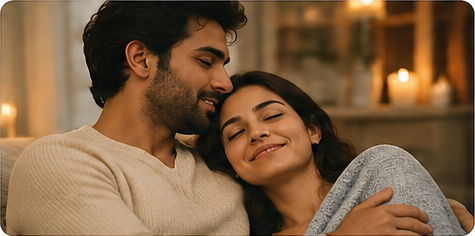
This is an original fictional short story featuring adult characters. Featured image: AI-generated editorial illustration; not a photograph. Readers interested in contemporary literary explorations of affection and memory can read our features on Before We Became Forever and Adhura Khat, or our guide to emotional and physical intimacy.




Your perspective matters
Share your thoughts respectfully. Comments are moderated.