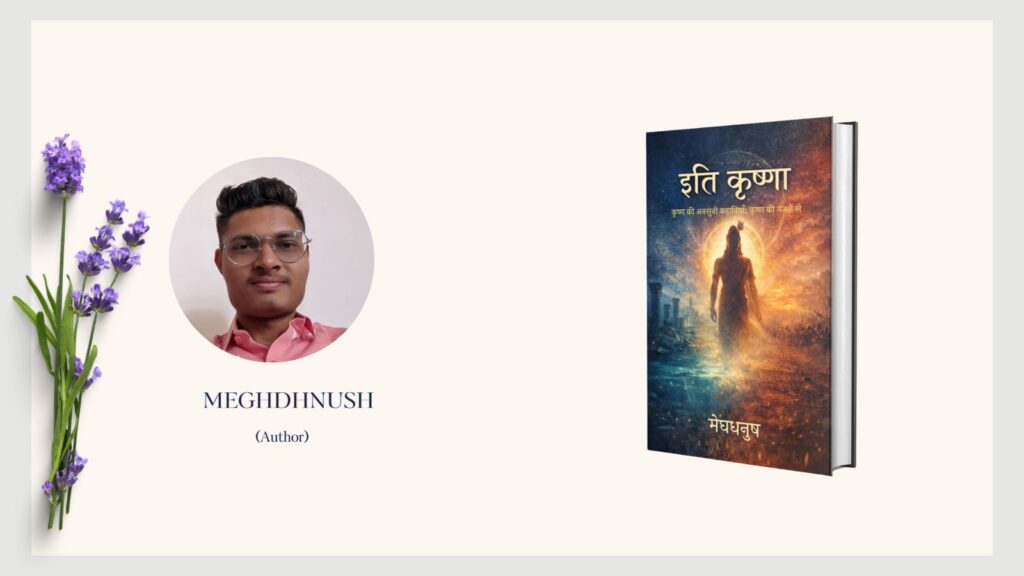
In an age where ancient wisdom is often dismissed as mythology and faith is frequently questioned through the lens of modern logic, author MEGHDHNUSH brings forth a compelling and thought-provoking narrative in Iti Krishna. This work is not merely a retelling of stories associated with Lord Krishna, but a deeply introspective and philosophical exploration that challenges the boundaries between myth and reality, belief and evidence, and history and experience.
“I am not in the pages of history; I am the heartbeat of the present.” This powerful statement sets the tone for the entire book, inviting readers to reconsider their understanding of Krishna—not just as a divine or historical figure, but as a living consciousness that continues to influence human thought and existence. Through this lens, MEGHDHNUSH does not attempt to impose conclusions but instead encourages readers to embark on their own journey of discovery.
The author’s approach is unique in that it blends historical references with spiritual insight. From the submerged remains of Dwarka to the deeply symbolic land of Kurukshetra, the narrative navigates through places that hold both archaeological significance and profound emotional resonance. These elements are not presented as rigid proofs but as invitations to reflect, to question, and ultimately to experience. The idea is not to prove Krishna’s existence through conventional means, but to understand the depth of his presence through awareness and perception.
One of the most striking aspects of this book is how Krishna is portrayed. Rather than being confined to the role of a mythological deity or a distant historical personality, Krishna emerges as a universal presence. He is depicted as the breath within every living being, the silence within Radha, and the inner conflict within Arjuna. This interpretation allows readers to relate Krishna to their own lives, transforming him from an external figure into an internal realization.
MEGHDHNUSH’s writing resonates with readers who find themselves caught between skepticism and faith. The book serves as a bridge between these two realms, acknowledging the importance of logic while also embracing the vastness of spiritual experience. It speaks directly to those who seek to understand the deeper meaning behind ancient narratives without rejecting the advancements of modern thought. In doing so, it creates a space where inquiry and devotion can coexist harmoniously.
The philosophical depth of the book is one of its greatest strengths. It emphasizes that truth does not require validation through argument; it must be lived and experienced. This idea challenges the reader to move beyond intellectual debates and to engage with the subject on a more personal level. It suggests that the essence of Krishna cannot be confined to definitions or doctrines but can only be understood through inner awareness.
Another significant dimension of the work is its modern perspective. In a time where disbelief often overshadows tradition, the book attempts to dismantle the rigid walls that label ancient knowledge as mere fiction. Instead, it presents a nuanced view that respects both scientific curiosity and spiritual intuition. By doing so, it addresses a contemporary audience that is searching for meaning in a rapidly changing world.
The narrative also highlights the importance of evidence, not in a conventional scientific sense alone, but in the form of lived experiences and subtle realizations. Stones, ruins, and historical remnants are portrayed as silent witnesses to a forgotten past, urging readers to listen more closely to what history may not explicitly state but still subtly reveals.
Ultimately, Iti Krishna is more than just a book; it is an invitation. It calls out to those who question, those who seek, and those who feel that there is more to existence than what is immediately visible. It challenges readers to look beyond surface interpretations and to explore the deeper layers of truth that lie within themselves.
As the pages unfold, readers are confronted with a reality that transcends time. The book does not promise answers but offers a path—one that leads from doubt to understanding, from separation to connection, and from illusion to truth. It reminds us that while truth may be hidden, it can never be erased.
Through this work, MEGHDHNUSH establishes himself not just as a storyteller, but as a thinker who dares to question established perceptions and invites others to do the same. His writing is both reflective and evocative, leaving a lasting impression on anyone willing to engage with it sincerely. In a world that often seeks quick answers, Iti Krishna stands as a reminder that some truths are meant to be experienced, not explained.







Your perspective matters
Share your thoughts respectfully. Comments are moderated.