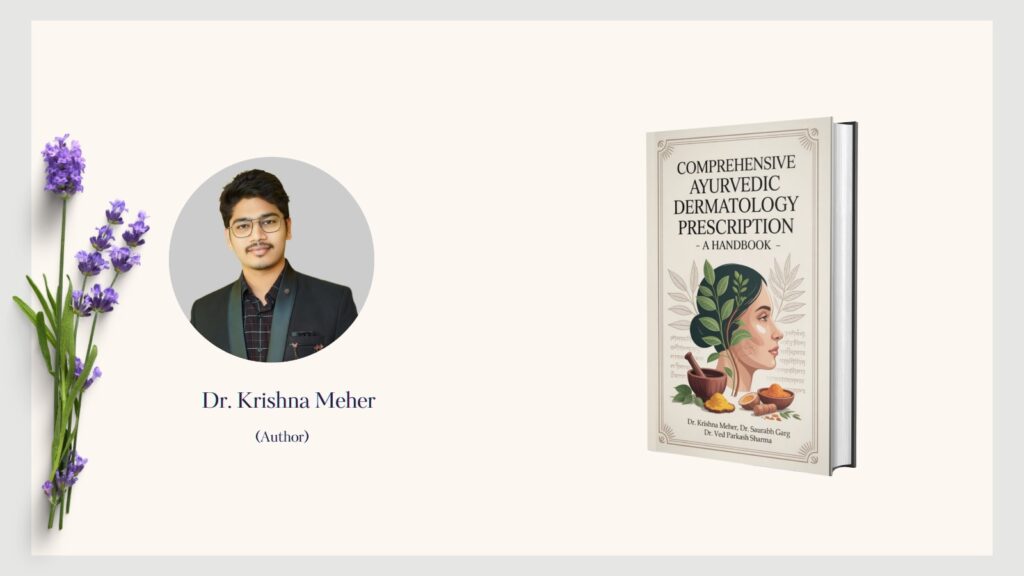
The growing burden of skin disorders in modern clinical practice has drawn increasing attention from both conventional and traditional systems of medicine. Conditions such as acne, eczema, psoriasis, vitiligo, fungal infections, and autoimmune dermatoses affect millions of people worldwide, cutting across age groups and social backgrounds. While many of these conditions are not immediately life-threatening, their long-term physical, emotional, and social impact can be profound. Skin diseases often influence a person’s confidence, interpersonal relationships, and psychological well-being. In such a context, the need for holistic, sustainable, and well-structured therapeutic approaches becomes more important than ever. Comprehensive Ayurvedic Dermatology Prescription – A Handbook emerges as a valuable contribution toward this goal, authored collaboratively by Dr. Krishna Meher, Dr. Saurabh Garg, and Dr. Ved Parkash Sharma.
Rooted deeply in the principles of Ayurveda, this handbook reflects the classical understanding that skin disorders are not merely superficial manifestations but are the visible outcomes of deeper systemic imbalances. Ancient Ayurvedic texts describe various skin disorders under broad categories such as Kushtha, Kshudra Roga, Rakta Pradoshaja Vikara, and other Twak-related diseases. These classical frameworks emphasize that disturbances in bodily elements such as Rakta, Pitta, Kapha, and digestive metabolism play a critical role in the development and persistence of dermatological conditions. The authors approach dermatology through this holistic lens, presenting an integrated perspective that connects classical Ayurvedic wisdom with contemporary clinical understanding.
What distinguishes this handbook is its strong clinical orientation. Instead of presenting Ayurveda purely as theoretical philosophy, the authors focus on practical applications that can be directly used in everyday clinical practice. The text provides structured prescription formats, making it easier for practitioners to translate classical principles into organized treatment plans. Disease-wise correlations help clinicians understand how specific dermatological conditions described in modern medicine correspond to classical Ayurvedic categories. By doing so, the book bridges the gap between traditional knowledge and modern diagnostic frameworks, enabling practitioners to approach skin diseases with clarity and confidence.
The authors have also given considerable importance to therapeutic procedures that address the root cause of disease rather than simply managing symptoms. The handbook explains the role of Panchakarma protocols, especially when deeper purification therapies are indicated. This Shodhana-pradhana approach focuses on eliminating accumulated toxins and correcting underlying metabolic disturbances. At the same time, the authors recognize that not every case requires aggressive detoxification. For milder conditions or long-term management, Shamana-based therapies are emphasized, aiming to maintain balance and prevent recurrence. This balanced methodology demonstrates a mature understanding of patient-centered care within Ayurvedic dermatology.
Another important dimension of the book lies in its emphasis on diet and lifestyle. Ayurveda consistently stresses that food, daily habits, and environmental factors significantly influence skin health. The handbook therefore outlines practical dietary guidelines and lifestyle modifications that complement medical treatment. Such recommendations reinforce the Ayurvedic principle that sustainable healing arises from harmonious living rather than medication alone. In many chronic skin disorders, these lifestyle adjustments can be as important as pharmacological interventions.
The authors also focus on chronic and recurrent dermatoses, which often pose therapeutic challenges in routine clinical settings. Conditions such as long-standing eczema, recurrent fungal infections, autoimmune skin disorders, and pigmentary abnormalities frequently resist conventional treatments or return after temporary improvement. By presenting Ayurvedic strategies that target systemic imbalances, the handbook aims to support long-term remission rather than short-term suppression. This philosophy aligns closely with the classical Ayurvedic objective of restoring equilibrium within the body’s functional systems.
Hair and nail disorders, often overlooked in dermatology texts, also receive attention in this work. Ayurveda considers these structures to be closely linked with the health of underlying tissues and metabolic processes. By addressing the broader physiological context in which hair and nail pathologies arise, the authors encourage practitioners to adopt a more comprehensive diagnostic approach. This perspective helps clinicians understand that dermatological manifestations may reflect deeper nutritional, metabolic, or systemic imbalances.
An equally important aspect of the handbook is its accessibility for both experienced practitioners and postgraduate scholars. The authors present information in a structured and practical manner that supports learning as well as clinical application. For Ayurvedic physicians running outpatient departments, the book offers ready-to-use formulations and prescription frameworks that simplify decision-making during patient consultations. For students and researchers, it provides a systematic overview of Ayurvedic dermatological management grounded in classical theory yet adapted to contemporary healthcare settings.
The collaborative expertise of the three authors plays a significant role in shaping the depth and reliability of the work. Each contributor brings clinical experience, academic knowledge, and a shared commitment to strengthening Ayurvedic dermatology as a practical and evidence-guided discipline. Their combined efforts demonstrate how traditional medical knowledge can evolve while remaining faithful to its foundational principles.
In an era when lifestyle changes, environmental factors, and stress increasingly contribute to skin disorders, integrative approaches to dermatology are gaining recognition. Ayurveda, with its emphasis on individualized treatment, systemic balance, and preventive care, offers valuable insights for addressing these complex conditions. Comprehensive Ayurvedic Dermatology Prescription – A Handbook stands as a thoughtful attempt to translate those insights into practical clinical guidance.
Ultimately, the work reflects a broader vision of healthcare—one that seeks not only to treat disease but also to restore balance, strengthen resilience, and promote long-term well-being. By presenting structured Ayurvedic prescriptions, therapeutic protocols, and holistic lifestyle guidance, the handbook contributes meaningfully to the evolving field of integrative dermatology and serves as a dependable reference for practitioners committed to classical yet clinically relevant Ayurvedic practice.







Your perspective matters
Share your thoughts respectfully. Comments are moderated.