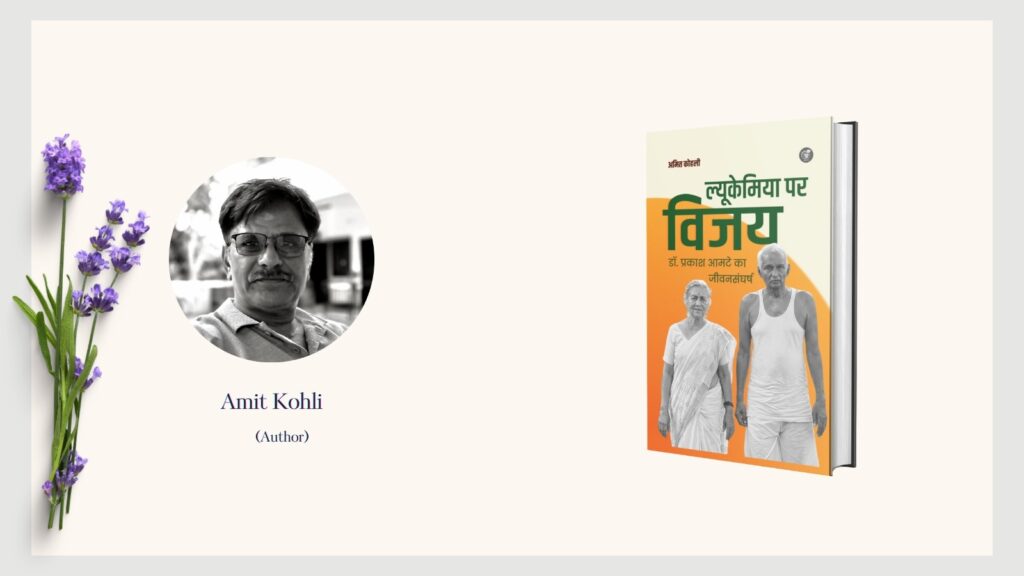
Lukemiya Par Vijay: Dr. Prakash Aamate ka Jeevan Sangharsh, authored by Amit Kohli, is more than a chronicle of personal struggle—it is a profound testament to resilience, dedication, and the triumph of the human spirit. This book captures the extraordinary journey of Dr. Prakash Aamate, a man whose life has been defined by service to others and unwavering commitment, even in the face of severe adversity. Kohli offers readers an intimate glimpse into the life of an individual who has consistently prioritized the well-being of others over his own, revealing a story that is at once inspiring, humbling, and deeply human.
The narrative revolves around Dr. Aamate’s battle with leukemia, a formidable challenge that struck in 2022 and tested every ounce of his strength. Yet, the book is not merely about illness—it is about the philosophy of life that Dr. Aamate embodies. From his childhood to his present circumstances, the reader is invited to witness the evolution of a character whose compassion and dedication remained steadfast, even as he confronted the fragility of his own health. In every chapter, Kohli captures both the external events and the internal reflections that have shaped Dr. Aamate’s journey, presenting a multi-dimensional portrait that resonates far beyond the specifics of his condition.
What makes Lukemiya Par Vijay particularly compelling is its focus on service and selflessness. Dr. Aamate’s life demonstrates that true heroism lies not in avoiding hardship, but in continuing to serve with integrity despite it. Throughout the book, Kohli highlights how Dr. Aamate has approached his responsibilities with tireless dedication, often placing the needs of others above his own. His life becomes a model of altruism, illustrating that the measure of a person is found in the impact they leave on those around them. Readers are reminded that courage is not only physical but moral and emotional, manifesting in choices made daily, even under duress.
Kohli’s narrative style blends biography with intimate storytelling, allowing readers to experience Dr. Aamate’s struggles and triumphs with immediacy and empathy. The author delves into moments of fear, pain, and uncertainty, yet balances them with reflections on hope, perseverance, and purpose. These moments are presented not as a litany of suffering but as integral experiences that have strengthened Dr. Aamate’s character. In doing so, the book transcends the conventions of a simple memoir, becoming a meditation on the resilience of the human spirit and the capacity to find meaning in life’s most challenging circumstances.
One of the central themes of the book is the intersection of personal sacrifice and professional duty. Dr. Aamate’s devotion to his work and his community is portrayed as unwavering, a constant even when his own health required attention and care. Kohli emphasizes that this steadfastness is not born of obligation alone, but of an intrinsic understanding of purpose—an inner conviction that serving humanity is a calling higher than personal comfort. This perspective resonates deeply in a world often preoccupied with self-interest, providing a powerful reminder of the nobility inherent in selfless action.
Health challenges, particularly life-threatening illnesses, often strip away pretenses and reveal the core of human character. In Lukemiya Par Vijay, readers witness Dr. Aamate confronting vulnerability, uncertainty, and the limitations of his own body with remarkable equanimity. Kohli presents these experiences with sensitivity, conveying both the physical reality of leukemia and the emotional and psychological dimensions of facing mortality. Through this lens, the narrative explores universal themes: the impermanence of life, the courage to endure, and the dignity of facing adversity with grace.
Beyond the personal and medical aspects, the book is also a celebration of the human values that Dr. Aamate has championed throughout his life. Service, compassion, and perseverance emerge as guiding principles, offering readers insights into a life lived with intention and integrity. Kohli’s portrayal of these values is neither didactic nor idealized; instead, it is grounded in lived experience, presenting Dr. Aamate as a real person whose journey offers lessons without preaching. This authenticity is one of the book’s greatest strengths, enabling readers to connect deeply with the narrative and reflect on their own lives in the process.
The structure of the book mirrors the ebb and flow of Dr. Aamate’s life, moving seamlessly between past and present, triumph and trial. Kohli employs a narrative rhythm that mirrors the resilience and persistence of his subject, reinforcing the central themes through both form and content. The result is a reading experience that is immersive, thought-provoking, and emotionally resonant. Each chapter is a window into the realities of struggle and the power of determination, creating a portrait that is as inspiring as it is instructive.
Ultimately, Lukemiya Par Vijay is a story about victory—not merely over illness, but over doubt, fear, and the limitations imposed by circumstance. It is a narrative that celebrates the human spirit, the capacity for endurance, and the quiet heroism found in everyday acts of courage and service. Dr. Prakash Aamate’s life, as chronicled by Amit Kohli, becomes a beacon for all who face challenges, demonstrating that strength is as much about character and conviction as it is about physical ability.
In reading this book, one comes away with a renewed appreciation for the resilience inherent in humanity and the transformative power of compassion. Lukemiya Par Vijay is more than a biography; it is a tribute to determination, selflessness, and the unwavering pursuit of a life dedicated to higher ideals. Kohli’s work ensures that Dr. Aamate’s story will continue to inspire, offering hope, courage, and guidance for readers navigating their own challenges, no matter how formidable.







Your perspective matters
Share your thoughts respectfully. Comments are moderated.