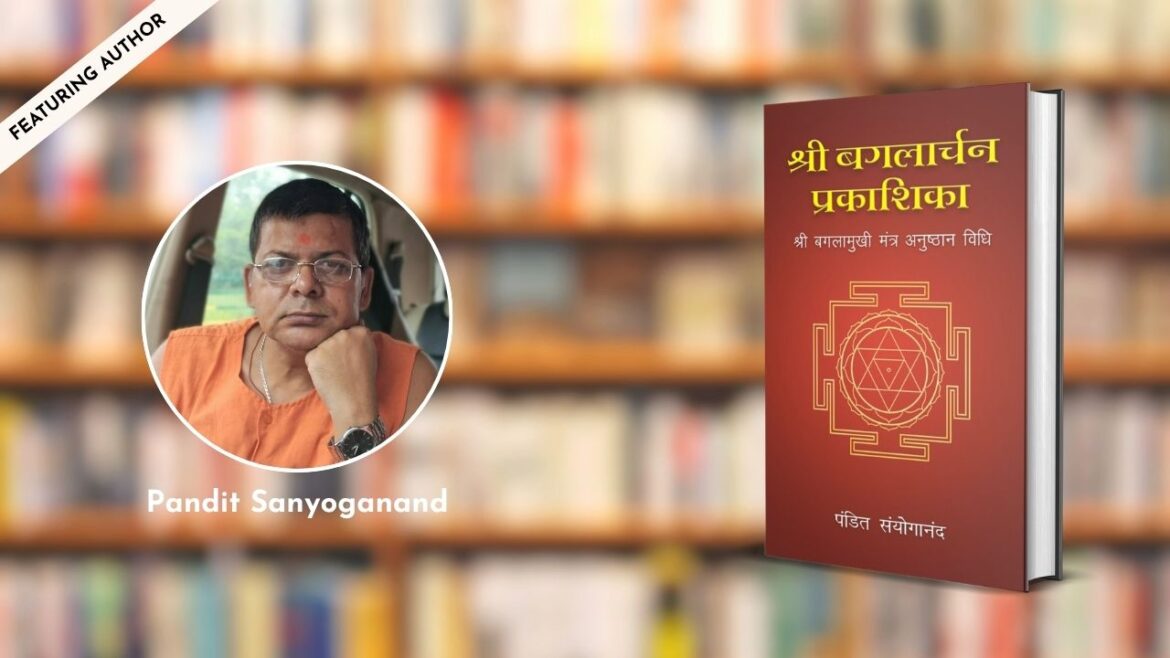
In a time when spiritual practices are often diluted, simplified, or turned into mere rituals of convenience, Sri Bagalarchan Prakashika arrives as a deeply authentic work—one that brings back the gravity, sanctity, and transformative power of ancient Tantric wisdom. At the center of this powerful guide stands its author, Pandit Sanyoganand, a practitioner whose life story is inseparably woven with the divine aura of Sri Bagalamukhi. His journey is not that of a writer who researched a subject; it is the journey of a seeker who lived it, breathed it, surrendered to it, and ultimately chose to share it.
For many, Sri Bagalamukhi is revered as the deity of protection, victory, and the neutralization of negative influences. But for Pandit Sanyoganand, she is far more—she is a living presence, a guiding force, and a transformative energy that shaped the entire course of his spiritual life. His introduction to the divine Mother came in 1994–95, through his Guru, the highly respected Pandit Harisharan Devarishi. It was not merely information that his Guru gave him; it was a calling. The moment he learned of Maa Bagalamukhi’s power, grace, and the depth of her Sadhana, something within him awakened. Under his Guru’s guidance, he received initiation—an initiation that became the axis around which his life would revolve.
Over the decades that followed, Pandit Sanyoganand did not simply practice Shri Bagalamukhi Sadhana; he immersed himself in it. He entered the discipline with humility and devotion, spending years exploring the layers of meaning encoded in ancient Tantric scriptures. This was not an intellectual exploration—it was experiential, demanding discipline, silence, introspection, and surrender. Such depth is rare in the modern world, and rarer still is the willingness to share it so openly with others.
This book emerges from that lifetime of practice. Sri Bagalarchan Prakashika is more than an instructional text; it is a bridge. It carries the hidden, intricate wisdom of age-old scriptures into the hands of ordinary seekers. It reveals what has been veiled, explains what has long remained obscure, and clarifies the processes that many practitioners have struggled to understand. The author’s intention is not merely to teach a ritual or offer a set of instructions. His intention is to guide the reader toward inner transformation—toward the calm, stable, courageous state that arises from true Sadhana.
The book highlights a crucial truth: while many know Sri Bagalamukhi as the deity associated with the Shatkarma—the six esoteric practices of neutralizing negative forces—her worship is not limited to victory over external obstacles. At a deeper level, the real enemy is the mind itself. The uncontrolled thoughts, the endless desires, the constant restlessness—these are the internal forces that weaken one’s spirit. When the author explains that Bagalamukhi Sadhana restrains the mind and pulls it away from worldly agitation, he is drawing from years of personal experience. He has observed this transformation not only in himself, but in hundreds of individuals he has guided.
Across India and abroad, countless families have sought his guidance for Bagalamukhi worship, and they speak of the clarity and stability that follows. Yet Pandit Sanyoganand never positions himself as a miracle-giver or spiritual authority. His tone is always that of a devoted student—someone who continues to learn, explore, and deepen his understanding with each passing year. It is this humility that gives his writing its authenticity. The reader feels they are not being instructed, but gently accompanied.
Alongside his spiritual discipline, the author is a serious student of astrology and Indian philosophy. His knowledge of ancient Tantric scriptures adds intellectual depth to the book, but he never allows scholarship to overshadow accessibility. One of his core missions in writing Sri Bagalarchan Prakashika was to ensure that even a reader unfamiliar with esoteric traditions could understand the essence, purpose, and method of the Sadhana. He believes that spiritual knowledge should not remain locked away in cryptic texts or exclusive circles—it must reach those who genuinely seek it, no matter their background.
What makes the book truly special is its grounding in lived reality. Every explanation is shaped by what the author has observed in practitioners over the years—their struggles, their breakthroughs, their fears, and their longing for stability. He understands that today’s world is filled with uncertainty, anxiety, and spiritual disconnect. For many, traditional rituals have become mechanical; the inner meaning has been lost. With this work, he attempts to restore that meaning. He reminds readers that Sadhana is not a ceremony; it is a discipline that reshapes one’s inner landscape.
Pandit Sanyoganand’s lifelong devotion to Bhagwati Peetambara—another revered form of the Divine Mother—adds yet another dimension to his spiritual understanding. This devotion taught him patience, surrender, and the quiet strength that only long-term spiritual practice can cultivate. His years of service reflect a path not chosen for recognition but embraced out of deep love.
In Sri Bagalarchan Prakashika, the author offers the essence of his journey to the world. It is a guide, a companion, and a gentle doorway into a tradition that is both powerful and profoundly transformative. For today’s seekers—those grappling with inner turmoil, those seeking protection, or those searching for deeper meaning—this book is not just relevant; it is essential.
And at the heart of it all is Pandit Sanyoganand, a man shaped by devotion, guided by the grace of his Guru, and committed to bringing ancient wisdom to those who need it the most.