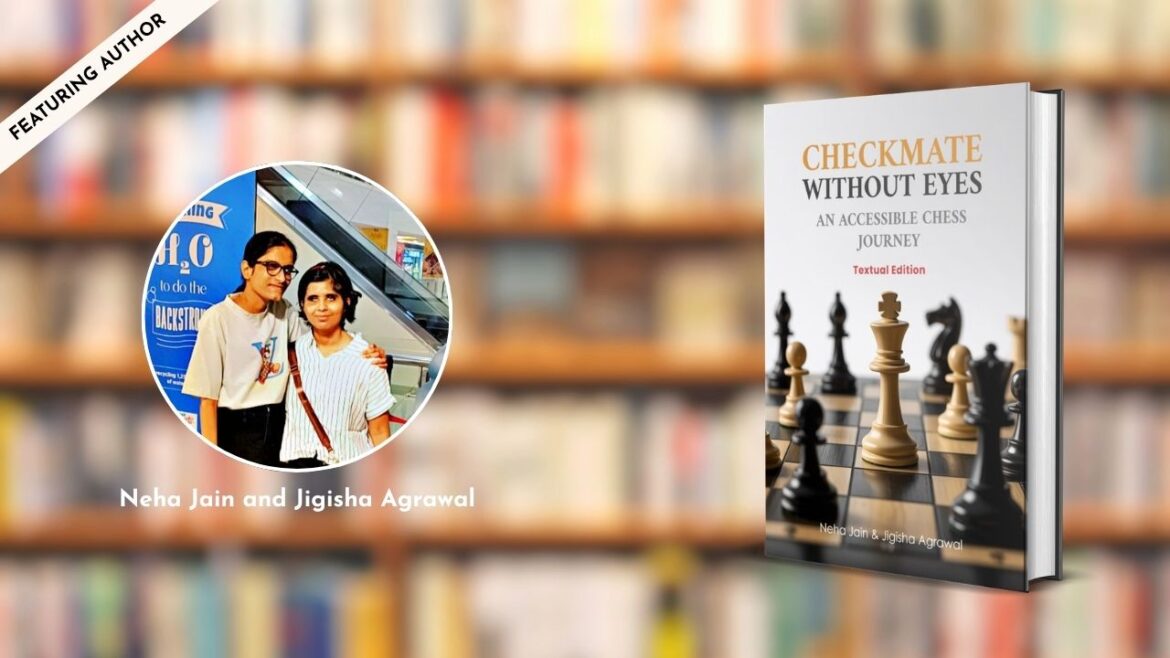
In a world where accessibility is still an ongoing conversation rather than a complete reality, Checkmate Without Eyes: An Accessible Chess Journey [Textual Edition] stands as a thoughtful and meaningful contribution—one that challenges assumptions about learning, perception, and the very nature of the game of chess. Written by Neha Jain and Jigisha Agrawal, this book is not just about teaching chess; it is about redefining how knowledge can be shared, understood, and experienced by everyone, including those who navigate the world without sight.
At its core, this book is driven by a powerful yet simple idea: that intellectual games like chess should belong to all minds, not just those who can see the board. While chess has long been associated with visual patterns, positional awareness, and board recognition, Neha and Jigisha approach it from a completely different perspective. They transform the game into a mental landscape—one that can be built, navigated, and mastered through understanding, imagination, and structured learning. In doing so, they open doors for visually impaired learners to not only access the game but to excel in it.
The authors present chess concepts in a comprehensive yet accessible manner, breaking down traditional barriers that often make the game intimidating for beginners. Every explanation is carefully designed to be understood without reliance on visual diagrams, allowing readers to grasp the logic of movement, positioning, and strategy through descriptive clarity. This thoughtful approach reflects not only their dedication to the subject but also their empathy toward learners who require alternative modes of understanding.
What makes the book even more remarkable is its focus on developing the skill of blindfold chess. Often considered an advanced ability reserved for seasoned players, blindfold chess demands exceptional memory, visualization, and mental calculation. By guiding readers step-by-step into this practice, the authors do something extraordinary—they turn a perceived limitation into a strength. For visually impaired learners, this approach does not merely compensate for the lack of sight; it empowers them to cultivate sharper cognitive abilities, enhancing concentration, spatial reasoning, and mental discipline.
Behind this meaningful initiative are two young minds whose collaboration is rooted in both friendship and shared passion. Neha Jain, a PhD scholar in political science at Guru Ghasidas Vishwavidyalaya, Bilaspur, brings with her a deep academic perspective and an analytical approach to structuring knowledge. Her ability to simplify complex ideas and present them in an organized, accessible format plays a crucial role in shaping the book’s clarity and effectiveness.
Alongside her is Jigisha Agrawal, a law student at Hidayatullah National Law University, Raipur, pursuing her BALLB. Her training in law equips her with a sharp sense of logic, reasoning, and articulation—qualities that seamlessly translate into the way chess strategies are explained in the book. Her structured thinking and attention to detail help ensure that the content remains precise, practical, and easy to follow.
What truly binds Neha and Jigisha’s work together is not just their academic strengths, but their shared identity as chess players and best friends. Their mutual love for the game has evolved into a larger purpose—making chess inclusive and accessible. This bond is evident throughout the book, where the tone feels collaborative, encouraging, and deeply invested in the reader’s learning journey. It is clear that this is not just a project, but a mission they both believe in.
Their work reflects a broader vision—one that goes beyond chess. It speaks about inclusivity in education, about designing learning experiences that respect diverse needs, and about ensuring that intellectual opportunities are not limited by physical constraints. In many ways, Checkmate Without Eyes becomes a symbol of what is possible when empathy meets innovation. It shows that accessibility is not merely about accommodation; it is about reimagining systems so that everyone can participate fully and confidently.
The book also carries an important message for educators, institutions, and content creators. It demonstrates that with thoughtful design and genuine intent, complex subjects can be made accessible without losing depth or quality. It encourages a shift in perspective—from asking how individuals can adapt to existing systems, to asking how systems can evolve to include everyone.
For readers, especially those who are visually impaired, this book offers more than just knowledge of chess. It offers independence, confidence, and the joy of mastering a game that has challenged minds for centuries. For sighted readers, it provides a new way of understanding the game—one that emphasizes thinking over seeing, imagination over observation, and mental clarity over visual cues.
Through Checkmate Without Eyes, Neha Jain and Jigisha Agrawal remind us that true vision lies not in the eyes, but in the mind. Their work is a testament to the power of inclusive thinking and the beauty of shared passion. It is a quiet yet powerful revolution—one that transforms a traditional board game into an accessible, empowering experience for all.
In creating this book, they have not only taught chess; they have expanded the boundaries of how learning itself can be imagined.