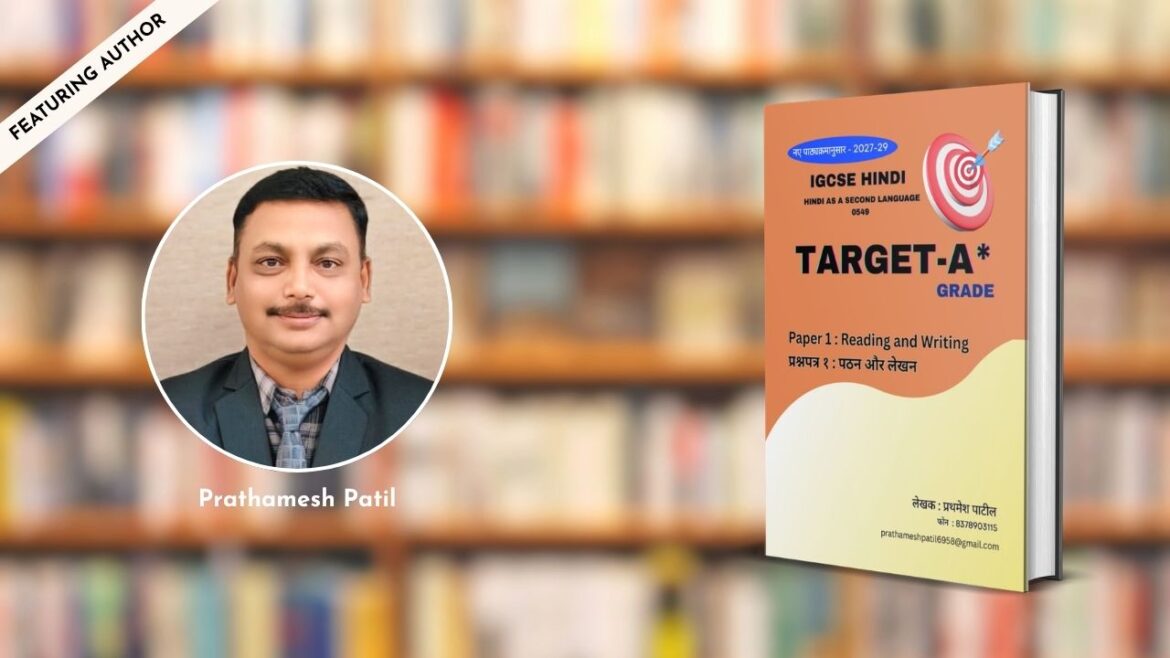
In an era where global education increasingly values multilingual competence, the study of Hindi as a second language holds a distinct place—offering not only linguistic skill but also access to a profound cultural and intellectual tradition. It is within this evolving academic landscape that Prathamesh Patil presents TARGET – A Grade: IGCSE Hindi Paper 1 Reading and Writing*, a carefully crafted guide aligned with the newly revised 2027 syllabus of Cambridge IGCSE Hindi as a Second Language (0549). For thousands of international learners, the updated curriculum marks a shift toward deeper comprehension, clearer expression, and more authentic engagement with the language. Patil’s book arrives at precisely the right moment, bridging these new academic demands with thoughtful pedagogy and a heartfelt commitment to the language.
What makes this work exceptional is how it transforms exam preparation from a mechanical exercise into a journey of discovery. Instead of treating Hindi as a set of rules to memorize, the book positions it as an experience—a living, breathing medium through which students learn to think, connect, and express. Patil understands that mastering a language, especially as a second language, requires more than correct grammar or vocabulary. It demands cultural sensitivity, contextual understanding, and opportunities for meaningful practice. Every lesson, exercise, and exam-oriented question in the book is designed to develop these qualities while still keeping students firmly focused on achieving the coveted A* grade.
The author’s long-standing involvement in international Hindi education deeply informs the structure and intent of this book. Having spent nearly a decade teaching Hindi to learners from diverse linguistic and cultural backgrounds, Patil knows firsthand the challenges they encounter—uncertainty with writing tasks, difficulty interpreting unseen texts, hesitation in expressing nuanced ideas, and the pressure of performing under exam conditions. Instead of overwhelming students, his book gently guides them into the rhythm of the language through scaffolded learning. Complex skills are broken down into approachable segments, yet nothing is oversimplified. The goal is mastery, but mastery achieved with confidence, clarity, and curiosity.
Patil’s role as an IBDP Hindi B Facilitator at Symbiosis International School, Pune, adds another dimension to his perspective. Working with young global citizens has helped him appreciate how language learning shapes identity, empathy, and worldview. His pedagogy embraces the idea that learning Hindi is not merely academic—it is emotional, cultural, and personal. Many of his students are encountering Hindi in structured ways for the first time, despite growing up in India or with Indian heritage. Others come from non-Hindi-speaking countries altogether. For both groups, his teaching philosophy emphasizes connection over memorization. This same philosophy pulses through the pages of TARGET – A Grade*, making it not only a guidebook but also a companion in their learning journey.
A remarkable aspect of the book is its commitment to balancing exam readiness with a deeper appreciation of the language. While it equips students thoroughly for Paper 1—Reading and Writing—it also nudges them toward reflective thinking. The exercises encourage clarity of thought. The writing tasks foster creativity and precision. The reading passages are chosen to expand comprehension while subtly introducing cultural textures. In this way, the book does not limit itself to academic objectives; it becomes a tool for enriching the student’s engagement with Hindi as a world language.
Patil writes not just as an educator but as a believer in the transformative power of Hindi. His words reflect a personal bond with the language, a devotion that extends beyond classrooms and syllabi. He acknowledges the many teachers who tirelessly promote Hindi education, often without enough resources, yet with extraordinary passion. His book, he says, is dedicated to them—an offering of support, appreciation, and solidarity. This acknowledgment elevates the book from a mere academic resource to a symbol of collective educational effort.
The sincerity with which Patil addresses students and teachers stands out as one of the most authentic features of his authorial voice. He speaks directly to them, recognizing their challenges and aspirations. For students, he offers guidance infused with empathy—reminding them that language learning is a process that strengthens not only intellect but also character. For teachers, he provides structure, clarity, and ready-to-use resources that can make their work easier and more effective. His hope is simple yet profound: that this book deepens a student’s friendship with Hindi or smoothens the teaching process in even the smallest way.
In crafting TARGET – A Grade*, Prathamesh Patil demonstrates that educational excellence is rooted in intention and integrity. The book respects the rigor of the Cambridge framework while honoring the emotional and cultural depth of Hindi. It prepares learners not only to excel in their examinations but also to step into the larger world as more articulate, culturally aware individuals. In doing so, it marks an essential contribution to international Hindi education—a field that continues to grow in significance as global communication becomes more diverse.
Ultimately, Patil’s work embodies the belief that teaching a language is an intimate act of connection. Through this book, he invites learners into a richer relationship with Hindi, one where academic success becomes a natural outcome of genuine understanding. His decade-long teaching journey, his dedication to cross-cultural education, and his vision for a more accessible and meaningful Hindi curriculum come together to create a resource that is both academically sound and deeply inspiring. In the pages of TARGET – A Grade*, Prathamesh Patil offers not just preparation for an exam, but a doorway into a language capable of shaping thought, perception, and expression for a lifetime.