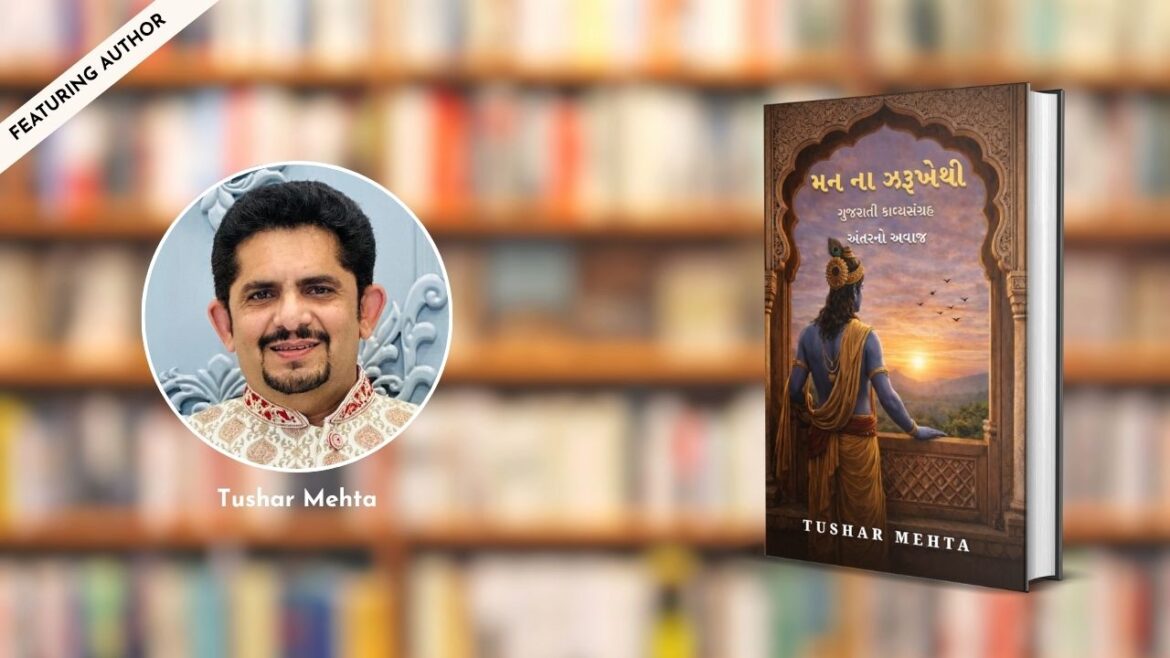
Tushar Mehta writes with a kind of quiet courage—an honesty that does not demand attention but earns it through sincerity, simplicity, and emotional depth. His poetry flows not from a desire to impress, but from a desire to understand. At a time when the world is loud, hurried, and crowded with expressions, he chooses the gentler path of introspection. Man Na Zarukhe Thi – Anter No Avaj is an extension of this inner world he has been nurturing for years, a world filled with observations of daily life, human connections, unspoken emotions, and the soft ache of memories.
What makes Tushar’s work distinct is the silence between his lines. He writes poetry that pauses, listens, and lets the reader breathe. Every poem becomes a space of reflection—a mirror that allows the reader to see something of themselves. His verses do not overwhelm with dramatic metaphors or complicated structure; instead, they invite emotional clarity. He understands that real feelings rarely come in grand declarations. They arrive quietly, unexpectedly, in the moments when we are paying attention to life. His poetry celebrates that attention.
Tushar’s writing journey is deeply rooted in lived experiences—childhood memories, the tenderness of family bonds, the weight of loss, the healing power of time, and the loneliness that exists even in the busiest of lives. These themes are not chosen for poetic effect; they rise naturally from the way he observes the world. Whether he writes about aging parents, distance between siblings, the innocence of youth, or the complexity of love, his tone remains compassionate. The simplicity of his language makes his work accessible to readers of all ages, while the emotional intensity ensures that every poem lingers long after it has been read.
His ability to write in Gujarati, Hindi, and English adds a unique richness to his voice. Each language brings its own emotional rhythm, and Tushar moves between them with ease. Gujarati allows him to express nostalgia with tenderness. Hindi lends directness to his reflections. English gives shape to his more philosophical musings. This multilingual expression mirrors his belief that emotions do not follow linguistic boundaries; they follow the heart.
Alongside his literary pursuits, Tushar Mehta is also the founder of Happinez Within, an initiative dedicated to emotional awareness and inner well-being. His background in guiding people through emotional challenges naturally influences the texture of his poetry. It is evident in the calmness of his tone, the wisdom woven into his lines, and the compassion with which he explores human vulnerability. His platform encourages people to pause, feel, reflect, and reconnect with themselves—principles that resonate strongly in his writing.
Happinez Within
Reading his poetry feels like conversing with someone who understands without needing explanations. He writes not to escape life, but to look at it more closely. His poems often capture fleeting moments—the light of an evening, a sudden memory, a conversation left unfinished, the heaviness of silence, the comfort of a familiar touch. These moments become anchors in his narratives, grounding the reader in emotional authenticity.
Man Na Zarukhe Thi – Anter No Avaj reflects Tushar’s belief that the most profound emotions are often simple. The poems explore longing, gratitude, acceptance, and gentle introspection. They touch upon the threads that hold relationships together—trust, understanding, unspoken care, and the space individuals give each other. The book also embraces themes of aging with dignity, healing with patience, and understanding life through the wisdom of everyday experiences. It is a book that does not rush; it invites the reader to slow down and find meaning in the ordinary.
Tushar’s approach to life and writing is deeply influenced by the idea that emotional expression is not weakness; it is connection. He writes for those who struggle to articulate their feelings, for those who find solace in inner silence, and for those who seek understanding rather than judgement. His poems often feel like conversations with one’s own heart—gentle reminders that it is okay to feel deeply, to remember, to hope, and to heal.
In the literary landscape, where many voices compete for attention, Tushar Mehta’s work stands apart because of its sincerity. He does not write to impress, nor does he write to perform. He writes because emotions deserve a language that respects their subtlety. He writes because readers deserve a space where they can be themselves, without fear or pretense. His poems do not dictate meaning; they allow readers to find their own.
Through Man Na Zarukhe Thi, Tushar continues to build a body of work that speaks across generations. His poetry resonates with young readers discovering emotions for the first time, adults carrying memories and responsibilities, and elders who have lived through decades of life’s joys and sorrows. His writing reminds readers that everyone carries an inner voice—one that deserves to be heard.
Tushar Mehta’s literary journey is ongoing, shaped by reflection, empathy, and a profound understanding of human nature. With each poem, he creates a small window into his world, while offering readers a quiet place to rest, feel, and rediscover themselves. His work is not just about words; it is about emotional presence. It is an invitation to step into the silence, listen inwardly, and reconnect with the truths we often overlook.
If his poems teach anything, it is this: the heart always knows the way—if only we pause long enough to hear its voice.