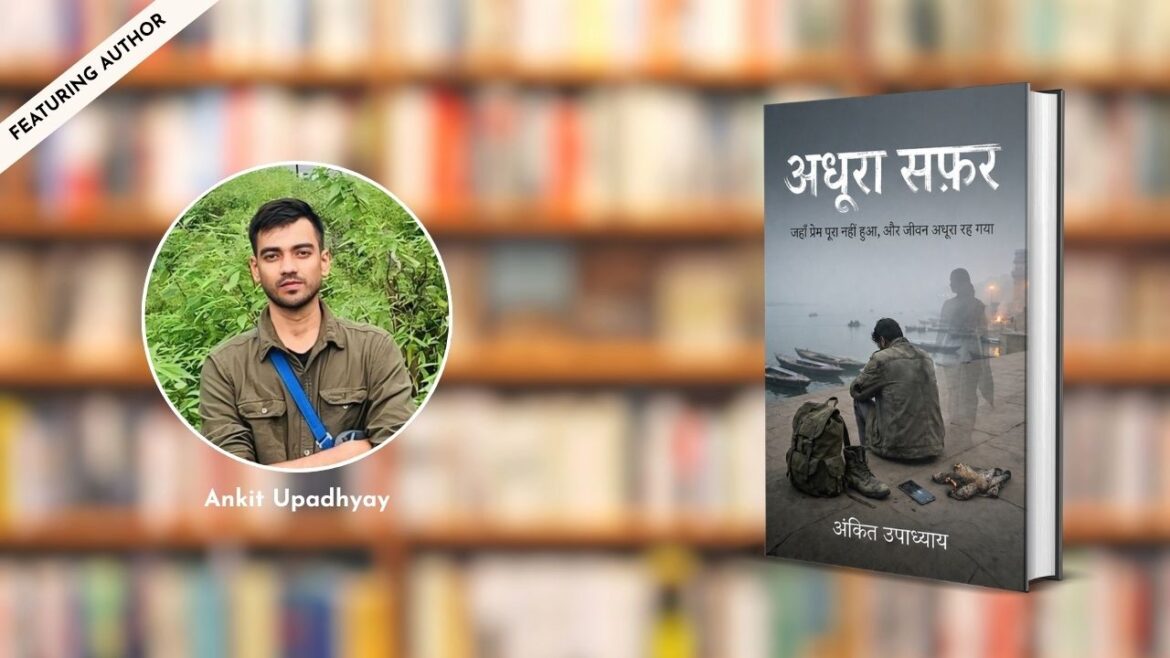
There are stories we read, and there are stories we feel. Adhura Safar belongs to the second kind — the kind that lingers long after the last page is turned, quietly reshaping the reader from within. In this poignant work, Ankit Upadhyay brings to life the fragile threads of incomplete love, silent heartbreak, and the type of emotional void that never truly disappears. His narrative does more than tell a tale; it mirrors the experiences of countless individuals who carry within them an unfinished chapter, a memory that still breathes, and a journey that never found its closure.
Ankit writes with the emotional sensitivity of someone who has observed human relationships closely — not from a distance, but from a place of genuine connection to pain, longing, and unspoken truth. Through his storytelling, he captures the internal turbulence that arises when love remains incomplete, when promises fall apart, and when life demands movement even as the heart refuses to let go. His prose is steeped in authenticity; he does not romanticize suffering but presents it as an intrinsic part of existence, shaping who we become and how we move forward.
What makes Adhura Safar stand out is not just its exploration of broken relationships but its ability to articulate the quiet grief that often goes unnoticed. Many people live with smiles on their faces while carrying invisible wounds within. Ankit’s novel gives voice to these wounds. The characters in the story are not idealistic lovers chasing perfection; they are real, flawed humans facing dilemmas that readers instantly recognize. They experience love that transforms them, loss that shakes them, and memories that stay etched like silent scars. These characters do not seek dramatic resolutions; instead, they learn to coexist with the hollowness left behind.
In the world Ankit creates, incompleteness is not a failure — it is a condition of the human heart. Life does not always give closure, and love does not always arrive at happily-ever-after. But it is within these incomplete stories that some of the deepest truths are found. Adhura Safar strips away the illusions of perfect romance and allows readers to confront the bittersweet reality that sometimes love ends, but feelings do not. Sometimes destinies break apart, but hopes still cling to life. And sometimes walking away is the only way to survive, even when the heart wishes to stay.
What makes Ankit’s writing powerful is his ability to transform personal emotions into universal experiences. Every reader who has ever felt the ache of separation or the weight of an unfinished bond will find themselves reflected in this book. His narrative carries an undercurrent of nostalgia — the kind that makes you pause, revisit old memories, and question whether the past was truly left behind or simply placed on a quiet shelf within your soul.
Though the novel delves deeply into themes of heartbreak, betrayal, and emotional incompleteness, it is ultimately a story about acceptance. Ankit understands that life continues even when love doesn’t. People learn to live with memories, not because they choose to, but because the heart adapts in ways the mind cannot comprehend. His characters learn to breathe again, to walk again, to rediscover themselves in fragments they thought they had lost. Adhura Safar is therefore not only about love that could not be completed but also about strength that emerges in unexpected ways.
Ankit’s journey as a writer reflects a similar depth. His decision to write Adhura Safar stems from a deep empathy for human emotions. He writes not to impress but to express — to articulate the feelings that people often suppress, to bring to light the tenderness that hides behind silence. Through his novel, he becomes a voice for those who struggle to articulate their heartache. Writing, for him, is a way of healing — both personally and for his readers. His words feel like gentle conversations, offering comfort without making promises, offering truth without judgement.
One of the most compelling aspects of Ankit’s storytelling is his ability to highlight the beauty within pain. He understands that heartbreak does not simply destroy a person; it shapes them, teaches them, and often becomes the foundation for new strength. In his world, incomplete love is not a tragedy — it is a testament to how deeply one can feel. The memories that haunt his characters are not weaknesses; they are proof of their courage to love wholeheartedly.
This delicate balance between sorrow and resilience is what transforms Adhura Safar into more than just a novel. It becomes an emotional experience — one that invites readers to reflect, to heal, and perhaps to forgive themselves for the stories in their own lives that remain unfinished. Many readers will recognize pieces of their own journeys reflected in the book’s intimate narrative. And in that recognition, they may find a sense of companionship and understanding.
With Adhura Safar, Ankit Upadhyay offers readers a mirror to their inner world. He reminds us that it is perfectly human to have chapters that don’t end the way we wish. It is human to carry memories that refuse to fade. It is human to continue searching, longing, and hoping — even when the heart feels incomplete. Through his evocative storytelling, Ankit reshapes the idea of unfulfilled love, presenting it not as a wound but as a part of growing, evolving, and ultimately becoming who we are meant to be.
The journey may be incomplete, but its impact is profound. And in that truth lies the essence of Adhura Safar — a novel that understands the heart more deeply than words alone ever could.