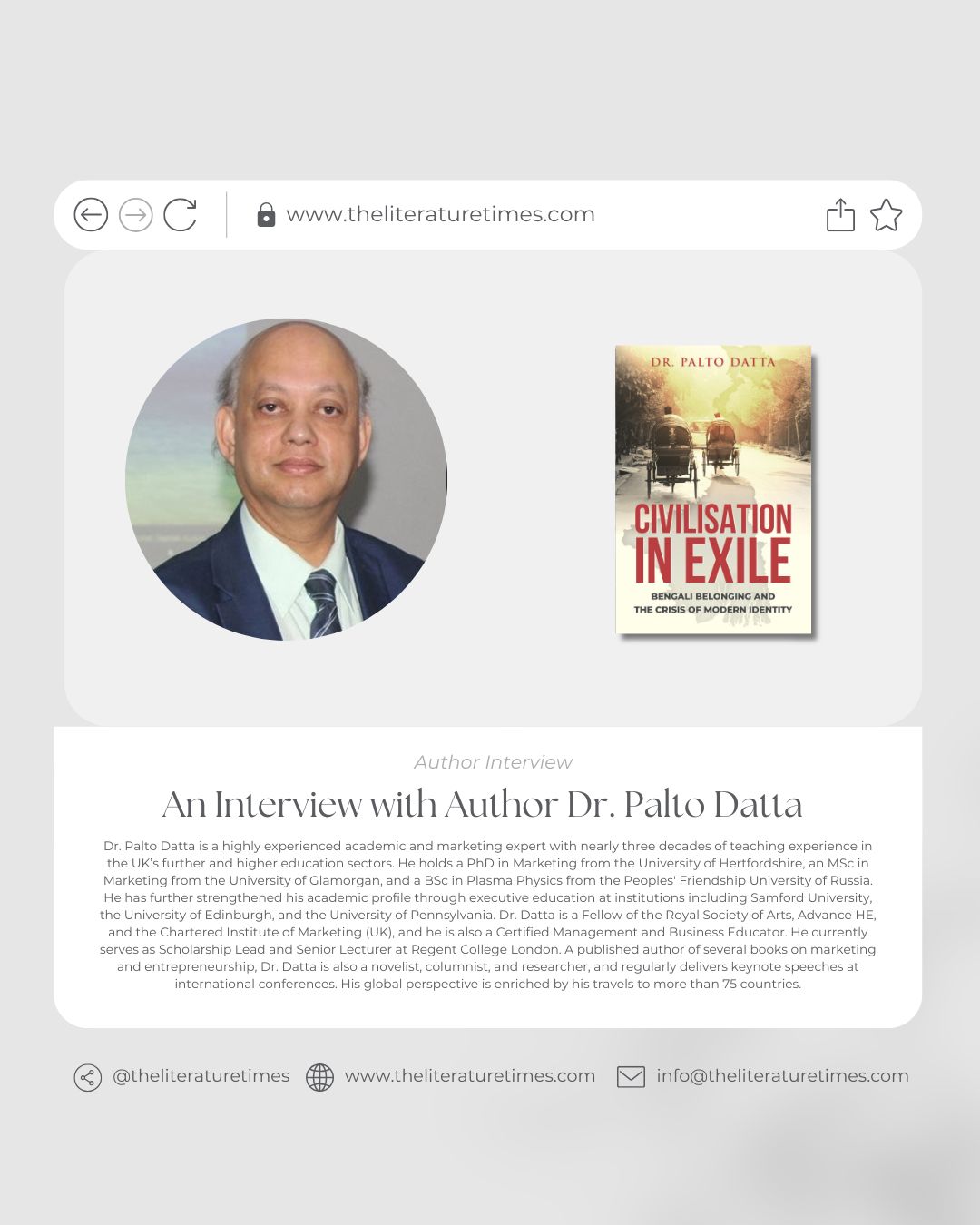
Literature Time – Your book Civilisation In Exile explores the idea of belonging in a globalized world. What inspired you to take up this theme, and why do you think it is so relevant today?
Dr. Datta –
The inspiration for Civilisation in Exile came from years of observing the growing distance between people and their cultural roots, especially within diaspora communities. While living and working across different intellectual and cultural environments, I realised that modern exile is not simply about leaving one’s homeland. It is about losing a deeper connection with memory, language, values, and civilisational consciousness. Globalisation has created unprecedented mobility and opportunity, but it has also produced cultural uncertainty. Many people today are materially connected to the world yet spiritually disconnected from themselves. I felt there was a need to examine this contradiction through the experience of Bengalis in Britain and beyond.
The theme is especially relevant today because technological advancement, consumerism, and global culture are rapidly reshaping identity. Younger generations are growing up between multiple worlds, often without a clear sense of historical continuity. This book attempts to ask an important question: how can a civilisation remain alive if its people gradually forget the ethical, cultural, and philosophical foundations that once shaped them?
Literature Time – You argue that exile is no longer just geographical but also psychological and civilisational. Could you elaborate on this concept for our audience?
Dr. Datta –
Traditionally, exile meant physical displacement from one’s homeland. But in the contemporary world, exile has taken a much deeper form. A person may still live in their own country and yet feel internally uprooted from their language, traditions, collective memory, and moral inheritance. This psychological and civilisational exile occurs when people become detached from the cultural meanings that once gave coherence to life. In the modern consumerist world, identity is increasingly shaped by market forces, social media, and imitation rather than reflection, history, or moral imagination. We become connected globally but disconnected inwardly.
For Bengalis, this condition is especially visible. Many still celebrate cultural festivals or speak the language, but often the deeper philosophical and ethical dimensions of Bengali civilisation are weakening. The result is a form of internal displacement where culture survives symbolically but loses its living essence. My argument is that exile today is not merely about geography; it is about the erosion of consciousness itself.
Literature Time – The Bengali diaspora is central to your narrative. How do you think migration has reshaped Bengali identity over time?
Dr. Datta –
Migration has transformed Bengali identity in both enriching and challenging ways. On one hand, the diaspora has demonstrated extraordinary resilience. Bengalis in Britain built communities, businesses, restaurants, cultural organisations, and intellectual spaces while preserving language, music, literature, and traditions. Places such as Brick Lane and Tower Hamlets became symbols of collective memory and survival. At the same time, migration has also produced identity fragmentation. Second- and third-generation Bengalis often grow up negotiating multiple cultural realities. They are influenced by Western individualism and consumerism while carrying inherited traditions from Bengal. This creates both creativity and confusion.
I believe migration has expanded Bengali identity beyond geography. Today, Bengali identity exists simultaneously in Dhaka, Kolkata, London, New York, and many other places. Yet the challenge remains whether this global identity can retain its moral and cultural depth without becoming merely performative or nostalgic.
Literature Time – You have drawn upon the legacy of Rabindranath Tagore and Michael Madhusudan Dutt in your book. How have these figures influenced your perspective on culture and identity?
Dr. Datta –
Rabindranath Tagore and Michael Madhusudan Dutt represent two profound dimensions of Bengali civilisation. Tagore taught us that identity must ultimately lead towards humanity, ethical imagination, and spiritual freedom. His critique of nationalism and moral decline remains deeply relevant in today’s fragmented world. He believed civilisation survives through humanity, not through material progress alone.
Michael Madhusudan Dutt, on the other hand, symbolises the tragedy and complexity of cultural modernity. He embraced Western education and aesthetics but later realised that one cannot completely abandon one’s roots without experiencing inner conflict. His life reflects the tensions between imitation and belonging, ambition and identity.
Both figures influenced my understanding that cultural engagement with the world is necessary, but it should never require the abandonment of civilisational memory. Their lives and works reveal the importance of balancing openness to modernity with fidelity to one’s cultural foundations.
Literature Time – East London features prominently in your reflections. What makes this location significant in understanding diaspora experiences?
Dr. Datta –
East London is much more than a geographical setting in my book. It is a living archive of memory, struggle, sacrifice, and cultural survival. Since first arriving in Britain in 1989 and permanently settling here from 1992 after my years of study in Moscow during the final phase of the Soviet Union, I have spent much of my life in East London, particularly among Bangladeshi communities in places such as Brick Lane, Whitechapel, Stepney Green, and Tower Hamlets. Over the decades, these streets have become deeply connected to my intellectual and emotional understanding of diaspora life.
For generations of Bangladeshis, especially Sylheti’s, East London became a place where dreams and hardship walked side by side. The first-generation immigrants arrived with very little. Many worked in factories, textile industries, restaurants, and night shifts under difficult and often hostile conditions. They faced racism, poverty, alienation, and uncertainty, yet through resilience, solidarity, and sacrifice, they built one of the most vibrant diaspora communities in Britain.
Brick Lane, Whitechapel, and Tower Hamlets are not simply locations on a map; they carry the living memories of migration and struggle. These streets witnessed anti-racist resistance and collective courage, particularly through tragedies such as the murder of Altab Ali, whose death became a powerful symbol of dignity, resistance, and the fight against racial hatred.
At the same time, East London also represents the beauty of cultural continuity. Bengali language, food, poetry, music, festivals, and family traditions continue to flourish there, creating a unique cultural landscape often described as the “Third Bangladesh.” Yet beneath this success lies another reality, the younger generation’s search for identity and belonging in a rapidly globalised and consumer-driven world.
That is why East London becomes, in my writing, a mirror of the wider philosophical condition of modern diaspora communities. It reflects both achievement and anxiety, belonging and displacement, memory and transformation. For me personally, living among these communities for more than three decades has been both an education and a moral journey. It allowed me to witness how ordinary people, despite immense struggles, carried their culture, dignity, and humanity across continents and rebuilt life with extraordinary courage.
Literature Time – Your book blends philosophy, history, and personal accounts. How did you approach structuring such a multidimensional narrative?
Dr. Datta –
I approached the book as both a cultural reflection and a civilisational inquiry. The subject itself demanded an interdisciplinary structure because identity cannot be understood through history alone, nor through philosophy alone. Human experience exists at the intersection of memory, politics, culture, emotion, and moral reflection. Therefore, I divided the book into thematic sections that move from identity and civilisational roots towards diaspora, exile, modernity, morality, and renewal. Historical narratives are combined with personal observations and philosophical reflections because lived experience often reveals truths that abstract theory cannot fully capture.
I also wanted the narrative to feel reflective rather than purely academic. The book is intentionally written in a style where memory, urban observation, and intellectual critique coexist. In many ways, the structure itself mirrors the fragmented but interconnected experience of modern identity.
Literature Time – Globalisation offers both opportunities and challenges. In your view, what is the biggest threat it poses to cultural identity?
Dr. Datta –
The greatest threat globalisation poses is not cultural exchange itself, because cultures have always evolved through interaction. The real danger lies in cultural homogenisation and the erosion of moral consciousness.
Globalisation often promotes a form of consumerist identity where people are valued more as consumers than as carriers of civilisation, memory, or ethical traditions. As societies become increasingly driven by markets, speed, and digital distraction, cultural depth is reduced to surface-level symbolism.
For many communities, especially in the Global South, this creates a crisis where younger generations begin to imitate dominant global cultures while gradually losing confidence in their own traditions. When language, literature, philosophy, and moral values become secondary to consumption and spectacle, civilisation weakens internally.
My concern is not modernity itself but uncritical modernity. We must engage with the world critically, creatively, and ethically rather than abandoning our cultural foundations in the pursuit of superficial progress.
Literature Time – As an academic and researcher, how has your professional background shaped your approach to writing this book?
Dr. Datta –
My academic and research background encouraged me to approach the book analytically while remaining deeply engaged with lived human experience. Research teaches discipline, critical thinking, and historical sensitivity, but literature and philosophy allow us to explore the emotional and existential dimensions of life. Throughout my teaching and intellectual work, I have been interested in questions of civilisation, education, morality, identity, and social transformation. These concerns naturally shaped the book. Rather than writing only from a nostalgic perspective, I wanted to examine the structural and philosophical forces influencing Bengali identity today.
At the same time, my interactions with diaspora communities, readers, students, and cultural activists helped me understand that identity is not an abstract concept. It is lived every day through language, family, memory, migration, and moral choices. The book emerged from this intersection between scholarship and lived observation.
Literature Time – What message or takeaway would you like readers—especially younger generations—to gain from Civilisation In Exile?
Dr. Datta –
I would like younger generations to understand that identity is not a burden from the past but a source of strength and self-understanding. Modernity should not require cultural amnesia. One can participate fully in a global world while remaining connected to language, heritage, and ethical values. I hope readers realise that civilisation survives not merely through economic success or technological advancement, but through memory, morality, creativity, and human dignity. The younger generation must critically engage with the modern world while also rediscovering the philosophical richness of their own traditions.
Above all, I want readers to reflect on the importance of humanity. Culture should never become narrow or exclusionary. True civilisation is built upon compassion, intellectual openness, justice, and moral responsibility.
Literature Time – Do you see this book as the beginning of a larger conversation or series on identity and diaspora? What can readers expect from your future work?
Dr. Datta –
Yes, I see Civilisation in Exile as part of a larger and continuing conversation about identity, diaspora, civilisation, morality, and cultural renewal in the modern age. This book raises questions that cannot be resolved within a single volume because the crisis of identity today is deeply layered and global. Over the past twenty-five years, much of my writing and research has focused on moral education, character formation, and the ethical foundations of civilisation. I strongly believe that education should not merely produce skilled individuals for the marketplace; it should also cultivate humane, morally responsible, and self-aware citizens. In this regard, I have also published another book titled Character: The End Goal of Education, where I explore the importance of character-building as the central purpose of education.
My intellectual work has consistently argued that without morality, compassion, self-discipline, and social responsibility, no civilisation can sustain itself for long, regardless of its economic or technological achievements. Therefore, Civilisation in Exile is closely connected to my broader concern about the erosion of ethical consciousness in modern societies.
In my future work, I hope to continue exploring themes such as moral education, the philosophical crisis of modern civilisation, the future of Bengali identity in the digital age, and the relationship between culture, education, and ethical responsibility. I am also interested in documenting the lived experiences of diaspora communities and examining how cultural memory can contribute to a more humane and just society.
Ultimately, my aim is not only to critique the present but also to contribute toward rebuilding a moral and civilisational consciousness for future generations.