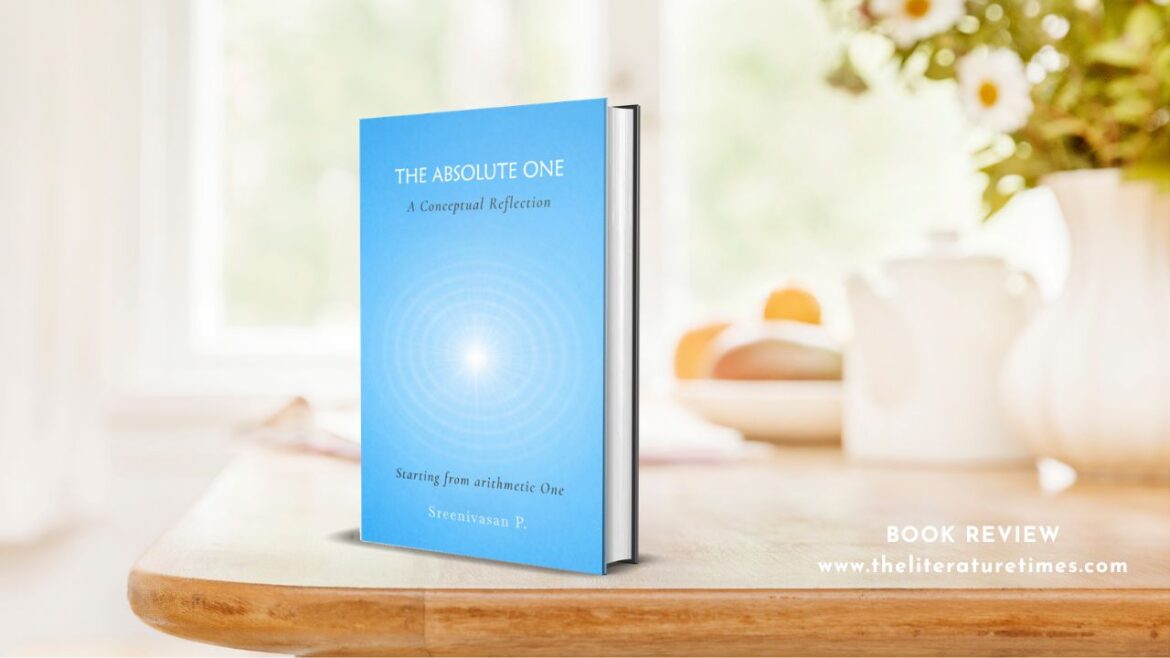
Sreenivasan P.’s The Absolute One: A Conceptual Reflection (Starting from arithmetic One) is an intellectually ambitious and philosophically meditative work that attempts to revisit some of humanity’s oldest questions through the simplest possible starting point: the arithmetic symbol “1.” Rather than approaching the subject through dense equations, specialized scientific frameworks, or rigid philosophical jargon, the author chooses a path of direct reasoning and conceptual reflection. This makes the book both unusual and intriguing, especially for readers interested in foundational thinking about existence, unity, and the origins of multiplicity.
At the heart of the book lies a deceptively simple inquiry: how does multiplicity emerge from unity? By taking the primitive concept of “one” as both a mathematical and ontological point of departure, the author gradually unfolds a larger reflection on existence itself. What distinguishes the book is its insistence that arithmetic operations alone cannot fully explain the nature of being. Sreenivasan P. separates quantitative manipulation from ontological presence, encouraging readers to think beyond numbers as mere tools of calculation and instead consider them as conceptual gateways into deeper metaphysical understanding.
One of the book’s strongest qualities is its clarity of intention. The author openly acknowledges that he is not writing from the standpoint of formal academic mathematics or theoretical physics. Instead, he approaches the subject as an independent thinker guided by logic, analogy, and sustained contemplation. This honesty gives the work a certain authenticity. Rather than attempting to imitate technical scholarship, the book embraces simplicity as a philosophical method. Readers are not overwhelmed with formulas or citations; they are invited into a process of reasoning that unfolds step by step, almost conversationally.
The writing style is reflective and contemplative, often encouraging readers to pause and reconsider assumptions they may have unconsciously accepted. The author repeatedly questions how concepts such as origin, division, generation, and existence are ordinarily understood. In doing so, he presents the idea that multiplicity may not require displacement or fragmentation from an original source. This becomes one of the central conceptual pillars of the work. The argument is not framed as a scientific theorem but as a philosophical possibility grounded in logical consistency and intuitive reasoning.
What makes the book particularly engaging is its interdisciplinary spirit. Though rooted in conceptual philosophy, it touches upon mathematics, cosmology, metaphysics, and even the philosophy of science. Readers familiar with classical philosophical traditions may notice echoes of monism, non-duality, and first-cause reasoning, while mathematically inclined readers may appreciate the attempt to reinterpret numerical foundations from a philosophical angle. Yet the book remains accessible because it avoids unnecessary technical complexity.
Another noteworthy aspect is the author’s intellectual independence. In an era where academic specialization often dominates discourse, The Absolute One stands as a reminder that profound questions can still emerge from personal reflection and disciplined thought outside institutional frameworks. Sreenivasan P.’s background as a retired independent thinker adds depth to the work, giving it the tone of a lifelong meditation rather than a purely academic exercise. There is sincerity in the way the ideas are presented, and this sincerity helps sustain reader engagement even when the concepts become abstract.
The book’s greatest strength may also be its greatest limitation. Because it relies heavily on conceptual reasoning rather than formal structure, some readers looking for rigorous mathematical proofs or scientifically testable models may find the arguments speculative. At times, the reflections move in circles, revisiting similar conceptual territories from slightly different angles. However, this appears intentional, reflecting the author’s meditative method of inquiry rather than a conventional argumentative structure. Readers approaching the work with openness and philosophical curiosity are likely to appreciate this style more than those expecting conventional academic analysis.
The philosophical tone of the book also encourages introspection. Beyond its discussion of numbers and origins, the text subtly raises existential questions about perception, identity, and the human tendency to separate reality into fragments. The recurring emphasis on unity invites readers to rethink not only cosmological principles but also the way they understand themselves in relation to the world around them. In this sense, the book transcends abstract speculation and enters the realm of contemplative philosophy.
The Absolute One is not a book meant to be rushed through. It is a slow and thoughtful exploration that asks readers to engage actively with ideas rather than passively consume conclusions. Its value lies less in delivering definitive answers and more in stimulating inquiry. Sreenivasan P. succeeds in creating a work that is intellectually provocative while remaining accessible to non-specialist readers. By beginning with the arithmetic “1” and expanding outward into questions of existence and unity, the book transforms a simple numerical concept into a philosophical lens through which reality itself may be reconsidered.
Overall, The Absolute One: A Conceptual Reflection (Starting from arithmetic One) is a deeply reflective and original contribution to philosophical thought. It is best suited for readers who enjoy contemplative inquiry, foundational questions, and interdisciplinary thinking that bridges mathematics, philosophy, and metaphysics. The book may not conform to academic conventions, but its strength lies precisely in its independent spirit, clarity of reflection, and courage to ask fundamental questions in a direct and accessible way.