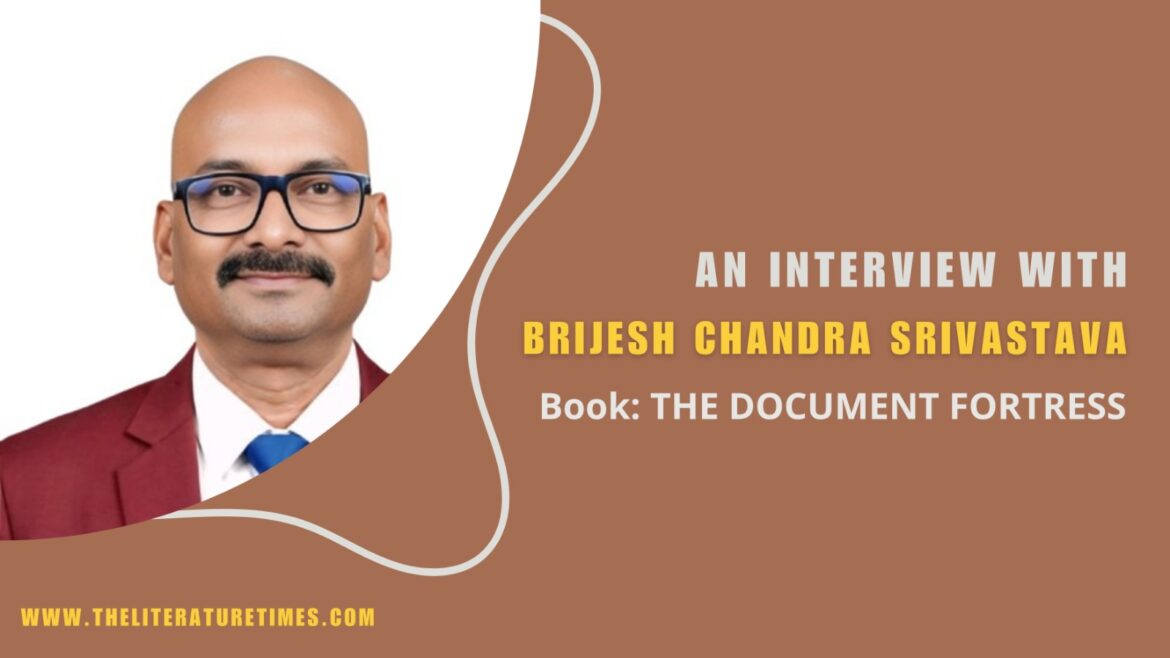
The Literature Times: What inspired you to become a writer, and how did your literary journey begin?
Brijesh Srivastava: I did not plan to become a writer. I planned to be an engineer — and I was one, for nearly four decades. The writing came from frustration. Across decades of railway infrastructure, highways, and public works projects, I watched good engineers lose. Not because they designed badly or executed poorly — but because they could not prove what they had done. The records were missing. The instructions were verbal. The measurements were not countersigned. The disputes came, and there was nothing to stand on. I wrote The Document Fortress because no engineering college teaches this, no training programme covers it, and the lesson usually arrives too late — after a career has already been damaged. Writing was the only way I knew to reach engineers before the lesson arrived.
The Literature Times: Which authors or books have had the most significant influence on your writing style and perspective?
Brijesh Srivastava: My influences for this book were not literary — they were professional. The Indian Railways Construction Manual, which I spent years working with and explaining to young engineers. The standard contract documents of public works — the CPWD manuals, the PWD specifications — which most engineers sign without reading carefully. The arbitration reports and audit observations that I studied across my career, which told me exactly where engineers go wrong and why. In terms of writing style, I have been most influenced by professionals who write plainly and precisely — who say exactly what they mean and do not hide behind jargon. I have tried to write The Document Fortress the same way: every sentence must earn its place, and every example must be real.
The Literature Times: Can you share the creative process you follow while writing a new piece or book?
Brijesh Srivastava: This book did not begin at a desk. It began at sites — on railway construction projects in the 1990s, on highway projects in remote locations, in rest houses where I would sit after a long day and make notes about what I had observed. I have always carried a notebook. Over decades, those notes accumulated into a pattern: the same mistakes, the same disputes, the same consequences, repeating themselves across different projects and different engineers. When the pattern became undeniable, the book announced itself. I then built a structure — each chapter addressing one specific category of professional risk. I wrote in the early mornings, before the day’s work began. I revised until every paragraph said exactly what I meant, no more and no less. The standard I applied was simple: would a young engineer on a difficult project site find this useful today?
The Literature Times: What challenges have you faced as an author, and how did you overcome them?
Brijesh Srivastava: The first challenge was resistance — not from publishers or readers, but from within the engineering profession itself. Engineers are trained to believe that technical competence is what matters. The idea that documentation — paperwork, as many call it — deserves serious attention is not instinctive. I had to make the case that documentation is not administrative work. It is professional protection. The second challenge was specificity. It would have been easy to write a general guide about the importance of records. What was difficult — and what I insisted on — was writing about specific situations: the measurement book, the site instruction, the variation order, the correspondence trail. Every chapter had to be grounded in something that actually happens on Indian project sites. The third challenge was tone. I did not want this book to read like a legal manual. I wanted it to read like advice from a senior colleague — direct, practical, and honest about what the consequences of getting it wrong actually are.
The Literature Times: How do you balance imagination and reality in your storytelling?
Brijesh Srivastava: In The Document Fortress, imagination plays almost no role. Every situation described in this book is drawn from reality — from what I witnessed, what I investigated, what colleagues reported, and what arbitration records revealed. The only imagination involved was in protecting identities: names of individuals and organisations have been changed or omitted, and specific details altered where necessary. But the essential facts — the nature of the documentation failure, the nature of the dispute, the professional consequence — are real. I made this choice deliberately. Engineers who read this book must be able to recognise the situations. If the scenarios feel invented, the lessons will not land. It is reality that gives this book its weight — not imagination.
The Literature Times: What message or emotion do you hope readers take away from your work?
Brijesh Srivastava: I want readers to feel protected. Not warned — protected. There is a difference. A warning says: here is what can go wrong. Protection says: here is what to do so that it does not. I want an engineer sitting in a difficult measurement dispute, or facing an audit observation, or receiving a contractor’s claim, to remember something from this book and think — I know exactly what to do. I also want younger engineers to feel that they have been told the truth — the truth that engineering college did not tell them, that the induction programme did not mention, that nobody explained until it was too late. If this book reaches a young engineer before the first difficult project, it will have done its job completely.
The Literature Times: How do personal experiences shape your writing and characters?
Brijesh Srivastava: Completely and directly. My first railway assignment was on the Mangalmurhi–Usra–Jakot section of Western Railway in Gujarat — a 12-kilometre stretch with repeated wagon derailments. I was new, I knew very little, and I was sent to the site alone. Six months in Dahod, in extreme heat, walking the section daily, collecting data kilometre by kilometre. That experience — of understanding a project not from a drawing but from the ground — shaped everything I subsequently wrote about documentation. The record is only as good as the observation behind it. Every chapter in this book carries that understanding. The engineers who appear in the examples — unnamed, but real — are people I worked with, reported to, or observed over nearly four decades. Their mistakes and their professionalism both deserve to be recorded.
The Literature Times: What role does literature play in today’s fast-changing world?
Brijesh Srivastava: In a world that moves quickly, professional literature serves one essential function: it preserves what experience has taught, in a form that the next generation can access before they need to learn it themselves. Technology changes. Contract frameworks evolve. Procurement methods shift. But the fundamental vulnerability of an engineer who cannot prove what they did — that does not change. The measurement book may eventually become a digital platform. The principle that measurements must be recorded contemporaneously, countersigned, and preserved will remain exactly as it is. Books like The Document Fortress carry institutional memory across generations. That is something a training video or a circular cannot do. Literature — even professional literature — asks the reader to sit with an idea long enough to understand it deeply. That depth is what makes the knowledge usable when it is needed.
The Literature Times: Are there any upcoming projects or books that readers can look forward to?
Brijesh Srivastava: Awareness to Mastery — a guide to examination excellence for IIT JEE, NEET, UPSC and CAT aspirants — is being published this month. Beyond the Syllabus, which takes a strategic and psychological approach to UPSC Civil Services preparation, follows shortly after. I am also developing a book titled Cracks in the Foundation, which will address the structural and institutional vulnerabilities in India’s public infrastructure system — the problems that practitioners see every day but that rarely appear in policy documents. My YouTube channel, Cerebral Pursuits, continues to grow — particularly the complete explainer series on the Indian Railways Construction Manual. And the Cerebral Pursuits learning application, designed for students from Class 6 through competitive examinations, is under development. The work continues.
The Literature Times: What advice would you give to aspiring writers who want to build a successful literary career?
Brijesh Srivastava: Write from earned knowledge. If you have spent years inside a profession — medicine, law, engineering, teaching, administration — you have accumulated something that no research can replicate: the lived understanding of how things actually work, and how they fail. That understanding is a book waiting to be written. Do not wait until you feel ready. You will never feel ready. Begin with the problem you know most intimately — the one that bothered you most, the one you wish someone had explained to you earlier. Write it plainly, specifically, and honestly. Cut everything that is not useful to the reader. And remember that a professional book is not written for reviewers or prizes. It is written for the person who needs it — sitting at a desk at eleven in the evening, facing a problem they do not know how to handle. Write for that person. Everything else will follow.