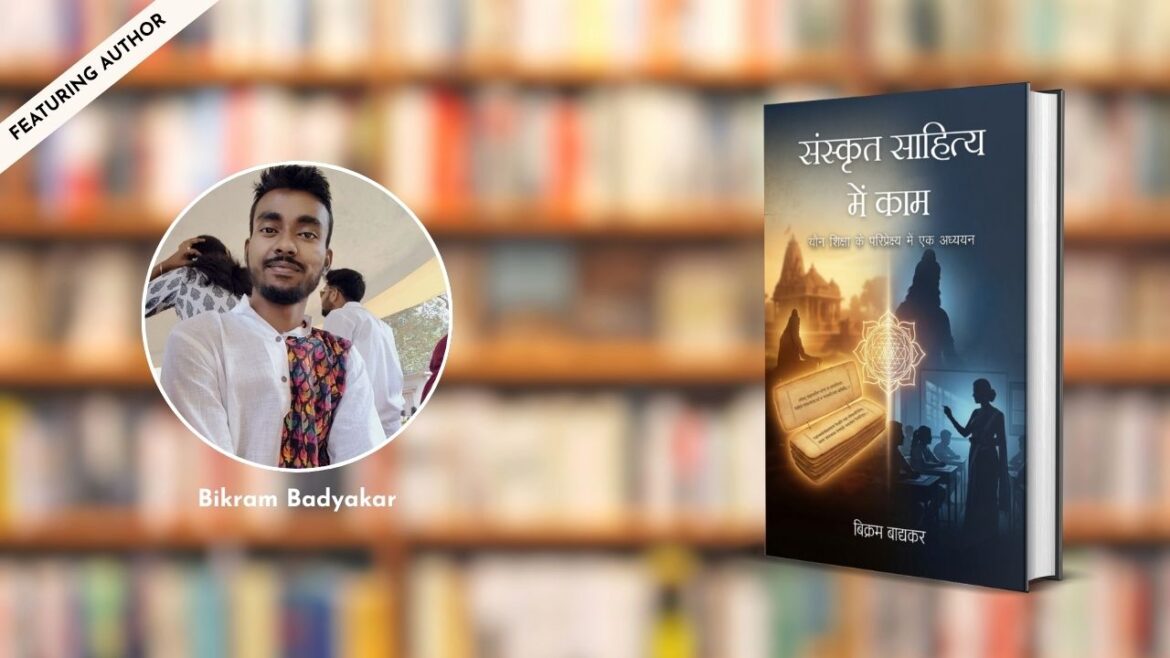
In an age where conversations around sex education oscillate between hesitation and urgency, Bikram Badyakar steps into this complex discourse with the clarity of a scholar and the sensitivity of a storyteller. His book Sanskrit Sahitya Mein Kaam: Yaun Shiksha ke Pariprekshya Mein Ek Adhyayan emerges as a significant bridge between India’s ancient textual heritage and the contemporary need for scientific, holistic sex education. At a time when educators, psychologists, and parents search for culturally rooted frameworks to address the subject, Bikram invites readers to discover that the foundations of healthy discourse on sexuality were laid in India centuries ago—through scriptures, literature, and philosophical traditions that approached the subject with openness, dignity, and scientific precision.
What makes his work particularly compelling is the way it responds to a cultural moment triggered by the film OMG 2, a cinematic attempt to position sex education as not only necessary but deeply aligned with Indian ethos. While the film offers glimpses of verses, concepts, and ancient references to support this argument, its narrative limitations allow only a surface view. Bikram, however, takes on the more demanding task—unpacking, contextualizing, and interpreting those very references with academic depth and intellectual rigor. His book moves beyond the film’s brief citations and delves into Sanskrit scriptures, commentaries, philosophical texts, and the broader tradition of Kāmaśāstra, revealing how intricately Indian thought has addressed sexuality, ethics, emotional well-being, and the psychology of relationships.
For readers who have long believed sex education to be a foreign import, the book becomes a revelation. It demonstrates that ancient Indian culture did not treat sexuality as taboo but rather as a natural, important, and morally nuanced dimension of human life. Whether through the Kāmasūtra, the Ratimanjari tradition, medical treatises, or didactic literature, Indian texts approached sexual knowledge with a blend of scientific inquiry, emotional maturity, and spiritual awareness. Bikram’s meticulous study offers a layered understanding of how education around desire, body, consent, and emotional health formed an integral part of ancient pedagogy. In doing so, he widens the conversation—showing that modern scientific perspectives can coexist with classical frameworks to form a robust educational model.
Behind this scholarly contribution lies the quiet dedication of a young academic who has immersed himself in Sanskrit literature for years. Having completed both his Bachelor’s and Master’s degrees from the revered Visva Bharati, Santiniketan, Bikram carries forward the institution’s legacy of intellectual openness and cultural synthesis. His academic journey naturally led him to research on the Kāmasūtra, a text often misunderstood or superficially interpreted. Pursuing his doctoral studies at the University of Delhi, he approaches this ancient treatise not as a manual of pleasure alone, but as a philosophical and sociological document that illuminates human relationships, emotional intelligence, and the ethics of intimacy.
His engagement with Sanskrit is not limited to scholarship alone. Bikram is also a poet, and his creative sensibility shines subtly through his academic writing. The precision with which he analyzes a verse, the care with which he interprets contextual meanings, and the elegance in his prose reflect the poetic instinct that lives within him. His poems, published across several anthologies, reveal his ability to navigate both classical and contemporary literary worlds, making him a rare blend of a traditional scholar and a modern thinker.
His academic contributions extend beyond writing. Several of his research papers have been published in national and international journals, marking his growing presence in global scholarship. His participation in international conferences, including one held in Indonesia, signals his commitment to bringing Sanskrit studies—and especially the discourse of kāma—into broader academic conversations. The forthcoming edited edition of Ratimanjari further underscores his ambition to preserve, reinterpret, and make accessible literary traditions that have shaped Indian cultural thought for centuries.
What distinguishes Bikram’s work is his refusal to treat kāma merely as a subject of sensuality. Instead, he explores it as a philosophical category—one that intersects with psychology, ethics, aesthetics, gender studies, and the understanding of human desire as a natural part of life. His sustained engagement with both classical Sanskrit literature and modern intellectual paradigms allows him to treat kāma not as a concept frozen in ancient time but as a living discourse that continues to evolve. This mature, multidimensional approach makes his book not only academically valuable but socially relevant.
In Sanskrit Sahitya Mein Kaam, Bikram accomplishes something profound: he restores confidence in India’s intellectual heritage while addressing one of the most pressing educational needs of the present. He opens doors for teachers, parents, researchers, and curious readers to understand sexuality not through fear or shame, but through knowledge, inquiry, and cultural wisdom. By doing so, he not only enriches contemporary conversations on sex education but also reclaims the depth and dignity with which ancient India once approached the subject.
Bikram Badyakar represents a new generation of scholars—rooted in tradition yet fully aware of the complexities of modern life. His work stands as a testament to what can be achieved when academic precision, cultural understanding, and poetic insight come together. Through this book and his ongoing research, he is shaping an important scholarly space—one where Sanskrit literature becomes a guiding light in redefining healthy, informed, and compassionate perspectives on human relationships.