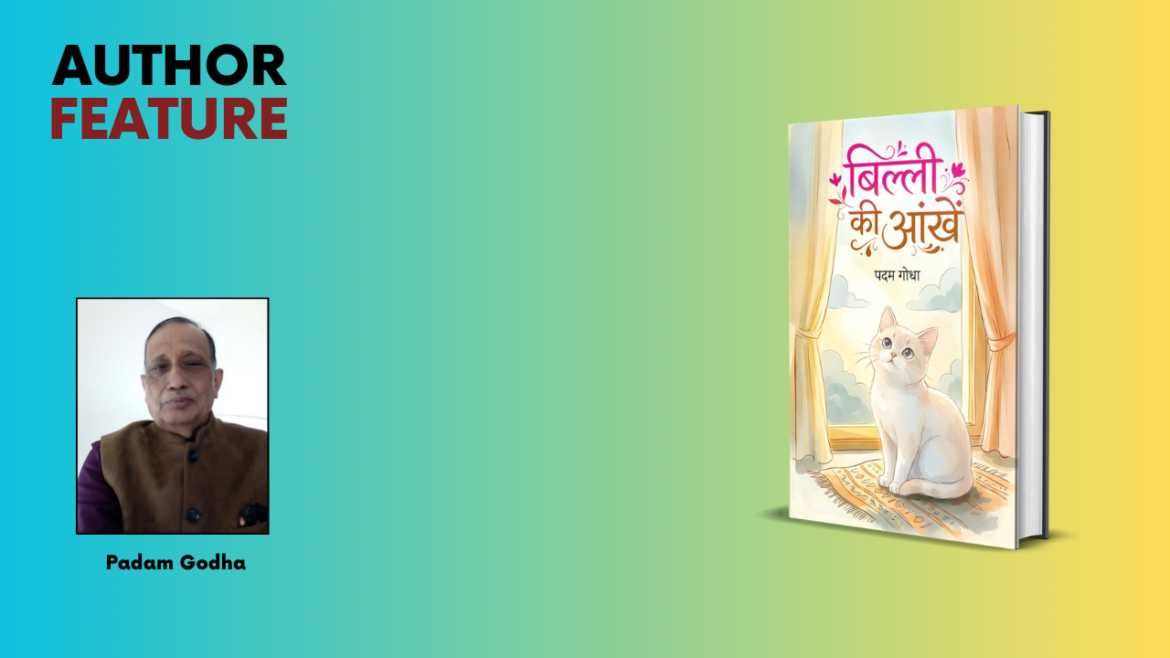
Literature becomes meaningful when it speaks about the real world around us. Some writers use complicated language and heavy ideas, while others touch the hearts of readers through simplicity and truth. Padam Godha belongs to the second category. His writing reflects ordinary life, human emotions, and social realities in a simple but powerful manner. His book Bili ki Aakhe carries this same strength and sensitivity. Padam Godha is a respected contemporary Hindi writer who has worked in many literary forms such as poetry, stories, essays, songs, and short-short stories. Born in Kota, Rajasthan, in 1948, he has spent many years observing society closely and expressing those observations through literature. His command over Hindi, English, and Hadoti language gives richness to his expression, but what truly makes his writing special is its emotional honesty and connection with common people.
The title Bili ki Aakhe itself creates curiosity. A cat’s eyes are often seen as sharp, alert, mysterious, and observant. In many ways, the title symbolically reflects the author’s way of looking at society. Just like a cat silently watches every movement around it, the writer carefully observes human behavior, social contradictions, and the realities hidden behind everyday life. The book presents society as it truly exists—with all its confusion, hypocrisy, humor, pain, and irony. It reflects an India where promises and reality often stand far apart. On one side are leaders making attractive promises, and on the other side are ordinary people struggling for daily needs. The book captures these contradictions with wit and sensitivity.
What makes this work interesting is that it is not bitter criticism. Instead, it uses satire and observation to make readers think deeply. The humor in the writing is not cruel. It is thoughtful and meaningful. Readers smile while reading, but at the same time they begin questioning the system, society, and even themselves. The book talks about the strange realities of modern life. People compare their lives with others and feel dissatisfied. Society often looks perfect from the outside, but inside there are struggles, insecurities, and loneliness. Through simple situations and observations, the author shows how human beings sometimes lose peace while chasing status, comfort, and recognition.
One important aspect of Padam Godha’s writing is his connection with common people. His characters and situations feel familiar because they are inspired by everyday life. Readers may feel that they have seen such people in their own surroundings—neighbors, relatives, officials, teachers, or ordinary workers. This relatability makes the book emotionally powerful. The author also highlights the gap between ideals and reality in society. People speak about honesty, morality, and simplicity, but often behave differently in real life. Religious teachings, political speeches, and social values sometimes become only words without true practice. The book raises these questions indirectly through satire and storytelling.
Padam Godha’s literary style is simple yet impactful. He does not use difficult words to impress readers. Instead, he writes in a natural and flowing style that keeps readers engaged. His simplicity becomes his strength because it allows people from different backgrounds to connect with his ideas easily. Another beautiful quality of the book is its emotional balance. Even while discussing serious social issues, the writing does not become too heavy or depressing. There is humor, warmth, and humanity throughout the narrative. The author understands that laughter itself can become a form of resistance against negativity and injustice.
The book also reflects the cultural richness of Indian society. Through language, situations, and social references, readers can feel the atmosphere of everyday Indian life. Small incidents become meaningful because they represent larger truths about society and human nature. Padam Godha’s long literary journey is clearly visible in his mature writing. His experience in life and literature gives depth to his observations. His earlier works such as Meri Chahat, Farewell, and Kana-Bati have already established him as a thoughtful writer, and Bili ki Aakhe further strengthens that identity.
Apart from literature, the author has also remained active in social and religious activities. His interest in astrology, palmistry, and homeopathy reflects his curiosity toward human life and inner understanding. This multidimensional personality adds richness to his writing and perspective. In today’s world, where people are surrounded by noise, news, and constant distractions, books like Bili ki Aakhe encourage readers to pause and observe life carefully. It reminds readers that literature is not only for entertainment but also for awareness and self-reflection.
Overall, Bili ki Aakhe is a thoughtful and engaging work that reflects the realities of Indian society through sharp observation, meaningful humor, and emotional depth. Padam Godha successfully uses simple language to discuss important social truths. The book entertains readers, but more importantly, it encourages them to think, question, and understand life more deeply. In the end, Bili ki Aakhe becomes more than just a literary work. It becomes a mirror where society can quietly see its own face.