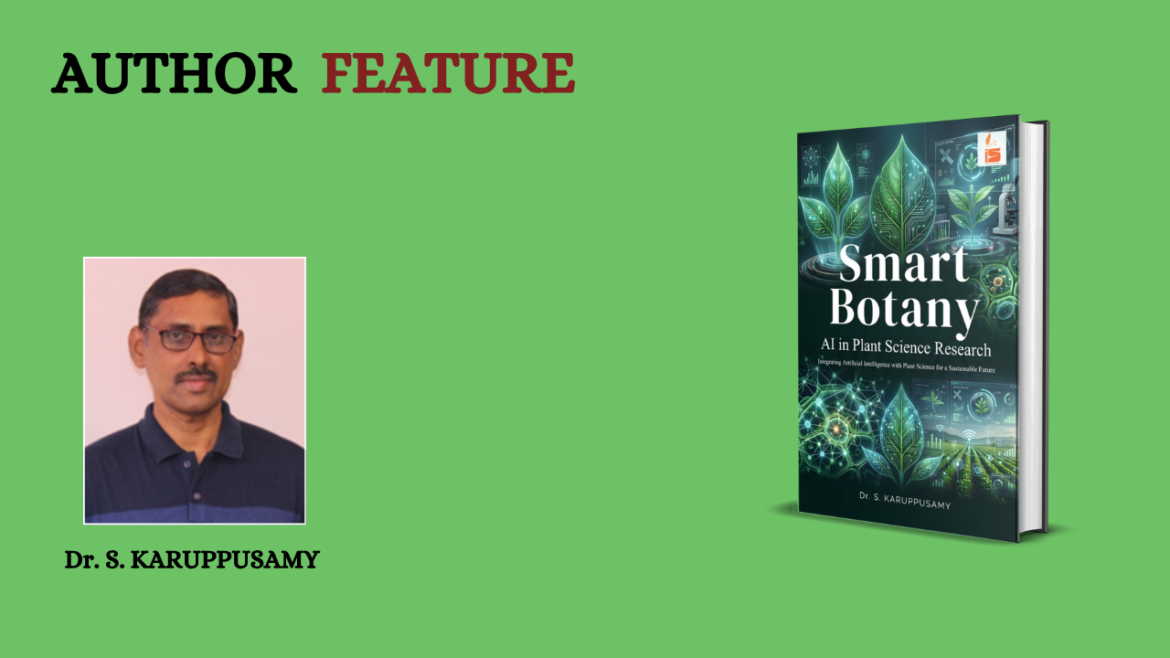
Title: Smart Botany:AI in Plant Science Research
Author: Dr. S. KARUPPUSAMY
ISBN: 978-93-7900-403-1
Publisher: Inksight Publishers
The world is changing very fast because of technology. Artificial Intelligence, also called AI, is becoming part of almost every field today. From hospitals to banks, from mobile phones to industries, AI is helping people work faster and smarter. Now, this modern technology is also entering the world of plants and agriculture. The book Smart Botany: AI in Plant Science Research by Dr. S. Karuppusamy beautifully explains how artificial intelligence is transforming plant science and agriculture for the future. This book is not only for scientists or researchers. It is written in a way that students, teachers, agriculturists, and ordinary readers can also understand the exciting connection between technology and nature. The author explains difficult scientific ideas in simple language, making the subject easy and interesting.
Dr. S. Karuppusamy is a highly respected botanist and researcher with many years of experience in plant science. His academic journey and research achievements are truly inspiring. He has written more than 200 research papers and several important books related to botany, medicinal plants, biodiversity, and taxonomy. His deep knowledge and passion for plant science are clearly reflected in this book. What makes this work special is that it connects two very different worlds—plants and artificial intelligence. Traditionally, botany was mainly based on field observation, laboratory research, and manual study. But now, AI is helping scientists study plants in smarter and faster ways.
The book explains how technologies like machine learning, robotics, remote sensing, and data analysis are helping researchers understand plants more accurately. Earlier, identifying plant diseases or studying crop growth could take a lot of time and effort. Today, AI systems can quickly analyze plant conditions and provide useful solutions. One of the most interesting parts of the book is how AI can help farmers and agriculture. In many countries, including India, farmers face problems such as climate change, water shortage, pests, and crop diseases. These challenges affect food production and increase the difficulties of farming communities.
Through AI-based tools, farmers can now monitor crops, predict weather conditions, detect diseases early, and use resources more efficiently. This not only saves time and money but also improves crop production. The book shows how smart agriculture can become a solution for future food security. The author also discusses precision agriculture, which means using technology carefully to improve farming practices. Instead of wasting water, fertilizers, or pesticides, farmers can use AI systems to understand exactly what their crops need. This helps both the environment and agricultural productivity.
Another important subject covered in the book is biodiversity conservation. Many plant species around the world are under threat because of deforestation, pollution, and climate change. AI can help scientists track endangered species, study ecosystems, and create better conservation strategies. This makes technology an important partner in protecting nature. Dr. Karuppusamy also explains complex scientific concepts in a learner-friendly way. Readers do not need advanced computer knowledge to understand the book. The author introduces AI concepts step by step and connects them with practical examples from plant science. This simple approach makes the book highly useful for beginners and students.
The book also reflects the future of education and research. Today, science is becoming more interdisciplinary. Subjects are no longer completely separate from each other. Biology, computer science, agriculture, and environmental studies are now working together to solve global problems. Smart Botany represents this new direction of scientific thinking. The author’s long research experience gives strong credibility to the work. His contributions to plant taxonomy, medicinal plants, and biodiversity studies have already earned him national and international recognition. Awards such as the Young Scientist Award and Prof. Y.S. Murthy Gold Medal highlight his dedication to botanical research.
At the same time, despite his high academic achievements, the author writes with simplicity and clarity. This balance between scientific depth and easy explanation is one of the strongest qualities of the book. Another inspiring aspect of the book is its focus on sustainable development. The author repeatedly reminds readers that technology should not harm nature but should support environmental balance. AI should be used to improve human life while protecting biodiversity, natural resources, and ecological systems.
The book also encourages young researchers and students to explore new possibilities in science. It shows that innovation is possible when curiosity, technology, and scientific knowledge come together. For students interested in botany, agriculture, or AI, this book can become a source of inspiration. In today’s world, where food security and environmental challenges are growing rapidly, books like Smart Botany become highly relevant. They prepare society for a future where science and technology work together for sustainable solutions.
Overall, Smart Botany: AI in Plant Science Research is an informative, forward-looking, and inspiring book. Dr. S. Karuppusamy successfully explains how artificial intelligence can transform plant science, agriculture, and environmental conservation. Through simple language and practical examples, the book makes a complex subject accessible to everyone. More importantly, the book gives hope for the future. It shows that when human intelligence and artificial intelligence work together with nature, a better and more sustainable world is possible.