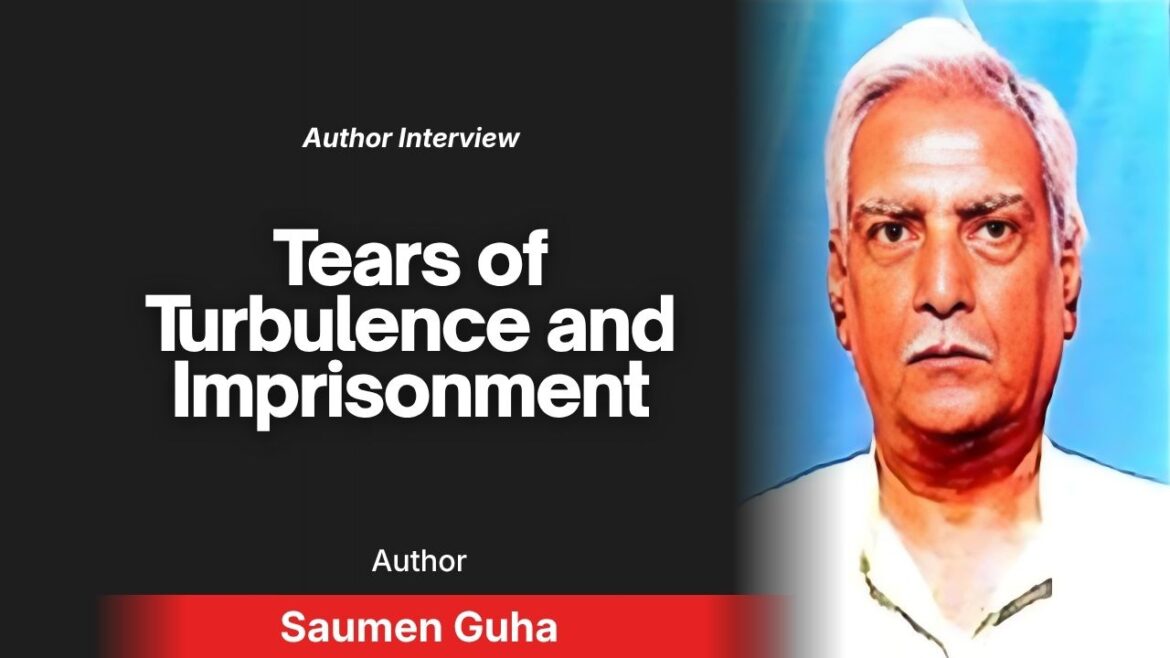
Title: Tears of Turbulence and Imprisonment
Author: Saumen Guha
ISBN: 9789373356594
Publisher: Evincepub Publishing
About the Book
The book consists of poems on various themes and feelings, and in addition English version of some older poems of the author with social, human and revolutionary context, and finally some poems written during imprisonment in 1970s.
About the Author
Saumen Guha was born in 1947 in East Pakistan (now Bangladesh), brought up as a poor refugee in West Bengal, and is now an Indian citizen.
Formally trained in science and engineering for his livelihood, he left his job as Engineering Overseer (Mechanical and Electrical) at the Calcutta Metropolitan Development Authority in 1970 to work with poor peasants in villages as a Communist revolutionary (called Naxalite).
Due to his involvement in militant Communist ideology, he and his family members, including his wife, were arrested and brutally tortured by the West Bengal and Calcutta police in 1974 and imprisoned for three years.
He is the architect of the internationally famous and historic ‘Archana Guha Case’ against torture in police custody, one of the world’s longest legal battles, and continues the crusade as counsel for the prosecution toward victory.
He is a devoted reader, writer, painter, and music lover. He has written and edited several books and authored many articles on human rights, music, films, literary biography, socio-economics, nuclear pollution, and related subjects.
Saumen is now busy preparing the English version of his memoir of imprisonment, Bright Darkness, and a compilation of documents related to the ‘Archana Guha Case’ against torture in police custody.
Deep in the Broken Words is the first book of English poems by Saumen Guha. Tears of Turbulence and Imprisonment is his second book of English poems.
Pavan Dewangan: How did your childhood as a refugee shape your thinking and writing?
Saumen Guha: In my early childhood, when I arrived in West Bengal as a refugee from East Bengal, we were extremely poor; I grew up amidst that poverty. During my student years, I never had electric lighting at home – we relied on kerosene lamps. Living in a house with a tin roof meant the interior would become scorching hot during the summer, while during the monsoon season, water would pour in through roof leaks, flooding the room. Yet, amidst this way of life, I gained something invaluable: a deep understanding of the neglected and the deprived – of who they are and the realities they face. I believe that growing up beyond the limitations of what is termed ‘babu’ or affluent culture has shaped my future, instilling in me the importance of struggle, action, and critical thinking.
Pavan Dewangan: What led you to leave your engineering career and work with poor peasants?
Saumen Guha: My earliest experiences in life showed me that people from the lower strata were subhuman; yet, having achieved considerable success in my own career, I never once erred in dreaming that one day, these people from the lower rungs would awaken and it was against this backdrop that, in 1967, the political climate… I, too, became a convert to the dream of a revolution; thus, leaving behind my lucrative domain, I traveled to an extremely poor village in the distant district of Bankura – a place where people lived in dire want and spent nearly four years among them; that experience opened my eyes to a whole new perspective on life. The depths of hardship people can endure – yet not even the faintest hint of that suffering is reflected in our ‘babu’ culture.
Pavan Dewangan: How did your experiences during the political movement influence your poetry?
Saumen Guha: Whether or not we succeeded in bringing about a revolution is beside the point; yet, the revolutionary spirit that took root within me remains a cherished, lifelong memory. Alongside that, a genuine consciousness regarding the struggle for human rights was born –
not merely in words, but in spirit. And so, in my moments of quiet solitude, my own thoughts and dreams took the form of words within my poetry – words I had first glimpsed deep within my heart.
Pavan Dewangan: What was the biggest lesson you learned during your years in prison?
Saumen Guha: I spent nearly three years in prison, and that experience taught me a great deal. While confined there, I formulated many plans for the future; it was upon acting on those very plans after my release that I was truly reborn. To those around me, Archana Guha became a figure of astonishment. The case originated from a vow I took in prison: I could not remain silent in the face of police brutality; I had to fight against it – and do so within the framework of the state. Thus, I stood tall – a new Saumen.
Pavan Dewangan: How did writing help you cope with difficult times in life?
Saumen Guha: My dreams, promises, and plans have gradually strengthened the inner resolve and potential within me; and my poetry, at first, became a conversation with myself. Silently and quietly, I was penning down the thoughts of my heart for the world to see, cherishing the hope that one day these poem might stir someone’s soul – touching them deeply. In that moment, these poems would find their fulfillment, and the days of my own suffering would seem radiant to me.
Pavan Dewangan: Did imprisonment change your view of people and society?
Saumen Guha: During my life in captivity, I witnessed another world – a realm often perceived by many as the domain of criminals, yet also a place where the humiliation and torture inflicted upon human beings are laid bare. Witnessing this firsthand has shaped my mind, steeling my resolve to move towards a firm, unyielding decision. This intellectual life has given me the opportunity to reflect on the fact that if one moves forward with a genuine commitment to the work, a great deal can be accomplished – even alone.
Pavan Dewangan: How do the poems written during imprisonment differ from your other poems?
Saumen Guha: There was a distinct kind of anguish in the poems written during captivity. Coupled with that was a deep-seated desire to give voice to thoughts long suppressed within the mind; in the absence of the Liberation War itself, I found a sanctuary for my reflections in friendship. And so, it was not the light and air of the outside world that taught me to think deeply about my society and the people at its lowest rungs; that was something made possible only from within the confines of the prison – something the ‘glamorous’ atmosphere outside could never have fostered.
Pavan Dewangan: What emotions came back while revisiting those prison memories?
Saumen Guha: Just as I used to think about my life outside while sitting in prison, today, when I reflect on my time in prison, I try to recall how I endured the anguish of that intellectual existence – and I seek to draw further strength from that memory.
Pavan Dewangan: How important is hope during times of struggle?
Saumen Guha: One must fight with optimism, for optimism is the greatest weapon in that struggle; I have always remained optimistic, yet I have constantly kept in mind that true action matters more than mere words – action that is within my capability to execute – and the very act of believing this constitutes optimism.
Pavan Dewangan: What kept you mentally strong during your toughest years?
Saumen Guha: In my difficult times, I have not lost hope, and most importantly, I have kept a strength in my mind, a strength that I have seen in the unknown, the unspoken, the people in our society who do not get publicity, who are not brought to publicity, I have seen those people when I was a friend, when I was sitting outside, when I was a resident. These unsung individuals are our greatest source of strength; just as I witnessed this in my own mother, I have seen many other mothers embody the ideal of a strong person while living in captivity.
Pavan Dewangan: How has your understanding of freedom changed over time?
Saumen Guha: For me, independence has been a natural state of affairs since early childhood, yet I have never witnessed the state’s independence actually resolving issues regarding people’s thoughts, education, housing, or even their food security. We, belonging to a privileged minority, have managed to reap some of the benefits of this independence, but what of those oppressed people? I have seen that the vast majority of people have never reaped any benefits of independence, and I have learned a great deal from that.
Pavan Dewangan: Do you believe pain can make a person more creative?
Saumen Guha: There is no denying that the history of art, science, and literature within global culture has often developed in the hands of those experiencing backward poverty or neglect. While neglect and poverty are undesirable conditions, human suffering frequently brings about both destruction and construction. Following that thread – creativity is born.
Pavan Dewangan: What would you like young people to learn from your life journey?
Saumen Guha: No matter where today’s young people come from, they must keep one important idea in mind: they have a role to fulfill in society and for others – regardless of whether that role receives praise or criticism. Actions speak louder than words; thus, they should remain committed to the belief that contributing to the greater good of humanity is one of life’s essential objectives.
Pavan Dewangan: Looking back, is there anything you would do differently?
Saumen Guha: The Archana Guha case – widely known not just in India but across the globe as one of the longest-running legal battles against police brutality – stands as one of the major achievements of my life. Moreover, no matter the financial or physical hardships life dealt me, it never stinted when it came to education and culture; I have received so much from life, and I have absolutely no regrets. So, when I look back at the past, I have no regrets whatsoever; I remain the same old Saumen I have always been.
Pavan Dewangan: How do you turn painful experiences into meaningful poetry?
Saumen Guha: I have witnessed a great deal of human suffering and endured significant pain myself; therefore, my poems are deeply rooted in that anguish, aiming to convey it into the future. However, suffering is not the ultimate conclusion; alongside it exists the joy of fulfillment that arises from new creation.