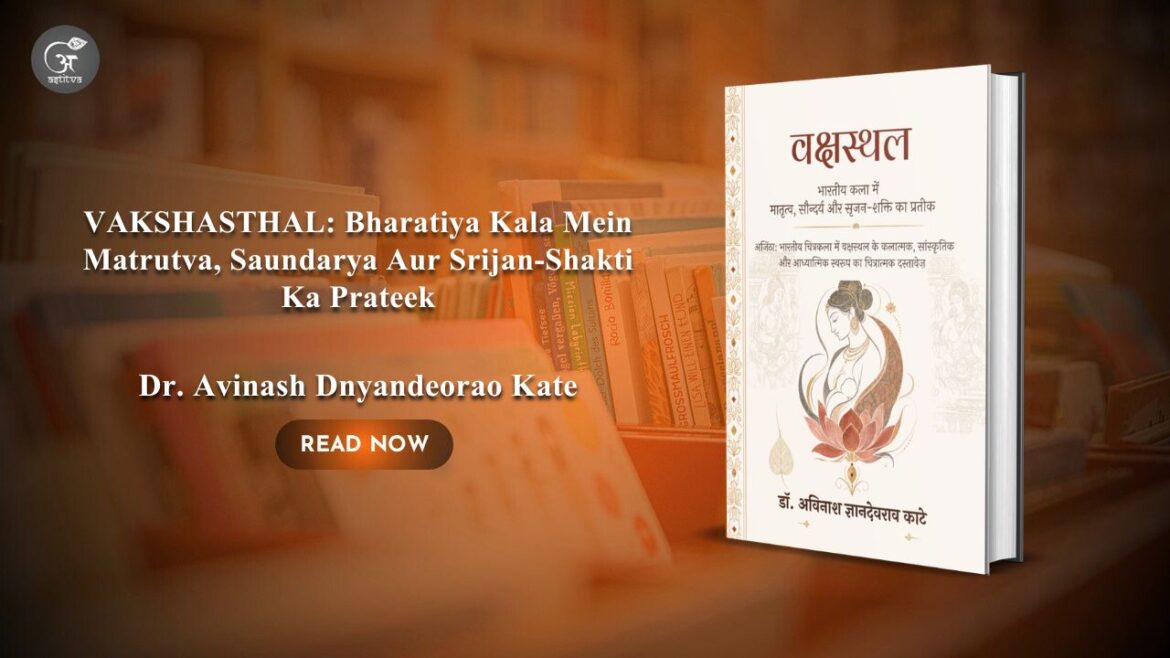
The release of VAKSHASTHAL: Bharatiya Kala Mein Matrutva, Saundarya Aur Srijan-Shakti Ka Prateek, with the subtitle Ajanta: Bharatiya Chitrakala Mein Vakshasthal Ke Kalatmak, Sanskritik Aur Adhyatmik Swaroop Ka Chitratmak Dastavez, by Dr. Avinash Dnyandeorao Kate, presents a thought-provoking exploration of Indian art, aesthetics, culture, spirituality, and the symbolic representation of the feminine. Going beyond a conventional study of paintings and images, the book invites readers to reconsider the way Indian art is viewed and understood.
At the heart of the book is the idea that art is not merely something to be seen, but something to be understood through the cultural and philosophical vision from which it emerged. In an age characterized by unprecedented access to information and visual content, the deeper understanding of art becomes increasingly important. Ancient Indian paintings, sculptures, temples, and architectural traditions cannot always be adequately understood when separated from their cultural, philosophical, spiritual, and aesthetic contexts. VAKSHASTHAL seeks to restore this contextual vision.
The book pays particular attention to the representation of the feminine form in Indian artistic traditions, especially in the murals of Ajanta and the broader sculptural and visual heritage of India. It challenges the tendency to interpret such representations solely through physical beauty or external form. Within the Indian aesthetic tradition, the feminine has often carried meanings far beyond appearance. It can represent motherhood, creation, Shakti, compassion, nature, knowledge, fertility, beauty, and the continuity of life. Through this perspective, the book encourages readers to look beyond the physical and discover the symbolic and spiritual dimensions embedded within artistic forms.
Ajanta becomes an important visual and cultural reference point in this exploration. However, the author’s vision extends beyond a single artistic centre to encompass the wider heritage of India, including Ajanta, Ellora, Khajuraho, Konark, Belur, Halebidu, and other remarkable centres of Indian art. The book argues that when these artistic traditions are viewed only through an external or modernized lens, their deeper meanings may remain concealed. By approaching them through Indian philosophy, spirituality, Shilpa Shastra, aesthetics, and cultural consciousness, familiar forms begin to reveal new dimensions of human existence and experience.
Dr. Avinash Dnyandeorao Kate brings a distinctive combination of artistic practice, academic inquiry, education, and cultural engagement to this work. An artist, educator, researcher, and academic professional, he has devoted significant attention to Indian art, culture, heritage, visual culture, Fine Arts, Design, and Indian Knowledge Systems. His professional journey encompasses painting, conceptual art, murals, exhibitions, art camps, curriculum development, research, and academic writing.
His association with institutions and cultural organizations such as All World Gayatri Pariwar, Shantikunj, Haridwar, and Dev Sanskriti Vishwavidyalaya has further strengthened his engagement with Indian cultural values, education, and traditions. As an educator and curriculum developer, Dr. Kate advocates an integrated approach in which art, creativity, technology, spirituality, Indian knowledge traditions, and human values enrich one another.
With VAKSHASTHAL, Dr. Kate offers readers an opportunity to revisit Indian art through a more sensitive and culturally rooted vision. The book ultimately suggests that changing the way we see art can transform the way we understand ourselves, our heritage, and human life itself. By connecting visual beauty with motherhood, creation, spirituality, and cultural consciousness, this work becomes not simply a study of artistic representation, but an invitation to rediscover the deeper meanings embedded within India’s extraordinary artistic heritage.