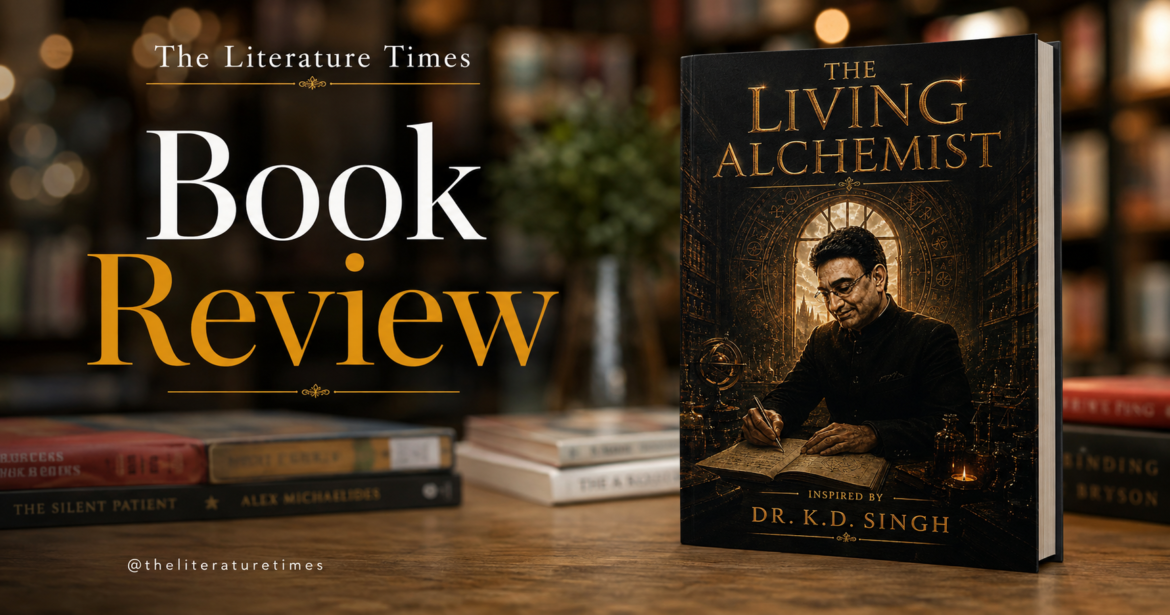
In a world that constantly celebrates speed, innovation, productivity, and growth, The Living Alchemist by Gaurav Arora asks a question that is both simple and deeply unsettling: are we truly becoming more advanced, or are we becoming more vulnerable? Rather than offering another conventional discussion about technology, careers, wellness, or the future, the book attempts to connect these seemingly separate aspects of modern life through a larger conversation about how human beings are living, thinking, and preparing for tomorrow. Written from the perspective of a corporate communicator, brand strategist, storyteller, and wellness professional, The Living Alchemist reflects an author who has spent years observing the changing relationship between people, businesses, technology, and society. The result is a contemporary work that encourages readers to pause, question familiar assumptions, and look beyond the obvious.
One of the book’s most relevant strengths is its engagement with the anxieties and uncertainties of the present generation. Gaurav Arora turns his attention towards Gen Z, education, careers, artificial intelligence, digital lifestyles, global conflicts, environmental challenges, and the health crises that may define the future. These are not distant subjects anymore. They are part of everyday conversations and decisions, influencing how young people study, work, communicate, build relationships, and imagine their futures. By bringing these subjects together, the book creates a broad picture of a world experiencing rapid transformation. However, its purpose is not simply to list the problems surrounding modern society. Instead, it asks readers to examine the consequences of progress and consider whether technological and economic advancement automatically translates into a healthier and more meaningful life.
At the heart of the book is the philosophy, “WELLNESS PRECEDES ILLNESS.” This idea provides the conceptual foundation for much of the narrative. Rather than encouraging people to think about health only after a problem appears, the philosophy places awareness, prevention, immunity, and conscious living at the centre of everyday life. In this sense, wellness becomes more than a health-related concept. It becomes a way of approaching life itself. The book encourages readers to think about prevention not only in relation to physical health, but also in relation to the choices, habits, environments, and systems that shape human wellbeing. This makes the central message particularly relevant in an era when people are increasingly surrounded by convenience but often struggle with stress, uncertainty, information overload, and lifestyle-related challenges.
Another compelling aspect of The Living Alchemist is the author’s professional journey and how it influences his perspective. Gaurav Arora brings together experience from pharmaceuticals, wellness, branding, and corporate communication. His association with organisations such as Cadila Pharmaceuticals, Ozone Pharmaceuticals, and Alchemist has exposed him to different dimensions of business, leadership, communication, and healthcare. His academic background, including a PGDM from Amity Business School, Noida, and a Post Graduate Diploma in Digital Marketing from IIT Delhi, further reflects his engagement with both management and the digital world. Today, as CXO of Alchemist Wellness, he operates at the intersection of strategy, communication, creativity, and wellness. This combination gives the book a distinctive perspective because it is not written purely from an academic or theoretical position. It emerges from professional observation and an attempt to transform those observations into a larger conversation.
The author’s identity as a storyteller also plays an important role in the book’s appeal. Gaurav Arora understands that ideas become more powerful when they can connect with people emotionally. His transition from building brands to telling stories represents one of the central movements behind The Living Alchemist. The book reflects the belief that communication should not merely deliver information. It should create awareness, encourage reflection, and give people a reason to think differently. This approach gives the work a broader purpose than conventional business or wellness writing. It attempts to bring together professional experience and human concerns, asking what kind of world people are collectively creating through their choices.
The tribute to Dr. K. D. Singh adds another meaningful dimension to the book. His vision and entrepreneurial legacy are presented as an important inspiration behind the Alchemist journey. Through this connection, the book also becomes a reflection on legacy and the ways in which ideas can travel from one generation to another. Success, in this context, is not presented simply as personal achievement. It is connected with the ability to create something that continues to influence people and inspire future possibilities.
Ultimately, The Living Alchemist is a book about looking beyond the surface of modern progress. It asks readers to question whether convenience is always beneficial, whether technological advancement is always synonymous with human advancement, and whether society is paying enough attention to prevention and wellbeing. Its most significant contribution lies in bringing these questions into one larger narrative. From Chandigarh to the wider world, from professional experience to personal reflection, and from brands to beliefs, Gaurav Arora’s journey demonstrates how observation can become expression and expression can become a larger idea.
The Living Alchemist will appeal to readers interested in wellness, technology, contemporary society, leadership, communication, and the future of human living. More importantly, it invites readers to become active participants in the conversation it creates. Its central message is not that progress should be rejected, but that progress should be accompanied by awareness. We can continue to innovate, build, scale, and transform, but we must also ask what those changes are doing to our health, our minds, our communities, and our future. In that sense, Gaurav Arora’s book is not simply a commentary on the world we inhabit today. It is an invitation to think about the world we are preparing to inhabit tomorrow.
Use up and down arrow keys to resize the meta box pane.
Use up and down arrow keys to resize the meta box pane.
Use up and down arrow keys to resize the meta box pane.
Use up and down arrow keys to resize the meta box pane.