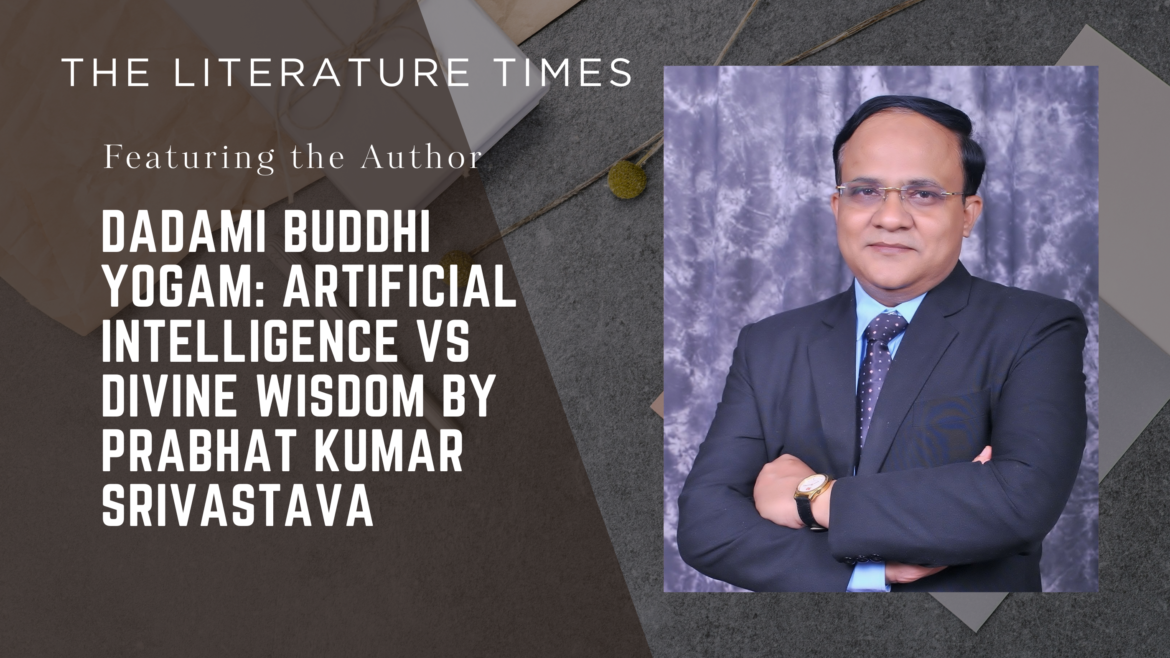
Prabhat Kumar Srivastava represents a distinctive voice emerging at the intersection of law, leadership, technology, and spirituality. With nearly 25 years of professional experience in the legal and corporate world, he has spent much of his career engaging with complex questions of law, business, leadership, decision-making, and human behaviour. Yet, beyond his professional accomplishments lies a deeper intellectual curiosity—an enduring search for the meaning, direction, and purpose behind human life. This search has now found expression in his debut work, Dadami Buddhi Yogam: Artificial Intelligence Vs Divine Wisdom.
Currently serving as Senior Director – Legal at an Indian multinational company, Srivastava brings a wealth of experience from the corporate environment. His professional journey has exposed him to the realities of modern organizations, where technology, data, strategic thinking, and artificial intelligence increasingly influence decisions. In an era where machines can process enormous amounts of information within seconds, he became increasingly interested in a fundamental question: Does greater intelligence necessarily lead to greater wisdom?
That question forms the philosophical foundation of his writing.
As artificial intelligence rapidly becomes part of everyday life, humanity is witnessing an unprecedented transformation. Machines can answer questions, analyse information, generate ideas, predict outcomes, and assist in decision-making. Yet technological advancement has not eliminated the timeless human struggles of anxiety, confusion, ambition, dissatisfaction, strained relationships, or the search for meaning. For Srivastava, this contradiction raises an important distinction between intelligence and wisdom.
His perspective is deeply influenced by the Bhagavad Gita, Vedic philosophy, and spiritual psychology. Rather than viewing ancient wisdom and modern technology as opposing forces, he explores the possibility that they address fundamentally different dimensions of human existence. Artificial intelligence can increase capability, but it cannot necessarily determine what is worth pursuing. It can provide information, but information alone does not guarantee understanding. It can assist with decisions, but the responsibility of choosing the right path ultimately remains deeply human.
This exploration takes literary form in Dadami Buddhi Yogam, a work that combines contemporary concerns with an eternal spiritual question. The title draws inspiration from the Bhagavad Gita, particularly the profound promise expressed in Chapter 10, Verse 10: “Dadami Buddhi Yogam”—the idea that divine wisdom guides the sincere seeker toward the right understanding.
At the centre of the story is Madhav, a boy from the sacred city of Kashi who is initially dismissed and ridiculed because of his limited intellectual abilities. His journey challenges conventional ideas about intelligence, success, and human potential. Through struggle, devotion, perseverance, and an unseen grace, Madhav undergoes a transformation that becomes far greater than a personal victory.
His story becomes a reflection on what happens when human effort meets a higher sense of purpose.
Through Madhav’s journey, Srivastava explores how a person’s limitations do not necessarily define his destiny. The qualities that society may overlook—faith, sincerity, perseverance, compassion, and inner strength—can become the foundation for meaningful transformation. As the story unfolds, Madhav’s evolution begins to influence others, leading to the creation of institutions, the touching of lives, and the emergence of a new understanding of intelligence.
The novel therefore moves beyond the conventional conflict between technology and spirituality. It asks readers to reconsider the very meaning of intelligence. In a world increasingly fascinated by artificial intelligence, perhaps the more important question is not how intelligent machines can become, but how wisely human beings choose to use them.
This perspective is particularly relevant to Srivastava’s own professional background. Having spent decades working within the corporate legal and business environment, he understands the importance of rational analysis, strategy, and technological capability. At the same time, his engagement with spiritual thought has led him to recognize that human beings require something beyond efficiency. They require direction, values, discernment, and an understanding of purpose.
His writing reflects this balance between the practical and the philosophical.
Srivastava does not position Dadami Buddhi Yogam as a conventional spiritual text or a technical discussion about artificial intelligence. Instead, he uses fiction as a medium to initiate an inner conversation. The story invites readers to look beyond external achievement and question what truly makes a life successful. It asks whether technological progress can answer questions of identity, purpose, morality, and fulfilment—or whether these questions require a different kind of intelligence altogether.
For Srivastava, the answer lies in the distinction between knowledge and wisdom. Knowledge may tell us what can be done. Intelligence may help us determine how it can be done. But wisdom asks whether it should be done and, more importantly, whether it serves a higher purpose.
This philosophy also defines his vision as an author. Through his writing, he hopes to encourage self-reflection, ethical leadership, and purposeful living. His message is especially significant for a generation growing up alongside rapidly evolving artificial intelligence, where the ability to access information is becoming easier while the ability to find meaning can remain profoundly difficult.
Dadami Buddhi Yogam is ultimately an invitation to pause amid the acceleration of modern life. It encourages readers to look beyond the noise of ambition, technology, success, and social expectations and return to the fundamental questions that have accompanied humanity for centuries: Who am I? What is my purpose? What should guide my choices?
Prabhat Kumar Srivastava’s journey from corporate legal professional to author reflects his belief that professional success and spiritual inquiry need not exist in separate worlds. His debut work brings these two dimensions together, offering readers a story that speaks to the challenges of the present while drawing strength from an ancient source of wisdom.
In an age when artificial intelligence continues to redefine what machines can do, Srivastava reminds us of something equally important: the future of humanity will not depend only on how intelligent our technology becomes, but on how wisely we choose to live. Where artificial intelligence can expand human capability, divine wisdom, in his vision, provides the direction. And it is in that space between capability and purpose that the real human journey begins.