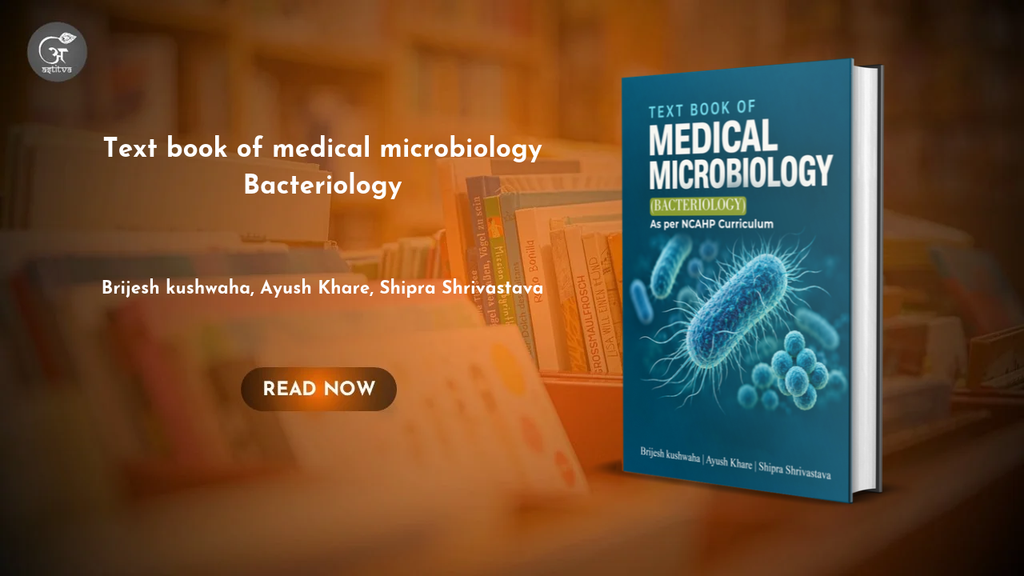
A valuable academic resource for students and professionals in the field of medical laboratory sciences, Text Book of Medical Microbiology (Bacteriology), authored by Brijesh Kushwaha, Ayush Khare, and Shipra Shrivastava, presents a comprehensive and structured exploration of medical bacteriology. Designed primarily for students pursuing B.Sc. Medical Laboratory Technology (MLT) and other allied health science programmes, the book follows the curriculum prescribed by the National Commission for Allied and Healthcare Professions (NCAHP). It aims to strengthen students’ conceptual understanding of medically important bacteria, bacterial infections, and the laboratory techniques essential for accurate diagnosis, management, and prevention of infectious diseases.
Bacteriology is an essential branch of medical microbiology that plays a significant role in understanding infectious diseases and their impact on human health. The book introduces readers to the fundamental principles of medical bacteriology, covering the characteristics, classification, pathogenicity, clinical significance, and laboratory identification of various bacterial species. Through a systematic and organism-wise approach, it explains the morphology, cultural characteristics, biochemical reactions, virulence factors, associated diseases, and diagnostic methods of clinically important bacteria.
The book covers a wide range of Gram-positive and Gram-negative bacteria, including Staphylococcus, Streptococcus, Corynebacterium, Bacillus, Mycobacterium, Neisseria, Enterobacteriaceae, Vibrio, Pseudomonas, and spirochetes. It further explores anaerobic bacteria, Mycoplasma, Actinomycetes, Nocardia, and other microorganisms of clinical importance. Special emphasis is placed on understanding the distinguishing features of these organisms and their identification through morphological, cultural, biochemical, and laboratory diagnostic characteristics.
Beyond the study of individual bacterial groups, the book addresses bacterial infections affecting different organ systems, healthcare-associated infections, and essential infection prevention and control practices. It also introduces environmental bacteriology, explaining the microbiological aspects of air, water, food, and milk, along with their relevance to public health, sanitation, and disease prevention. The concepts are supported by structured explanations, comparative tables, illustrations, and practical laboratory-oriented approaches, making complex scientific information easier to understand and apply.
The book is a collaborative academic effort by three experienced professionals who bring together their knowledge, teaching experience, research contributions, and practical expertise in medical laboratory sciences.
Mr. Brijesh Kushwaha is an emerging academic professional in Medical Laboratory Sciences, currently serving as an Assistant Professor in the Department of Medical Laboratory Technology at Mansarovar Global University, Sehore, Bhopal. He holds a Bachelor of Medical Laboratory Technology (BMLT) and a Master of Medical Laboratory Technology (MMLT) in Medical Microbiology, along with specialized certifications in Reflexology. With a strong commitment to academic excellence, scientific inquiry, and professional mentorship, he actively contributes to healthcare education through innovative teaching and research-oriented practices. His academic interests include laboratory sciences, clinical diagnostics, and evidence-based healthcare education. As an educator and author, he believes in developing critical thinking, analytical competence, and scientific temperament among students. His vision is to inspire future healthcare professionals to pursue excellence, integrity, and innovation while making meaningful contributions to medical science.
Mr. Ayush Khare is a dedicated educator, researcher, and author currently serving as an Assistant Professor at SAM Global University. He holds qualifications in B.Sc., BMLT, and MMLT (Histopathology) and brings seven years of teaching experience in medical laboratory sciences and life sciences. His academic and research contributions include four published research papers, four authored book chapters, and one granted patent. He is also actively involved in research projects aimed at contributing to scientific advancements. Having taught and mentored more than 8,000 students, he is passionate about making complex scientific concepts simple, engaging, practical, and accessible. His contribution to this book reflects his academic expertise, research experience, and dedication to providing students with quality educational resources that support their learning and professional development.
Ms. Shipra Shrivastava is the Principal of S S College, Bhopal, with over 15 years of extensive experience in academics and clinical practice. She holds an M.Sc. in Biochemistry and an MMLT in Medical Microbiology, bringing multidisciplinary expertise across Medical Laboratory Technology, Clinical Biochemistry, General Biochemistry, Biotechnology, Applied Microbiology, and Medical Microbiology. Her research contributions include more than 10 articles published in national and international peer-reviewed journals, along with two published books. She has also presented over 10 research papers at academic conferences and holds two Indian patents. Her experience in guiding students through dissertations and clinical training reflects her commitment to academic excellence, research, innovation, and the advancement of allied health sciences education.
Together, the three authors have developed a resource that bridges theoretical knowledge with practical laboratory applications. Their combined academic backgrounds and professional experiences contribute to the book’s comprehensive approach, making it relevant not only for undergraduate students but also for teachers, researchers, and laboratory professionals seeking to strengthen their understanding of clinical bacteriology and diagnostic microbiology.
Text Book of Medical Microbiology (Bacteriology) is intended to serve as a useful learning companion for students preparing for academic examinations and developing the practical competencies required in medical laboratories. By presenting essential concepts in a systematic, accessible, and clinically relevant manner, the book encourages readers to understand the relationship between microorganisms, infectious diseases, and laboratory diagnosis.
With its curriculum-oriented content, detailed explanations, and emphasis on practical understanding, this book makes a meaningful contribution to medical laboratory science education. It reflects the authors’ shared commitment to knowledge, research, and the development of skilled healthcare professionals. The publication is expected to support aspiring medical laboratory technologists in building a strong scientific foundation and developing the diagnostic understanding necessary for their future professional responsibilities.






Your perspective matters
Share your thoughts respectfully. Comments are moderated.