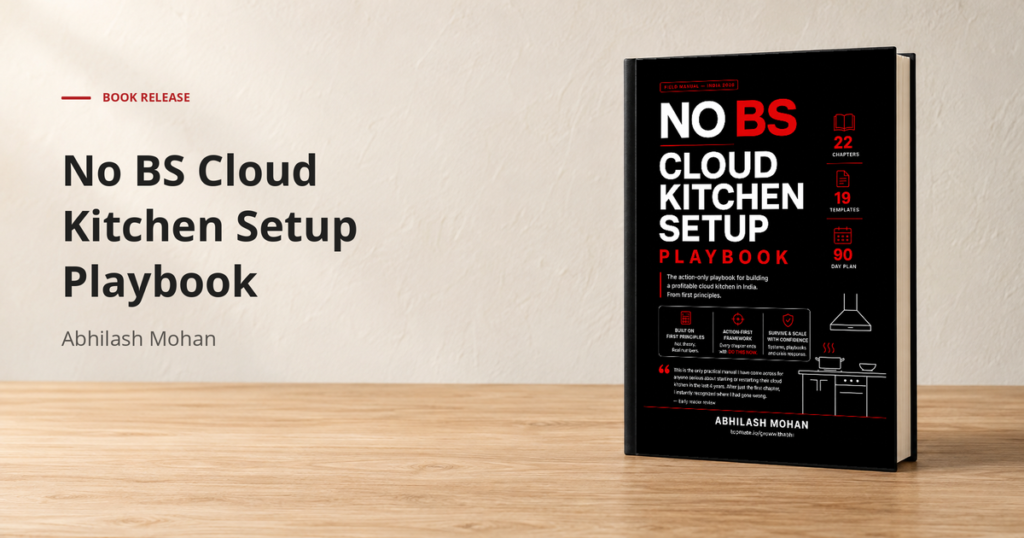
No BS Cloud Kitchen Setup Playbook
Abhilash Mohan brings an operations-led perspective to food entrepreneurship with No BS Cloud Kitchen Setup Playbook, an English-language nonfiction guide for first-time cloud kitchen founders in India. Presented as a practical field manual, the book focuses on the decisions behind setting up and running a delivery-led food business. Its stated scope extends from unit economics and compliance to aggregator strategy, customer retention and crisis management, placing the work of operating a kitchen at the centre of the entrepreneurial journey.
The book is intended for readers who want to move beyond researching a business idea and begin evaluating what it would take to execute it. Its central proposition is that the preparation for a cloud kitchen needs to address financial and operational realities alongside the food itself. For someone considering a first venture, that means approaching the kitchen as a business with interdependent decisions, rather than treating the launch as the end of the planning process.
A business framework that begins before the launch
The guide is organised into 22 chapters across five sections: Before You Spend a Rupee, Build the Machine, Get Customers, Optimize and Scale, and Survive. Those titles establish a sequence that begins with early decisions about committing resources and continues through the demands of daily operations, customer acquisition, growth and disruption. The structure gives the proposed business a longer horizon than its opening day.
Before You Spend a Rupee signals the importance the book places on examining a venture before capital is committed. Unit economics is among the subjects identified in its description, bringing the financial implications of individual orders into the discussion. This emphasis is especially relevant to the book’s intended reader: a first-time founder trying to connect an appealing food concept with the practical demands of sustaining a business.
Build the Machine then places attention on the operating structure behind the concept. The book’s overall coverage includes compliance and operational systems, while its account of the founder’s journey moves beyond setup to the work of keeping a kitchen functioning. In that context, a business plan becomes the starting point for a set of recurring decisions rather than a document completed once and set aside.
The remaining sections extend that perspective to demand, improvement and resilience. Get Customers connects with the guide’s coverage of aggregator strategy and retention marketing. Optimize and Scale and Survive acknowledge that attracting orders is only one stage of the journey. Taken together, the section outline presents growth and crisis management as part of the same operating responsibility, giving readers a view of the business that includes both progress and pressure.
Practical tasks and reusable working tools
A defining feature described in the book’s overview is the action block at the end of every chapter. Labelled DO THIS NOW, these blocks contain specific tasks intended to move the reader from an idea to an executable next step. The format makes application a recurring part of the reading process, rather than leaving all implementation work until the final chapter.
The guide also includes 19 printable templates. The examples identified in the book description include a unit economics calculator, a compliance checklist, a 90-day execution calendar, a weekly profit and loss tracker, and crisis response scripts. These materials span preparation, routine monitoring and responses to difficult situations, reinforcing the field-manual format.
The combination of chapter-end tasks and working templates gives the book a clearly defined purpose. A reader can approach it with a business question in mind and use the accompanying materials to organise the work that follows. A calendar introduces a time dimension to planning, while a weekly tracker creates a recurring point of reference. Their inclusion reflects the book’s emphasis on turning decisions into an operating routine.
This practical orientation also shapes the guide’s tone. Its description places the emphasis on calculations, systems and decisions, rather than motivation alone. The subject is the work a founder needs to understand before committing resources and the discipline involved in carrying that understanding into day-to-day operations. That focus gives the playbook a specific audience and a specific role within a founder’s preparation.
An author with corporate and kitchen experience
Mohan’s author biography describes him as an Operations and Workforce Management leader with more than ten years of experience in complex delivery organisations. It lists senior roles at World Wide Technology, IBM Consulting and Teqfocus, with responsibilities spanning workforce planning, capacity management, performance systems and delivery operations. His professional experience, as outlined in the biography, covers India, APAC, the United Kingdom, Germany and Switzerland.
The same biography records his move into food entrepreneurship in 2024, when he founded and operated Bengaluru Breads & Chops. The cloud kitchen was launched on Zomato and Swiggy. Over a twelve-month period, the biography reports, Mohan fulfilled more than 1,500 orders and maintained a 4.2 rating on Zomato. These details provide the personal operating context behind the guide’s account of cloud kitchen ownership.
His responsibilities at the kitchen included vendor onboarding, staffing, compliance, menu engineering, platform management, quality control and digital marketing. According to the biography, he managed these functions independently, without external agency support. The breadth of that work is relevant to the book’s premise: a founder has to engage with several parts of the business, even when the original idea begins with a particular product or menu.
Mohan’s academic background includes a dual Master of Business Administration from THWS Germany and Christ University, Bengaluru, with a thesis on Emotional Intelligence in Leadership Development. His biography also identifies a career and leadership coaching practice, through which he works with engineers, managers and first-time entrepreneurs on performance conversations, career transitions and operational planning. He is based in Bengaluru, Karnataka.
A focused resource for first time entrepreneurs
No BS Cloud Kitchen Setup Playbook brings these two strands of experience together: the management of delivery organisations and the direct responsibilities of running a food business. The book description identifies that combination as the basis of its approach. Its intended contribution is to make the operational questions of cloud kitchen ownership more concrete for readers preparing to encounter them for the first time.
The Indian focus is integral to that audience. Rather than presenting a broad account of entrepreneurship, the guide concentrates on a defined business model and the decisions surrounding it. Its coverage of aggregators, customer retention, financial tracking and crisis response keeps attention on the work that continues after setup. The 22-chapter structure and accompanying templates provide a framework for considering those subjects together.
For aspiring food entrepreneurs, the book introduces a practical route into the questions that sit behind a cloud kitchen launch. Its emphasis on preparation is matched by attention to the responsibilities that follow the first orders, giving readers a reason to consider the whole operating journey from the outset. By carrying its scope from preparation through survival, Mohan’s playbook positions the first launch within the larger task of building and managing a business.







Your perspective matters
Share your thoughts respectfully. Comments are moderated.