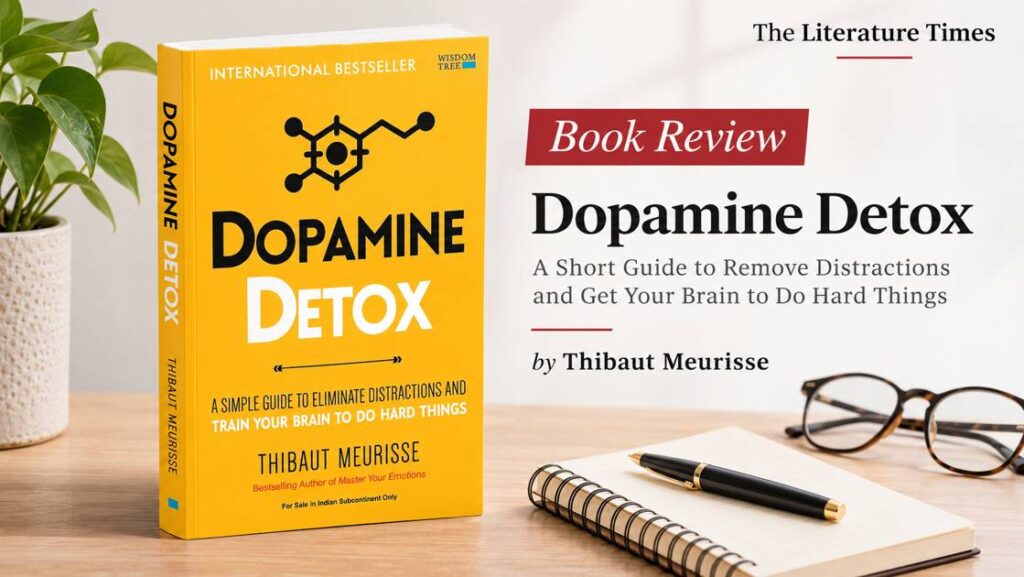
Have you ever opened your phone to check one message, looked up twenty minutes later and realised you have forgotten why you picked it up? That familiar cycle of notifications, scrolling and unfinished work is the starting point for Dopamine Detox: A Short Guide to Remove Distractions and Get Your Brain to Do Hard Things by Thibaut Meurisse. The short book suggests that constant access to quick stimulation can crowd out the sustained attention needed for difficult but meaningful work. This detailed Dopamine Detox book review examines its advice, practical strengths and scientific limitations.
Interested in Dopamine Detox by Thibaut Meurisse?
Affiliate link: we may earn a commission on qualifying purchases at no extra cost to you.
Dopamine Detox: About the Book
| Title | Dopamine Detox: A Short Guide to Remove Distractions and Get Your Brain to Do Hard Things |
|---|---|
| Author | Thibaut Meurisse |
| Category | Self-help, productivity, focus and habits |
| Original publication | 2021 |
| Main theme | Reducing digital distraction and building capacity for sustained effort |
The book’s structure is straightforward. It starts by describing dopamine and attention, introduces a problem of overstimulation, then moves into the possible benefits of a short break from distracting activities. A three-step approach leads into chapters about actually doing difficult work and avoiding a return to old habits. Its brevity is an advantage for readers who struggle to finish long productivity books, although it necessarily leaves some complexities unexplored.
What Does the Book Mean by a Dopamine Detox?
Meurisse uses the term to describe temporarily cutting back on activities that constantly pull at our attention: social media, entertainment feeds, habitual browsing and other easy distractions. Rather than repeatedly depending on motivation, the book encourages readers to change the environment that makes distraction effortless.
It is important to distinguish the metaphor from neuroscience. You cannot literally detox from dopamine. Dopamine is a normal and essential neurotransmitter; it is not a harmful substance that needs to be flushed out. Avoiding social media for a weekend does not scientifically prove that a person has “reset” their brain chemistry. The useful part of the proposal is behavioural: interrupting automatic habits, creating boundaries and giving focused work a better chance. For medical context, see Cleveland Clinic’s explanation of dopamine fasting.
Lesson One: Recognise Your Own Distraction Triggers
A valuable first step is simply noticing what interrupts you most often. Some people check group chats as soon as a difficult assignment begins. Others click on one recommended video and continue watching without choosing to. The book encourages the reader to identify those patterns rather than treating every loss of focus as a personal failure.
For example, a student may notice that every time a textbook becomes challenging, a hand reaches for the phone. A writer might discover that editing a single paragraph somehow turns into half an hour of browsing. Both can benefit from observing the trigger and placing a barrier between themselves and the reflex.
Lesson Two: Take a Realistic Break From Overstimulation
The central exercise is to take a deliberate break from some high-frequency distractions. It need not mean abandoning all technology. For many readers, a defined period without recreational feeds or nonessential notifications is more realistic than an extreme digital fast. Important work, emergency calls, accessibility tools and family communication should remain available.
The strength of this idea is its specificity. “Spend less time online” is vague. “Keep social apps closed during the first thirty minutes of study” can actually be tested. A reduction in automatic switching may also make it easier to notice when a genuinely useful break is needed.
Lesson Three: Learn to Sit With Boredom
One of the book’s more relatable observations is that the initial discomfort of hard work often pushes us toward entertainment. A quiet room and a demanding document can feel less attractive than a rapidly changing social feed. Meurisse’s remedy is to allow some unoccupied time instead of immediately reaching for stimulation.
That should not be interpreted as saying enjoyment is bad. Leisure, connection, laughter and rest are important parts of a healthy life. The useful distinction is between chosen entertainment and an automatic escape that repeatedly prevents us from doing what we care about.
Lesson Four: Doing the Hard Thing Matters More Than Avoiding the Easy Thing
Deleting a distracting application does not, on its own, finish a project or teach a difficult subject. The book eventually turns toward replacing distractions with deliberate work. A practical approach is to identify one meaningful task before a focus session starts, prepare the necessary materials, set a manageable period and begin without waiting for the perfect mood.
This is where the advice becomes more than a temporary digital-cleanup exercise. It asks: once your attention is available, what will you use it for? That question matters to students preparing for examinations, professionals trying to complete demanding assignments and readers attempting to establish a consistent reading habit.
How to Prevent a Return to Old Patterns
Many attempts at digital restriction fail when old triggers return unchanged. The book highlights the value of keeping practical safeguards in place after a short break. Disabling nonessential alerts, moving entertainment apps off the home screen and choosing specific times for messages may be more sustainable than relying on an occasional burst of discipline.
Another important consideration is self-compassion without self-deception. One unplanned hour of scrolling does not invalidate the entire effort. A more useful response is to identify what triggered it and make the next focused session easier to start.
Strengths of Dopamine Detox
- Short and accessible: it offers a manageable introduction to distraction and attention management.
- Action-oriented: readers can try changes such as notification limits without expensive tools.
- Relatable situations: it addresses procrastination, habitual scrolling and the difficulty of starting demanding work.
- Clear environmental focus: reducing temptation can be more effective than repeatedly demanding greater willpower from yourself.
- Useful entry point: it encourages readers to think deliberately about where their time goes.
Weaknesses and Criticisms
The largest concern is the title itself. “Dopamine detox” sounds like a medical reset, but the scientific reality is much more complicated. The book’s advice is most credible when understood as a way to adjust behaviour, not a method for lowering or cleansing dopamine. Some readers may also find the guidance familiar if they have already read widely about digital minimalism, time-blocking or habit formation.
Its methods are not a treatment for ADHD, depression, compulsive behaviours or other health conditions. Persistent attention difficulties may have causes that require professional support. People with demanding jobs, caring responsibilities or limited control over their schedules may need more flexible boundaries than the book’s simplest examples imply.
A Practical Two-Day Experiment Inspired by the Book
- Identify one nonessential distraction that repeatedly interrupts important work.
- Choose two short daily blocks for focused effort and silence unrelated notifications during those blocks.
- Write down the task to be completed before each session.
- Keep essential communication channels available for safety and responsibility.
- When the urge to scroll arises, notice it and return to the task without treating the moment as a moral test.
- At the end, note which changes helped and which rules were unrealistic.
This is an editorial application of the book’s themes, not a clinical protocol or a guarantee of measurable changes in dopamine.
Dopamine Detox vs Atomic Habits
Dopamine Detox primarily concerns attention and reducing immediately rewarding distractions. Atomic Habits by James Clear offers a broader system for building desirable habits and breaking unwanted ones. Readers looking for a short starting point on phone distraction may find Meurisse approachable; those interested in a comprehensive toolkit for everyday behaviour change may prefer Clear.
Frequently Asked Questions
Does dopamine detox actually remove dopamine from the brain?
No. Dopamine is essential to normal functioning. The term is best treated as shorthand for deliberately reducing distracting activities.
Is Dopamine Detox good for beginners?
The book’s concise style and practical focus make it approachable, provided readers understand its scientific limitations.
Can Dopamine Detox cure procrastination?
No guaranteed cure exists. The book may offer useful behaviour-management ideas, but procrastination has many causes.
Should students read Dopamine Detox?
Students who frequently interrupt their studies with social feeds or notifications may benefit from the practical suggestions, adapted to their needs.
Final Verdict: Is Dopamine Detox Worth Reading?
Dopamine Detox is most useful as a compact reminder to regain control over the environment in which we work. Its straightforward advice on reducing interruptions can be put into practice quickly, but the title should not be taken as a literal neuroscience claim. Read it for a behavioural experiment rather than a miracle reset: keep what improves your attention, leave what is too rigid, and remember that productivity should serve a meaningful life rather than consume it.
Source for the book’s structure: Open Library bibliographic record and table of contents.
Editorial note: This review is based on the book’s documented ideas and public sources, not on a claim of clinical testing or guaranteed outcomes.
Interested in Dopamine Detox by Thibaut Meurisse?
Affiliate link: we may earn a commission on qualifying purchases at no extra cost to you.





Your perspective matters
Share your thoughts respectfully. Comments are moderated.